
Charles Sumner: his complete works, volume 20 (of 20)
Charles Sumner
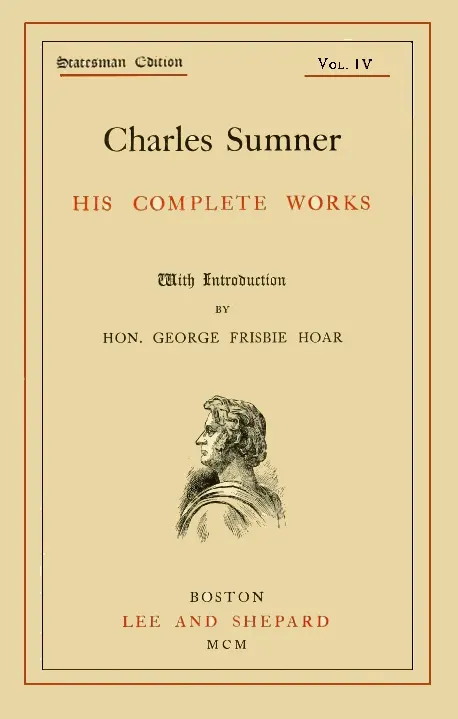
THE CLASSIC COLLECTION · 1900
"Charles Sumner: his complete works, Volume 04 (of 20)" by Charles Sumner is a historical collection written in the late 19th century. This volume encompasses speeches and writings of Charles Sumner, a prominent abolitionist and senator, focusing on his views and advocacy regarding key political issues of his time, notably slavery and civil rights. At the start of this volume, the contents are outlined, revealing a series of speeches delivered by Sumner on various topics such as the legacy of Andrew J. Downing, the necessity of freedom, and the political landscape surrounding the issue of slavery. The opening portion includes a speech where Sumner argues for compensation to Downing's widow, establishing a precedent for valuing contributions of individuals to society. It also teases a later speech made at a Free-Soil Party convention, highlighting Sumner's commitment to freedom and his criticism of existing political parties that supported slavery, setting a tone of moral urgency and political activism that characterizes his work throughout this collection.
Introduction adapted from the source catalogue; source summaries may be automatically generated.
Free to read · English · 101,030 words · No account needed
MAKE TIME FOR A GOOD BOOK
On by default. Untick to stop anonymous reading totals. Each page counts after 10 seconds in view. How this works.
Anonymous counting is on unless you have switched it off.
[40] This masque, entitled Coelum Britannicum, was performed at Whitehall, February 18, 1633.
Such, Sir, is the voice from Plymouth Rock, as it salutes my ears. Others may not hear it; but to me it comes in tones which I cannot mistake. I catch its words of noble cheer:--
"New occasions teach new duties; Time makes ancient good uncouth; They must upward still and onward who would keep abreast of Truth: Lo, before us gleam her camp-fires! we ourselves must Pilgrims be, Launch our Mayflower, and steer boldly through the desperate winter sea."
BOSTON, August 2, 1853.
Gentlemen,--It is not in my power to be with you on the evening of the celebration at Faneuil Hall, but, I pray you, do not consider me insensible to the honor of your invitation.
Permit me to say that no country excites a generous sympathy more than Ireland; nor is any society more genial and winning than that of Irishmen.
Believe me, Gentlemen, faithfully yours,
SPEECH IN THE SENATE, AGAINST THE REPEAL OF THE MISSOURI PROHIBITION OF SLAVERY NORTH OF 36° 30´ IN THE NEBRASKA AND KANSAS BILL, FEBRUARY 21, 1854.
Cursed be he that removeth his neighbor's landmark. And all the people shall say, Amen.--DEUTERONOMY, xxvii. 17.
"The Nebraska Debate," as it was called at the time, was one of the most remarkable in our history. It grew out of the proposition to overturn the famous Missouri Compromise, so as to admit Slavery into the vast territory west of the Mississippi, where it had been prohibited by that Compromise. The country was startled by the outrage. Many who had tried to reconcile themselves to the Fugitive Slave Bill, as required by the Constitution, were maddened by this most audacious attempt. Even assuming that the Fugitive Slave Bill was in any sense justifiable, there was nothing to justify this flagrant violation of plighted faith, where Slavery was the inexorable robber. Here began those heats which afterwards showed themselves in blood. Never was the action of Congress watched with more anxiety. Speeches were read as never before, especially those opposed to this new aggression. That of Mr. Sumner was extensively circulated in various editions, and he received numerous letters expressing sympathy and gratitude. The tone of these illustrates the reception of the speech. The late Rufus W. Griswold, so well known in contemporary literature, wrote from New York on the day after its delivery: "The admirable speech which you delivered in the Senate yesterday will bring you a wearying quantity of approving letters; but, though aware of this, I cannot refrain from assuring you of my own admiration of it and gratitude for it, nor from telling you that all through the city it appears to be the subject of applauding conversation.... I congratulate you on having made a speech so worthy of an American Senator, and calculated to be so serviceable to the cause of Liberty." Frederick Douglass, who watched the contest from a distance with the interest of a former slave, wrote: "All the friends of Freedom in every State and of every color may claim you just now as their representative. As one of your sable constituents, I desire to thank you for your noble speech for Freedom and for your country, which I have now read twice over." An original Abolitionist wrote: "Let me thank you from my heart of hearts for your noble speech. It is everything that we could wish,--bold, free, and true. God will surely bless you!" The feeling of the hour appeared also in the following from John G. Whittier: "I am unused to flatter any one, least of all one whom I love and honor; but I must say, in all sincerity, that there is no orator or statesman living in this country or in Europe whose fame is so great as not to derive additional lustre from such a speech. It will live the full life of American history." Professor C. S. Henry, of the New York University, wrote: "I thank you for your noble speech on the Nebraska Bill. In every quality of nobleness transcendently noble. Unsurpassed in tone and temper,--unrivalled in impregnable soundness and judicious statement of positions, in clearness and logical force of historical recital, in conclusiveness of reasoning, in beautiful fitness of style, and in the true eloquence of a justice-loving soul." Among the curiosities of praise, considering the political position of the writer, was a letter from Pierre Soulé, our minister at Madrid, and formerly Senator from Louisiana, containing the following passage: "Que je profite de cette occasion pour vous dire combien j'ai été heureux du succès, et pour mieux dire, du triomphe éclatant que vous avez obtenu à l'occasion de votre discours sur le Nebraska Bill. Courage! Sic itur ad astra. Mais que dis-je? Vous y êtes déjà, et habile qui réussirait vous en déloger." These are examples only; but they help to exhibit the condition of the public mind. The North was aroused, and felt as never before towards those who spoke in its behalf.
Your reading position is saved on this browser. Take it to another device with a library code. Reading pages adapt to text, rather than matching a printed edition.
Charles Sumner

Charles Sumner

Charles Sumner

Charles Sumner
BEHIND THE BOOK
This eBook is for the use of anyone anywhere in the United States and most other parts of the world at no cost and with almost no restrictions whatsoever. You may copy it, give it away or re-use it under the terms of the Project Gutenberg License included with this eBook or online at www.gutenberg.org. If you are not located in the United States, you will have to check the laws of the country where you are located before using this eBook. Read the source licence.
The original source file, including credits and licence, is retained by this library. Request an original-format copy at no charge. Please include the book title and Project Gutenberg identifier #45954.
KEEP YOUR CURIOSITY GOING

David Patterson (Spirit) Hatch

David Patterson (Spirit) Hatch

David Patterson (Spirit) Hatch
Cécile Tormay

Moritz Busch
John L. Ransom