
Charles Sumner: his complete works, volume 20 (of 20)
Charles Sumner
THE CLASSIC COLLECTION · 1900
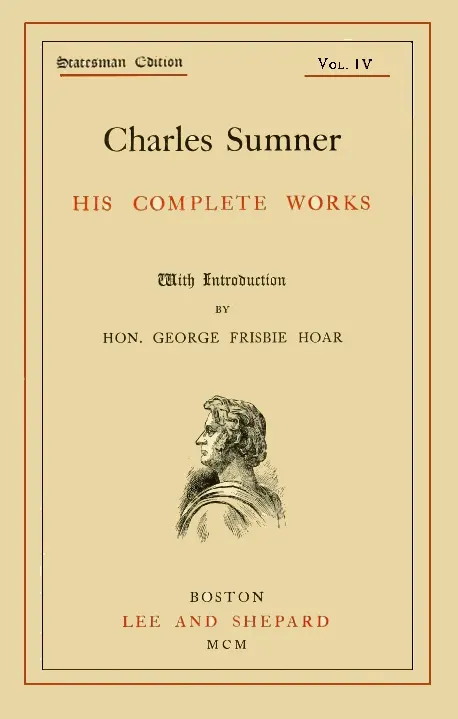
"Charles Sumner: his complete works, Volume 04 (of 20)" by Charles Sumner is a historical collection written in the late 19th century. This volume encompasses speeches and writings of Charles Sumner, a prominent abolitionist and senator, focusing on his views and advocacy regarding key political issues of his time, notably slavery and civil rights. At the start of this volume, the contents are outlined, revealing a series of speeches delivered by Sumner on various topics such as the legacy of Andrew J. Downing, the necessity of freedom, and the political landscape surrounding the issue of slavery. The opening portion includes a speech where Sumner argues for compensation to Downing's widow, establishing a precedent for valuing contributions of individuals to society. It also teases a later speech made at a Free-Soil Party convention, highlighting Sumner's commitment to freedom and his criticism of existing political parties that supported slavery, setting a tone of moral urgency and political activism that characterizes his work throughout this collection.
Introduction adapted from the source catalogue; source summaries may be automatically generated.
Free to read · English · 101,030 words · No account needed
MAKE TIME FOR A GOOD BOOK
On by default. Untick to stop anonymous reading totals. Each page counts after 10 seconds in view. How this works.
Anonymous counting is on unless you have switched it off.
Mr. President, since things are so, it were well to remove this Act from our statute-book, that it may no longer exist as an occasion of ill-will and a point of conflict. Let the North be relieved from this usurpation, and the first step will be taken towards permanent harmony. The Senator from Louisiana [Mr. BENJAMIN] has proclaimed anew to-night, what he has before declared on this floor, "that Slavery is a subject with which the Federal Government has nothing to do." I thank him for teaching the Senate that word. True, most true, Sir, ours is a Government of Freedom, having nothing to do with Slavery. This is the doctrine which I have ever maintained, and am happy to find recognized in form, if not in reality, by the Senator from Louisiana. The Senator then proceeded to declare that "all that the South asks is to be let alone." This request is moderate. And I say, for the North, that all we ask is to be let alone. Yes, Sir, let us alone. Do not involve us in the support of Slavery. Hug the viper to your bosoms, if you perversely will, within your own States, until it stings you to a generous remorse, but do not compel us to hug it too; for this, I assure you, we can never do.
The Senator from Louisiana, with these professions on his lips, proceeds to ask, doubtless with complete sincerity, but in strange forgetfulness of our country's history: "Did we ever bring this subject into Congress?" Yes, Sir, that was his inquiry,--as if there was any moment, from the earliest days of the Republic, when the supporters of Slavery ceased to bring this subject into Congress. Almost from the beginning it has been here, through the exercise of usurped power, nowhere given under the Constitution: for I am glad to believe that the Constitution of my country contains no words out of which Slavery, or the power to support Slavery, can be derived; and this conclusion, I doubt not, will yet be affirmed by the courts. And yet the honorable Senator asks, "Did we ever bring this subject into Congress?" The answer shall be plain and explicit. Sir, you brought Slavery into Congress, when, shortly after the adoption of the Constitution, you sanctioned it in the District of Columbia, within the national jurisdiction, and adopted that barbarous slave code, still extant on your statute-book, which the Senator from Connecticut [Mr. GILLETTE] so eloquently exposed to-night. You brought Slavery into Congress, when, at the same period, you accepted the cession of territories from North Carolina and Georgia, now constituting States of the Union, with conditions in favor of Slavery, and thus began to sanction Slavery in territories within the exclusive jurisdiction of Congress. You brought Slavery into Congress, when, at different times, you usurped a power, not given by the Constitution, over fugitive slaves, and by most offensive legislation thrust your arms into distant Northern homes. You brought Slavery into Congress, when, by express legislation, you regulated the coastwise slave-trade, and thus threw the national shield over a traffic on the coast of the United States which on the coast of Congo you justly brand as "piracy." You brought Slavery into Congress, when, from time to time, you sought to introduce new States with slaveholding Constitutions into the National Union. And, permit me to say, Sir, you brought Slavery into Congress, when you called upon us, as you have done even at this very session, to pay for slaves, and thus, in defiance of a cardinal principle of the Constitution, pressed the National Government to recognize property in man. And yet the Senator from Louisiana, with strange simplicity, says that the South only asks to be let alone. Sir, the honorable Senator borrows the language of the North, which, at each of these usurpations, exclaims, "Let us alone!" And let me say, frankly, that peace can never prevail until you do let us alone,--until this subject of Slavery is banished from Congress by the triumph of Freedom,--until Slavery is driven from its usurped foothold, and Freedom is made national instead of sectional,--and until the National Government is brought back to the precise position it occupied on the day that Washington took his first oath as President of the United States, when there was no Fugitive Act, and the national flag, as it floated over the national territory within the jurisdiction of Congress, nowhere covered a single slave.
Your reading position is saved on this browser. Take it to another device with a library code. Reading pages adapt to text, rather than matching a printed edition.
Charles Sumner

Charles Sumner

Charles Sumner

Charles Sumner
BEHIND THE BOOK
This eBook is for the use of anyone anywhere in the United States and most other parts of the world at no cost and with almost no restrictions whatsoever. You may copy it, give it away or re-use it under the terms of the Project Gutenberg License included with this eBook or online at www.gutenberg.org. If you are not located in the United States, you will have to check the laws of the country where you are located before using this eBook. Read the source licence.
The original source file, including credits and licence, is retained by this library. Request an original-format copy at no charge. Please include the book title and Project Gutenberg identifier #45954.
KEEP YOUR CURIOSITY GOING

David Patterson (Spirit) Hatch

David Patterson (Spirit) Hatch

David Patterson (Spirit) Hatch
Cécile Tormay

Moritz Busch
John L. Ransom