
Charles Sumner: his complete works, volume 20 (of 20)
Charles Sumner
THE CLASSIC COLLECTION · 1900
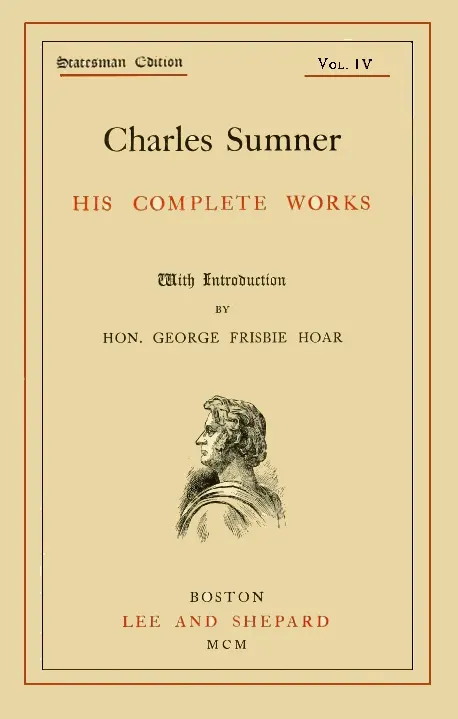
"Charles Sumner: his complete works, Volume 04 (of 20)" by Charles Sumner is a historical collection written in the late 19th century. This volume encompasses speeches and writings of Charles Sumner, a prominent abolitionist and senator, focusing on his views and advocacy regarding key political issues of his time, notably slavery and civil rights. At the start of this volume, the contents are outlined, revealing a series of speeches delivered by Sumner on various topics such as the legacy of Andrew J. Downing, the necessity of freedom, and the political landscape surrounding the issue of slavery. The opening portion includes a speech where Sumner argues for compensation to Downing's widow, establishing a precedent for valuing contributions of individuals to society. It also teases a later speech made at a Free-Soil Party convention, highlighting Sumner's commitment to freedom and his criticism of existing political parties that supported slavery, setting a tone of moral urgency and political activism that characterizes his work throughout this collection.
Introduction adapted from the source catalogue; source summaries may be automatically generated.
Free to read · English · 101,030 words · No account needed
MAKE TIME FOR A GOOD BOOK
On by default. Untick to stop anonymous reading totals. Each page counts after 10 seconds in view. How this works.
Anonymous counting is on unless you have switched it off.
[159] A British writer, giving an account of the Somerset case, says of this maxim, that "it has found its way into use as a classical expression, and, as no one has been able to find it in any Latin author, it is supposed to have been of Lord Mansfield's own coining." (Chambers's Edinburgh Journal, July 31, 1852, N. S. Vol. XVIII. p. 71: Slaves in Britain.) This is a mistake. The precise phrase will be found in Ward's "Simple Cobler of Aggawamm in America," written in 1615, and first printed in 1647,--"It is lesse to say, Statuatur veritas, ruat Regnum, than Fiat justitia, ruat Coelum" (p. 14); but its origin, in substance, if not in form, is earlier. There is little doubt that it does not occur in any Latin author. Its Latinity is good, and might belong to the classical period. The latter clause, ruat coelum, has classical authority, as in the passage of Terence, showing that it was a common saying in his time, "Quid si redeo ad illos qui aiunt, Quid si nunc coelum ruat?" (Heauton., Act. IV. sc. 3.) The idea is also Roman. On the European continent, and especially in Germany, the maxim has another form, which is common,--Fiat justitia, pereat mundus. Binder, in his Novus Thesaurus Adagiorum Latinorum, (Stuttgart, 1861,) cites it in this form as Regula Juris, explained as "a designation for the maxims, taken from the Corpus Juris and the works of the different ancient civilians, which have become proverbial." In the same authority is the hexameter verse, Fiat justitia, pereat licet integer orbis, from Johannis Leibi Studentica (Coburg, 1627). In England the maxim was current in other forms. As early as February 26, 1624-5, in a letter to the English ambassador at Holland, alluding to "the business of Amboyne," we meet Fiat justitia et ruat mundus. (Birch's Court and Times of James I., Vol. II. p. 500.) In a speech in the House of Commons, December 22, 1640, against the judges who pronounced in favor of ship-money, an orator says: "If ever any nation might justifiably, we certainly may now, now most properly, most seasonably, cry out, and cry aloud, Vel sacra regnet justitia vel ruat coelum." And he concludes with a motion, "That a special committee may be appointed to examine the whole carriage of that extrajudicial judgment, ... and, upon report thereof, to draw up a charge against the guilty; and then Lex currat, fiat justitia. (Parl. Hist., 2d ed., London, 1763, Vol. IX. p. 192.) In the answer of the Duke of Richmond (January 31, 1641-2) to the charge of the Commons, it is said: "Magna est veritas et prevalebit. I wish it may do so in what concerns me. Regnet justitia et ruat coelum." (Parl. Hist., Vol. X. p. 254. Also, Howell's State Trials, Vol. IV. col. 116.) The first clause of the maxim is an old law phrase, found in Law Dictionaries, and often repeated. A letter, dated London, May 4, 1621, relating the fine and degradation of Lord Bacon, concludes, Fiat justitia. (Birch's James I., Vol. II. p. 252.) Charles I., in a letter to the Lords, dated May 11, 1641, interceding for Strafford, said: "But if no less than his life can satisfy my people, I must say, Fiat justitia." (Parl. Hist. Vol. IX. p. 316. Howell's State Trials, Vol. III. col. 1520.) If not classical in authority, the maxim is not without interest from association with great events of English history, while it is a perpetual injunction to justice. Shakespeare gives expression to similar truth, when he says, "Be just and fear not."
Your reading position is saved on this browser. Take it to another device with a library code. Reading pages adapt to text, rather than matching a printed edition.
Charles Sumner

Charles Sumner

Charles Sumner

Charles Sumner
BEHIND THE BOOK
This eBook is for the use of anyone anywhere in the United States and most other parts of the world at no cost and with almost no restrictions whatsoever. You may copy it, give it away or re-use it under the terms of the Project Gutenberg License included with this eBook or online at www.gutenberg.org. If you are not located in the United States, you will have to check the laws of the country where you are located before using this eBook. Read the source licence.
The original source file, including credits and licence, is retained by this library. Request an original-format copy at no charge. Please include the book title and Project Gutenberg identifier #45954.
KEEP YOUR CURIOSITY GOING

David Patterson (Spirit) Hatch

David Patterson (Spirit) Hatch

David Patterson (Spirit) Hatch
Cécile Tormay

Moritz Busch
John L. Ransom