
Charles Sumner: his complete works, volume 20 (of 20)
Charles Sumner
THE CLASSIC COLLECTION · 1900
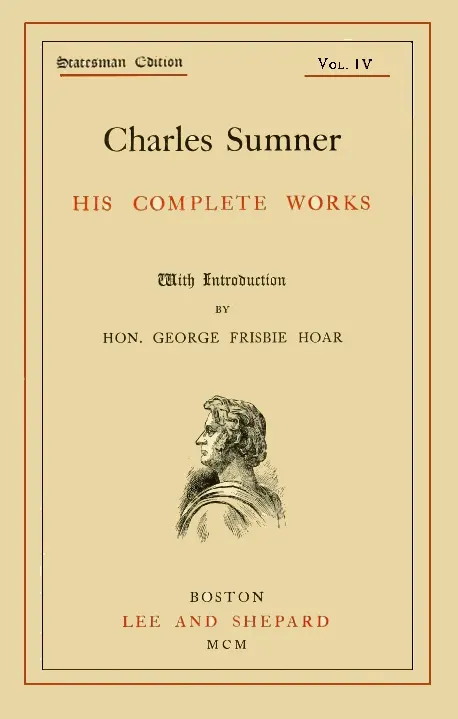
"Charles Sumner: his complete works, Volume 04 (of 20)" by Charles Sumner is a historical collection written in the late 19th century. This volume encompasses speeches and writings of Charles Sumner, a prominent abolitionist and senator, focusing on his views and advocacy regarding key political issues of his time, notably slavery and civil rights. At the start of this volume, the contents are outlined, revealing a series of speeches delivered by Sumner on various topics such as the legacy of Andrew J. Downing, the necessity of freedom, and the political landscape surrounding the issue of slavery. The opening portion includes a speech where Sumner argues for compensation to Downing's widow, establishing a precedent for valuing contributions of individuals to society. It also teases a later speech made at a Free-Soil Party convention, highlighting Sumner's commitment to freedom and his criticism of existing political parties that supported slavery, setting a tone of moral urgency and political activism that characterizes his work throughout this collection.
Introduction adapted from the source catalogue; source summaries may be automatically generated.
Free to read · English · 101,030 words · No account needed
MAKE TIME FOR A GOOD BOOK
On by default. Untick to stop anonymous reading totals. Each page counts after 10 seconds in view. How this works.
Anonymous counting is on unless you have switched it off.
[141] King's Life of Locke, Vol. I. p. 104.
[142] Boswell's Life of Johnson, ed. Croker, (London, 1835,) Vol. II. p. 294, note, anno 1765.
[143] Boswell's Johnson, Vol. V. pp. 63, 64, Oct. 18, 1773.
In America feudalism never prevailed, and our Revolution severed the only cord by which we were connected with this ancient system. It was fit that the Congress which performed this memorable act should have for its President a merchant. It was fit, that, in promulgating the Declaration of Independence, by which, in the face of kings, princes, and nobles, the New Era was inaugurated, the education of the counting-house should flaunt conspicuously in the broad and clerkly signature of JOHN HANCOCK. Our fathers "builded better than they knew"; and these things are typical of the social change then taking place. By yet another act, fresh in your recollection, and of peculiar interest to this assembly, has our country borne the same testimony. A distinguished merchant of Boston, who has ascended through all the gradations of trade, honored always for private virtues as well as public abilities,--need I mention the name of ABBOTT LAWRENCE?--has been sent to the Court of St. James as ambassador of our Republic, and with that proud commission, higher than any patent of nobility, taken precedence of nobles in that ancient realm. Here I see the triumph of personal merit, but still more the consummation of a new epoch.
Yes, Sir! say what you will, this is the day of the merchant. As in the early ages war was the great concern of society, and the very pivot of power, so is trade now; and as feudal chiefs were the "notables," placed at the very top of their time, so are merchants now. All things attest the change. War, which was once the universal business, is now confined to a few; once a daily terror, it is now the accident of an age. Not for adventures of the sword, but for trade, do men descend upon the sea in ships, and traverse broad continents on iron pathways. Not for protection against violence, but for trade, do men come together in cities, and rear the marvellous superstructure of social order. If they go abroad, or if they stay at home, it is trade that controls them, without distinction of persons. In our country every man is trader: the physician trades his benevolent care; the lawyer trades his ingenious tongue; the clergyman trades his prayers. And trade summons from the quarry choicest marble and granite to build its capacious homes, and now, in our own city, displays warehouses which outdo the baronial castle, and sales-rooms which outdo the ducal palace. With these magnificent appliances, the relations of dependence and protection, marking the early feudalism, are reproduced in the more comprehensive feudalism of trade. There are European bankers who vie in power with the dukes and princes of other days, and there are traffickers everywhere whose title comes from the ledger and not the sword, fit successors to counts, barons, and knights. As the feudal chief allocated to himself and his followers that soil which was the prize of his strong arm, so now the merchant, with grasp more subtle and reaching, allocates to himself and his followers, ranging through multitudinous degrees of dependence, all the spoils of every land, triumphantly won by trade. I would not press this parallel too far; but at this moment, especially in our country, the merchant, more than any other character, stands in the very boots of the feudal chief. Of all pursuits or relations, his is now the most extensive and formidable, making all others its tributaries, and bending at times even the lawyer and the clergyman to be its dependent stipendiaries.
Your reading position is saved on this browser. Take it to another device with a library code. Reading pages adapt to text, rather than matching a printed edition.
Charles Sumner

Charles Sumner

Charles Sumner

Charles Sumner
BEHIND THE BOOK
This eBook is for the use of anyone anywhere in the United States and most other parts of the world at no cost and with almost no restrictions whatsoever. You may copy it, give it away or re-use it under the terms of the Project Gutenberg License included with this eBook or online at www.gutenberg.org. If you are not located in the United States, you will have to check the laws of the country where you are located before using this eBook. Read the source licence.
The original source file, including credits and licence, is retained by this library. Request an original-format copy at no charge. Please include the book title and Project Gutenberg identifier #45954.
KEEP YOUR CURIOSITY GOING

David Patterson (Spirit) Hatch

David Patterson (Spirit) Hatch

David Patterson (Spirit) Hatch
Cécile Tormay

Moritz Busch
John L. Ransom