
Charles Sumner: his complete works, volume 20 (of 20)
Charles Sumner
THE CLASSIC COLLECTION · 1900
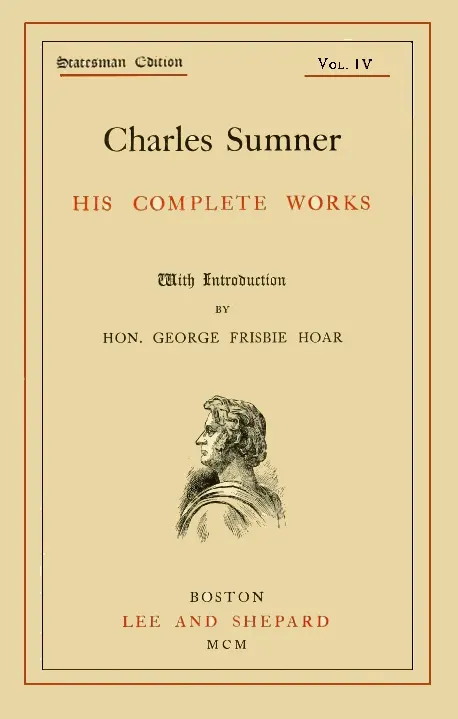
"Charles Sumner: his complete works, Volume 04 (of 20)" by Charles Sumner is a historical collection written in the late 19th century. This volume encompasses speeches and writings of Charles Sumner, a prominent abolitionist and senator, focusing on his views and advocacy regarding key political issues of his time, notably slavery and civil rights. At the start of this volume, the contents are outlined, revealing a series of speeches delivered by Sumner on various topics such as the legacy of Andrew J. Downing, the necessity of freedom, and the political landscape surrounding the issue of slavery. The opening portion includes a speech where Sumner argues for compensation to Downing's widow, establishing a precedent for valuing contributions of individuals to society. It also teases a later speech made at a Free-Soil Party convention, highlighting Sumner's commitment to freedom and his criticism of existing political parties that supported slavery, setting a tone of moral urgency and political activism that characterizes his work throughout this collection.
Introduction adapted from the source catalogue; source summaries may be automatically generated.
Free to read · English · 101,030 words · No account needed
MAKE TIME FOR A GOOD BOOK
On by default. Untick to stop anonymous reading totals. Each page counts after 10 seconds in view. How this works.
Anonymous counting is on unless you have switched it off.
The power of our Supreme Court is great, and its sphere is vast; but there are limits to its power and its sphere. According to the Constitution, "the judicial power shall extend to all cases in law and equity, arising under the Constitution, the laws of the United States, and treaties"; but it by no means follows that the interpretation of the Constitution, incident to the trial of these "cases," is final. Of course, the judgment in the "case" actually pending is final, as the settlement of a controversy, for weal or woe, to the litigating parties; but as a precedent it is not final even on the Supreme Court itself. When cited afterwards, it will be regarded with respect as an interpretation of the Constitution, and, if nothing appears against it, of controlling authority; but, at any day, in any litigation, at the trial of any "case," it will be within the unquestionable competency of the Court to review its own decision, so far as it establishes any interpretation of the Constitution. If the Court itself be not constrained by its own precedents, how can coördinate branches, under oath to support the Constitution, and, like the Court itself, called incidentally to interpret the Constitution, be constrained by them? In both instances, the power to interpret is simply incident to other principal duties, as the trial of "cases," the making of laws, or the administration of government; and it seems as plainly incident to a "case" of legislation or of administration as to a "case" of litigation. And on this view I shall act with entire confidence, under the oath I have taken.
For myself, let me say, that I hold judges, and especially the Supreme Court, in much respect; but I am too familiar with the history of judicial proceedings to regard them with any superstitious reverence. [Sensation.] Judges are but men, and in all ages have shown a full share of human frailty. Alas! alas! the worst crimes of history have been perpetrated under their sanction. The blood of martyrs and of patriots, crying from the ground, summons them to judgment. It was a judicial tribunal which condemned Socrates to drink the fatal hemlock, and which pushed the Saviour barefoot over the pavements of Jerusalem, bending beneath his cross. It was a judicial tribunal which, against the testimony and entreaties of her father, surrendered the fair Virginia as a slave,--which arrested the teachings of the great Apostle to the Gentiles, and sent him in bonds from Judæa to Rome,--which, in the name of the Old Religion, persecuted the saints and fathers of the Christian Church, and adjudged them to a martyr's death, in all its most dreadful forms,--and afterwards, in the name of the New Religion, enforced the tortures of the Inquisition, amidst the shrieks and agonies of its victims, while it compelled Galileo to declare, in solemn denial of the great truth he had disclosed, that the earth did not move round the sun. It was a judicial tribunal which, in France, during the long reign of her monarchs, lent itself to be the instrument of every tyranny, as during the brief Reign of Terror it did not hesitate to stand forth the unpitying accessary of the unpitying guillotine. Ay, Sir, it was a judicial tribunal in England, surrounded by all forms of law, which sanctioned every despotic caprice of Henry the Eighth, from the unjust divorce of his queen to the beheading of Sir Thomas More,--which lighted the fires of persecution that glowed at Oxford and Smithfield, over the cinders of Latimer, Ridley, and John Rogers,--which, after elaborate argument, upheld the fatal tyranny of ship money against the patriot resistance of Hampden,--which, in defiance of justice and humanity, sent Sidney and Russell to the block,--which persistently enforced the laws of Conformity that our Puritan fathers persistently refused to obey, and afterwards, with Jeffreys on the bench, crimsoned the pages of English history with massacre and murder, even with the blood of innocent women. Ay, Sir, it was a judicial tribunal in our own country, surrounded by all forms of law, which hung witches at Salem,--which affirmed the constitutionality of the Stamp Act, while it admonished "jurors and people" to obey,--and which now, in our day, lends its sanction to the unutterable atrocity of the Fugitive Slave Act. [Long continued applause, and three cheers for Sumner.]
Your reading position is saved on this browser. Take it to another device with a library code. Reading pages adapt to text, rather than matching a printed edition.
Charles Sumner

Charles Sumner

Charles Sumner

Charles Sumner
BEHIND THE BOOK
This eBook is for the use of anyone anywhere in the United States and most other parts of the world at no cost and with almost no restrictions whatsoever. You may copy it, give it away or re-use it under the terms of the Project Gutenberg License included with this eBook or online at www.gutenberg.org. If you are not located in the United States, you will have to check the laws of the country where you are located before using this eBook. Read the source licence.
The original source file, including credits and licence, is retained by this library. Request an original-format copy at no charge. Please include the book title and Project Gutenberg identifier #45954.
KEEP YOUR CURIOSITY GOING

David Patterson (Spirit) Hatch

David Patterson (Spirit) Hatch

David Patterson (Spirit) Hatch
Cécile Tormay

Moritz Busch
John L. Ransom