
Charles Sumner: his complete works, volume 20 (of 20)
Charles Sumner
THE CLASSIC COLLECTION · 1900
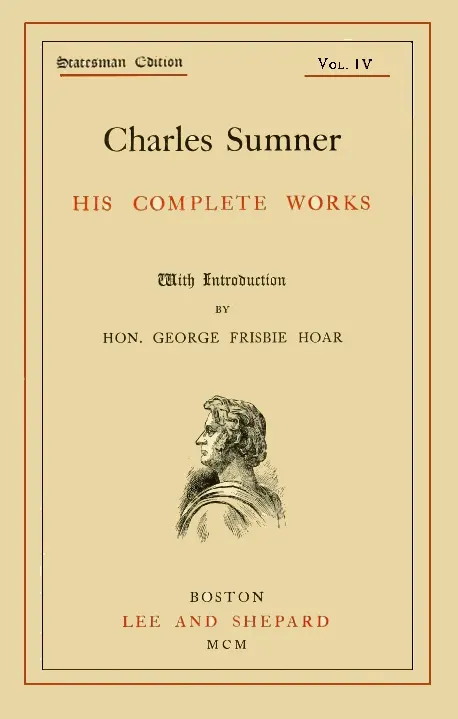
"Charles Sumner: his complete works, Volume 04 (of 20)" by Charles Sumner is a historical collection written in the late 19th century. This volume encompasses speeches and writings of Charles Sumner, a prominent abolitionist and senator, focusing on his views and advocacy regarding key political issues of his time, notably slavery and civil rights. At the start of this volume, the contents are outlined, revealing a series of speeches delivered by Sumner on various topics such as the legacy of Andrew J. Downing, the necessity of freedom, and the political landscape surrounding the issue of slavery. The opening portion includes a speech where Sumner argues for compensation to Downing's widow, establishing a precedent for valuing contributions of individuals to society. It also teases a later speech made at a Free-Soil Party convention, highlighting Sumner's commitment to freedom and his criticism of existing political parties that supported slavery, setting a tone of moral urgency and political activism that characterizes his work throughout this collection.
Introduction adapted from the source catalogue; source summaries may be automatically generated.
Free to read · English · 101,030 words · No account needed
MAKE TIME FOR A GOOD BOOK
On by default. Untick to stop anonymous reading totals. Each page counts after 10 seconds in view. How this works.
Anonymous counting is on unless you have switched it off.
"There is not a gentleman on the floor who is a stranger to the feeble situation of our State, when we entered into the war to oppose the British power. We were not only without money, without an army or military stores, but we were few in number, and likely to be entangled with our domestics, in case the enemy invaded us."[119]
[119] Annals of Congress, 1st Cong. 2d Sess., II. 1484, March 30,
1790.
Similar testimony to this weakness was borne by Mr. Madison in open
debate in Congress.
"Every addition they [Georgia and South Carolina] receive to their number of slaves tends to weaken, and render them less capable of self-defence."[120]
[120] Ibid., 1st Cong. 1st Sess., I. 340, May 13, 1789.
The historian of South Carolina, Dr. Ramsay, a contemporary observer of the very scenes which he describes, to whom I have already referred, also exposes this weakness.
"The forces under the command of General Prevost marched through the richest settlements of the State, where are the fewest white inhabitants in proportion to the number of slaves. The hapless Africans, allured with hopes of freedom, forsook their owners, and repaired in great numbers to the royal army. They endeavored to recommend themselves to their new masters by discovering where their owners had concealed their property, and were assisting in carrying it off."[121]
[121] History of South Carolina, Vol. I. pp. 312, 313.
The same candid historian, describing the invasion of the next year,
says:--
"The slaves a second time flocked to the British army."[122]
[122] Ibid., p. 334.
At a still later day, Mr. Justice Johnson, of the Supreme Court of the United States, and a citizen of South Carolina, in his elaborate Life of General Greene, speaking of negro slaves, makes the same unhappy admission. He says:--
"But the number dispersed through these [Southern] States was very great,--so great as to render it impossible for the citizens to muster freemen enough to withstand the pressure of the British arms."[123]
[123] Life of Greene, Vol. II. Appendix, p. 472.
Here is illustration from an English pamphlet entitled "Account of the Duckenfield Hall Estate Negroes, 1806, Law Case," where will be found the following incident.
"In 1779 I bought ten negroes, which, with sixty others, were taken by a privateer from a plantation in South Carolina."
Thus from every quarter are we conducted to the same conclusion.
And all this cumulative and unimpeachable testimony is reinforced by testimony of an earlier day, also from South Carolina. The Assembly of the Colony represented to the King, in 1734, that they were
"Subject to many intestine dangers from the great number of negroes that are now among us."[124]
[124] Grahame, History of the United States, Vol. III. p. 161.
Another representation shortly afterwards declared:--
Your reading position is saved on this browser. Take it to another device with a library code. Reading pages adapt to text, rather than matching a printed edition.
Charles Sumner

Charles Sumner

Charles Sumner

Charles Sumner
BEHIND THE BOOK
This eBook is for the use of anyone anywhere in the United States and most other parts of the world at no cost and with almost no restrictions whatsoever. You may copy it, give it away or re-use it under the terms of the Project Gutenberg License included with this eBook or online at www.gutenberg.org. If you are not located in the United States, you will have to check the laws of the country where you are located before using this eBook. Read the source licence.
The original source file, including credits and licence, is retained by this library. Request an original-format copy at no charge. Please include the book title and Project Gutenberg identifier #45954.
KEEP YOUR CURIOSITY GOING

David Patterson (Spirit) Hatch

David Patterson (Spirit) Hatch

David Patterson (Spirit) Hatch
Cécile Tormay

Moritz Busch
John L. Ransom