
Charles Sumner: his complete works, volume 20 (of 20)
Charles Sumner
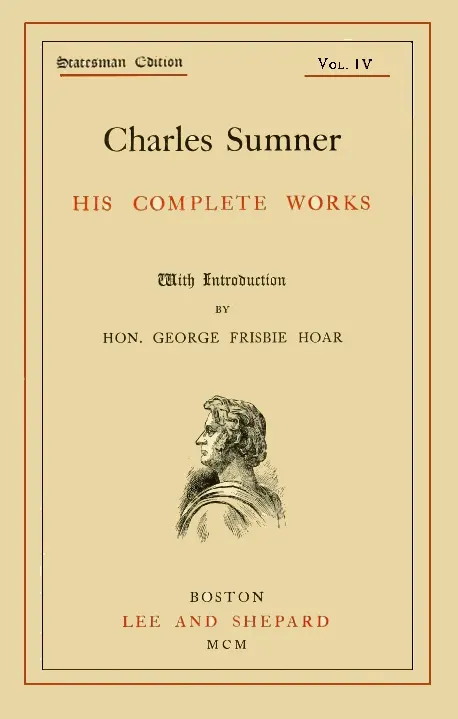
THE CLASSIC COLLECTION · 1900
"Charles Sumner: his complete works, Volume 04 (of 20)" by Charles Sumner is a historical collection written in the late 19th century. This volume encompasses speeches and writings of Charles Sumner, a prominent abolitionist and senator, focusing on his views and advocacy regarding key political issues of his time, notably slavery and civil rights. At the start of this volume, the contents are outlined, revealing a series of speeches delivered by Sumner on various topics such as the legacy of Andrew J. Downing, the necessity of freedom, and the political landscape surrounding the issue of slavery. The opening portion includes a speech where Sumner argues for compensation to Downing's widow, establishing a precedent for valuing contributions of individuals to society. It also teases a later speech made at a Free-Soil Party convention, highlighting Sumner's commitment to freedom and his criticism of existing political parties that supported slavery, setting a tone of moral urgency and political activism that characterizes his work throughout this collection.
Introduction adapted from the source catalogue; source summaries may be automatically generated.
Free to read · English · 101,030 words · No account needed
MAKE TIME FOR A GOOD BOOK
On by default. Untick to stop anonymous reading totals. Each page counts after 10 seconds in view. How this works.
Anonymous counting is on unless you have switched it off.
This, Sir, is not the first time, even during my little experience here, that the same claim has been made on this floor; and this seems the more astonishing, because the archives of the country furnish such ample and undoubted materials for its refutation. The question of the comparative contributions of men by different States and sections of the country in the war of the Revolution was brought forward as early as 1790, in the first Congress under the Constitution, in the animated and protracted debate on the assumption of State debts by the Union. On that occasion, Fisher Ames, a Representative from Massachusetts, famous for classic eloquence, moved a call upon the War Department for the number of men furnished by each State to the Revolutionary armies. The motion, though vehemently opposed, was carried by a small majority. Shortly afterwards an answer to the call was received from the Department, at that time under the charge of General Knox. This answer, which is one of the documents of our history, places beyond cavil or criticism the exact contributions in arms made by each State. Here it is,--taken from the original, in a volume of the "American State Papers,"[98] published under the authority of Congress. This is official.
[98] Military Affairs, Vol. I. pp. 14-19. Compare with Coll. New Hamp. Hist. Soc., Vol. I. p. 236.
Statement of the number of troops and militia furnished by the several States, for the support of the Revolutionary War, from 1775 to 1783, inclusive.
Number of Number of Total militia Conjectural continental militia. and continental estimate of NORTHERN STATES. troops. troops. militia. New Hampshire 12,496 2,093 14,589 3,700 Massachusetts 67,907 15,155 83,062 9,500 Rhode Island 5,908 4,284 10,192 1,500 Connecticut 32,039 7,792 39,831 3,000 New York 17,781 3,312 21,093 8,750 Pennsylvania 25,608 7,357 32,965 2,000 New Jersey 10,726 6,055 16,781 2,500 ------ ------ ------ ------ Total 172,465 46,048 218,513 30,950
SOUTHERN STATES. Delaware 2,387 376 2,763 1,000 Maryland 13,912 5,464 19,376 4,000 Virginia 26,678 4,163 30,841 21,880 North Carolina 7,263 2,706 9,969 12,000 South Carolina 6,417 ---- 6,417 25,850 Georgia 2,679 ---- 2,679 9,900 ------ ------ ------ ------ Total 59,336 12,709 72,045 74,630
At this time there was but little difference in numbers between the population of the Southern States and that of the Northern States. By the census of 1790 the Southern had a population of 1,851,804; the Northern a population of 1,882,615. Notwithstanding this essential equality of population in the two sections, the North furnished vastly more men than the South.
Of continental troops, the Southern States furnished 59,336; the Northern, 172,465: making about three men furnished to the continental army by the Northern States to one from the Southern.
Of militia whose services are authenticated by the War Office, the Southern States furnished 12,709; the Northern, 46,048: making nearly four men contributed to the militia by the Northern States to one from the Southern.
Your reading position is saved on this browser. Take it to another device with a library code. Reading pages adapt to text, rather than matching a printed edition.
Charles Sumner

Charles Sumner

Charles Sumner

Charles Sumner
BEHIND THE BOOK
This eBook is for the use of anyone anywhere in the United States and most other parts of the world at no cost and with almost no restrictions whatsoever. You may copy it, give it away or re-use it under the terms of the Project Gutenberg License included with this eBook or online at www.gutenberg.org. If you are not located in the United States, you will have to check the laws of the country where you are located before using this eBook. Read the source licence.
The original source file, including credits and licence, is retained by this library. Request an original-format copy at no charge. Please include the book title and Project Gutenberg identifier #45954.
KEEP YOUR CURIOSITY GOING

David Patterson (Spirit) Hatch

David Patterson (Spirit) Hatch

David Patterson (Spirit) Hatch
Cécile Tormay

Moritz Busch
John L. Ransom