
Charles Sumner: his complete works, volume 20 (of 20)
Charles Sumner
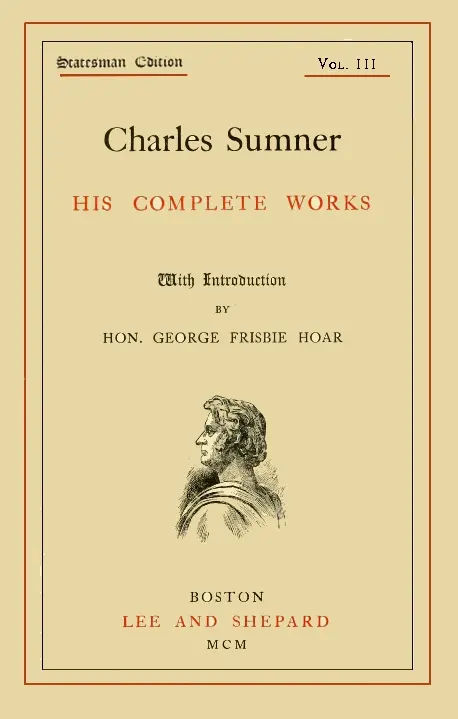
THE CLASSIC COLLECTION · 1900
"Charles Sumner: his complete works, volume 03 (of 20)" by Charles Sumner is a historical collection written in the late 19th century. This volume of Sumner's works includes speeches, letters, and addresses primarily focused on the principles of liberty, equality, and the fight against slavery. Sumner, a prominent abolitionist and senator, addresses pivotal topics during a time of significant social and political upheaval in America. The opening of the volume introduces Sumner's impassioned commitment to the abolition of slavery and the importance of adhering to the Declaration of Independence. He expresses his regret for not being able to attend a public meeting celebrating the Ordinance of Freedom in Ohio, emphasizing the need for the national government to be emancipated from the control of slavery. In subsequent portions, he delivers a speech to the Free-Soil Party convention, reinforcing the idea that their party's core mission aligns with the ideals of freedom and human rights. Sumner's rhetoric is rich with historical references and appeals to moral responsibility, setting the stage for his influential arguments against the injustices of slavery and for the advancement of freedom in America.
Introduction adapted from the source catalogue; source summaries may be automatically generated.
Free to read · English · 105,117 words · No account needed
MAKE TIME FOR A GOOD BOOK
On by default. Untick to stop anonymous reading totals. Each page counts after 10 seconds in view. How this works.
Anonymous counting is on unless you have switched it off.
"Know all men by these presents, that I, JONATHAN JACKSON, of Newburyport, in the County of Essex, gentleman, in consideration of the impropriety I feel, and have long felt, in holding any person in constant bondage, more especially at a time when my country is so warmly contending for the liberty every man ought to enjoy, and having sometime since promised my negro man, POMP, that I would give him his freedom, and in further consideration of five shillings paid me by said POMP, I do hereby liberate, manumit, and set him free; and I do hereby remise and release unto said POMP all demands of whatever nature I have against POMP. In witness whereof I have hereunto set my hand and seal, this 19th of June, 1776.
"JONATHAN JACKSON. [Seal.]
"Witness, MARY COBURN,
"WILLIAM NOYES."
[1] Printed, since this Address, in the History of Newton, by Francis Jackson, (Boston, 1854,) p. 336.
The same conviction animated the hearts of the people, whether at the North or South. In a town-meeting at Danbury, Connecticut, held on the 12th of December, 1774, the following declaration was made.
"It is with singular pleasure we note the second article of the Association, in which it is agreed to import no more negro slaves,--as we cannot but think it a palpable absurdity so loudly to complain of attempts to enslave us, while we are actually enslaving others."[2]
The South responded in similar strain. At a meeting in Darien, Georgia, January 12th, 1775, the following important resolution speaks, in tones worthy of freemen, the sentiments of the time.
"We, therefore, the Representatives of the extensive District of Darien, in the Colony of Georgia, being now assembled in Congress, by the authority and free choice of the inhabitants of the said District, now freed from their fetters, do Resolve, ... To show the world that we are not influenced by any contracted or interested motives, but a general philanthropy for all mankind, of whatever climate, language, or complexion, we hereby declare our disapprobation and abhorrence of the unnatural practice of Slavery in America, (however the uncultivated state of our country, or other specious arguments, may plead for it,) a practice founded in injustice and cruelty, and highly dangerous to our liberties, (as well as lives,) debasing part of our fellow-creatures below men, and corrupting the virtue and morals of the rest, and is laying the basis of that liberty we contend for (and which we pray the Almighty to continue to the latest posterity) upon a very wrong foundation. We therefore resolve at all times to use our utmost endeavors for the manumission of our slaves in this Colony, upon the most safe and equitable footing for the masters and themselves."[3]
Your reading position is saved on this browser. Take it to another device with a library code. Reading pages adapt to text, rather than matching a printed edition.
Charles Sumner

Charles Sumner

Charles Sumner

Charles Sumner
BEHIND THE BOOK
This eBook is for the use of anyone anywhere in the United States and most other parts of the world at no cost and with almost no restrictions whatsoever. You may copy it, give it away or re-use it under the terms of the Project Gutenberg License included with this eBook or online at www.gutenberg.org. If you are not located in the United States, you will have to check the laws of the country where you are located before using this eBook. Read the source licence.
The original source file, including credits and licence, is retained by this library. Request an original-format copy at no charge. Please include the book title and Project Gutenberg identifier #45637.
KEEP YOUR CURIOSITY GOING

David Patterson (Spirit) Hatch

David Patterson (Spirit) Hatch

David Patterson (Spirit) Hatch
Cécile Tormay

Moritz Busch
John L. Ransom