
Charles Sumner: his complete works, volume 20 (of 20)
Charles Sumner
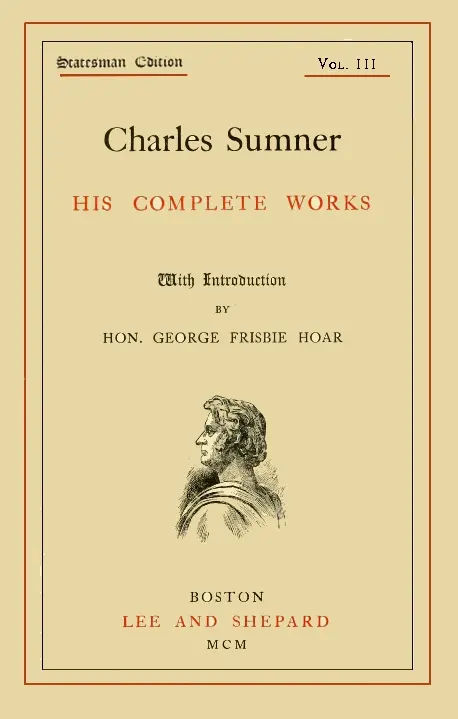
THE CLASSIC COLLECTION · 1900
"Charles Sumner: his complete works, volume 03 (of 20)" by Charles Sumner is a historical collection written in the late 19th century. This volume of Sumner's works includes speeches, letters, and addresses primarily focused on the principles of liberty, equality, and the fight against slavery. Sumner, a prominent abolitionist and senator, addresses pivotal topics during a time of significant social and political upheaval in America. The opening of the volume introduces Sumner's impassioned commitment to the abolition of slavery and the importance of adhering to the Declaration of Independence. He expresses his regret for not being able to attend a public meeting celebrating the Ordinance of Freedom in Ohio, emphasizing the need for the national government to be emancipated from the control of slavery. In subsequent portions, he delivers a speech to the Free-Soil Party convention, reinforcing the idea that their party's core mission aligns with the ideals of freedom and human rights. Sumner's rhetoric is rich with historical references and appeals to moral responsibility, setting the stage for his influential arguments against the injustices of slavery and for the advancement of freedom in America.
Introduction adapted from the source catalogue; source summaries may be automatically generated.
Free to read · English · 105,117 words · No account needed
MAKE TIME FOR A GOOD BOOK
On by default. Untick to stop anonymous reading totals. Each page counts after 10 seconds in view. How this works.
Anonymous counting is on unless you have switched it off.
[136] Bangs's History of the Methodist Episcopal Church in the United States, Vol. I. pp. 213, 218.
[137] Thoughts upon Slavery, by John Wesley, (London, 1774,) pp.
24, 27.
[138] Minutes of the Synod of New York and Philadelphia, 1787: Records of the Presbyterian Church in the United States, p. 540.
[139] A Dialogue concerning the Slavery of the Africans; Works,
Vol. II. p. 552.
[140] The Injustice and Impolicy of the Slave-Trade, and of the Slavery of the Africans, (Providence, 1792,) pp. 27-30.
Thus, at this time, the Church, in harmony with the Nation, by its leading denominations, Quakers, Methodists, Presbyterians, and Congregationalists, thundered against Slavery. The COLLEGES were in unison with the Church. Harvard University spoke by the voice of Massachusetts, which already had abolished Slavery. Dartmouth College, by one of its learned Professors, claimed for the slaves "an equal standing, in point of privileges, with the whites."[141] Yale College, by its President, the eminent divine, Ezra Stiles, became the head of the Abolition Society of Connecticut.[142] And the University of William and Mary, in Virginia, at this very time testified its sympathy with the cause by conferring upon Granville Sharp, the acknowledged chief of British Abolitionists, the honorary degree of Doctor of Laws.[143]
[141] Tyrannical Liberty-Men: A Discourse on Negro Slavery in the United States, February 19, 1795, by Moses Fiske, Tutor in Dartmouth College. American Quarterly Register, May, 1840. Weld, Power of Congress over the District of Columbia, p. 33.
[142] Kingsley's Life of Stiles: Sparks's American Biography,
Second Series, Vol. VI. p. 69.
[143] Hoare's Memoirs of Sharp, p. 254. Weld's Power of Congress,
p. 34.
The LITERATURE of the land, such as then existed, agreed with the Nation, the Church, and the College. Franklin, in the last literary labor of his life,[144]--Jefferson, in his "Notes on Virginia,"--Barlow, in his heroic verse,--Rush, in a work which inspired the praise of Clarkson,[145]--the ingenious author of the "Algerine Captive," the earliest American novel, and, though now but little known, one of the earliest American books republished in London,--were all moved by the contemplation of Slavery. "If our fellow-citizens in the Southern States are deaf to the pleadings of Nature," exclaims the last earnestly, "I will conjure them, for the sake of consistency, to cease to deprive their fellow-creatures of freedom, which their writers, their orators, representatives, senators, and even their Constitutions of Government, have declared to be the unalienable birthright of man."[146] A female writer and poet, earliest in our country among the graceful throng, Sarah Wentworth Morton, at the very period of the National Convention, admired by the polite society in which she lived, poured forth her sympathies also. The generous labors of John Jay in behalf of the crushed African inspired her muse; and in another poem, commemorating a slave who fell while vindicating his freedom, she rendered a truthful homage to his inalienable rights, in words which I now quote as testimony of the times:--
Your reading position is saved on this browser. Take it to another device with a library code. Reading pages adapt to text, rather than matching a printed edition.
Charles Sumner

Charles Sumner

Charles Sumner

Charles Sumner
BEHIND THE BOOK
This eBook is for the use of anyone anywhere in the United States and most other parts of the world at no cost and with almost no restrictions whatsoever. You may copy it, give it away or re-use it under the terms of the Project Gutenberg License included with this eBook or online at www.gutenberg.org. If you are not located in the United States, you will have to check the laws of the country where you are located before using this eBook. Read the source licence.
The original source file, including credits and licence, is retained by this library. Request an original-format copy at no charge. Please include the book title and Project Gutenberg identifier #45637.
KEEP YOUR CURIOSITY GOING

David Patterson (Spirit) Hatch

David Patterson (Spirit) Hatch

David Patterson (Spirit) Hatch
Cécile Tormay

Moritz Busch
John L. Ransom