
Charles Sumner: his complete works, volume 20 (of 20)
Charles Sumner
THE CLASSIC COLLECTION · 1900
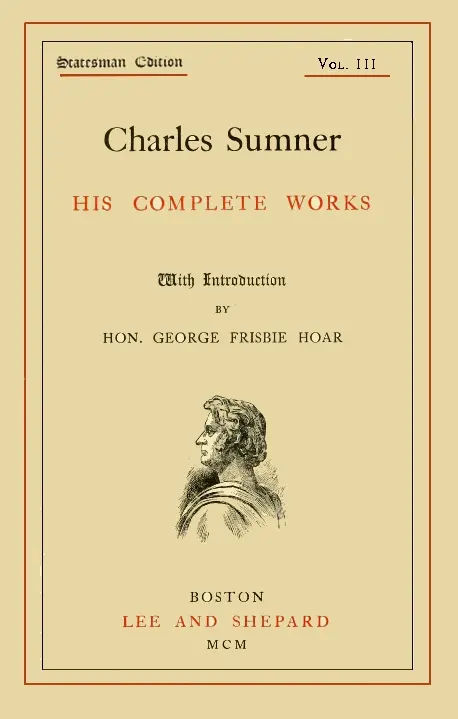
"Charles Sumner: his complete works, volume 03 (of 20)" by Charles Sumner is a historical collection written in the late 19th century. This volume of Sumner's works includes speeches, letters, and addresses primarily focused on the principles of liberty, equality, and the fight against slavery. Sumner, a prominent abolitionist and senator, addresses pivotal topics during a time of significant social and political upheaval in America. The opening of the volume introduces Sumner's impassioned commitment to the abolition of slavery and the importance of adhering to the Declaration of Independence. He expresses his regret for not being able to attend a public meeting celebrating the Ordinance of Freedom in Ohio, emphasizing the need for the national government to be emancipated from the control of slavery. In subsequent portions, he delivers a speech to the Free-Soil Party convention, reinforcing the idea that their party's core mission aligns with the ideals of freedom and human rights. Sumner's rhetoric is rich with historical references and appeals to moral responsibility, setting the stage for his influential arguments against the injustices of slavery and for the advancement of freedom in America.
Introduction adapted from the source catalogue; source summaries may be automatically generated.
Free to read · English · 105,117 words · No account needed
MAKE TIME FOR A GOOD BOOK
On by default. Untick to stop anonymous reading totals. Each page counts after 10 seconds in view. How this works.
Anonymous counting is on unless you have switched it off.
[127] Letter to John F. Mercer, September 9, 1786: Writings, ed. Sparks, Vol. IX. p. 159, note.
[128] Letter to Robert Morris, April 12, 1786: Writings, ed.
Sparks, Vol. IX. p. 159.
[129] Brissot de Warville, New Travels in the United States, 2d
ed., Vol. I. pp. 246, 247.
By the side of Washington, as, standing beneath the national flag, he swore to support the Constitution, were illustrious men, whose lives and recorded words now rise in judgment. There was John Adams, the Vice-President, great vindicator and final negotiator of our national independence, whose soul, flaming with Freedom, broke forth in the early declaration, that "consenting to Slavery is a sacrilegious breach of trust,"[130] and whose immitigable hostility to this wrong is immortal in his descendants. There also was a companion in arms and attached friend, of beautiful genius, the yet youthful and "incomparable" Hamilton,--fit companion in early glories and fame with that darling of English history, Sir Philip Sidney, to whom the latter epithet has been reserved,--who, as member of the Abolition Society of New York, had recently united in a solemn petition for those who, though "free by the laws of God, are held in Slavery by the laws of this State."[131] There, too, was a noble spirit, of spotless virtue, the ornament of human nature, who, like the sun, ever held an unerring course,--John Jay. Filling the important post of Secretary for Foreign Affairs under the Confederation, he found time to organize the "Society for Promoting the Manumission of Slaves" in New York, and to act as its President, until, by the nomination of Washington, he became Chief Justice of the United States. In his sight Slavery was an "iniquity," "a sin of crimson dye," against which ministers of the Gospel should testify, and which the Government should seek in every way to abolish. "Till America comes into this measure," he wrote, "her prayers to Heaven for liberty will be impious. This is a strong expression, but it is just. Were I in your Legislature, I would prepare a bill for the purpose with great care, and I would never cease moving it till it became a law or I ceased to be a member."[132] Such words as these, fitly coming from our leaders, belong to the true glories of the country:--
"While we such precedents can boast at home, Keep thy Fabricius and thy Cato, Rome!"
[130] Dissertation on the Canon and Feudal Law: Works, Vol. III. p.
463.
[131] Life and Writings of John Jay, Vol. I. p. 231. Slavery and AntiSlavery, by William Goodell, p. 97.
[132] Life and Writings, Vol. I. pp. 229, 230.
Your reading position is saved on this browser. Take it to another device with a library code. Reading pages adapt to text, rather than matching a printed edition.
Charles Sumner

Charles Sumner

Charles Sumner

Charles Sumner
BEHIND THE BOOK
This eBook is for the use of anyone anywhere in the United States and most other parts of the world at no cost and with almost no restrictions whatsoever. You may copy it, give it away or re-use it under the terms of the Project Gutenberg License included with this eBook or online at www.gutenberg.org. If you are not located in the United States, you will have to check the laws of the country where you are located before using this eBook. Read the source licence.
The original source file, including credits and licence, is retained by this library. Request an original-format copy at no charge. Please include the book title and Project Gutenberg identifier #45637.
KEEP YOUR CURIOSITY GOING

David Patterson (Spirit) Hatch

David Patterson (Spirit) Hatch

David Patterson (Spirit) Hatch
Cécile Tormay

Moritz Busch
John L. Ransom