
Charles Sumner: his complete works, volume 20 (of 20)
Charles Sumner
THE CLASSIC COLLECTION · 1900
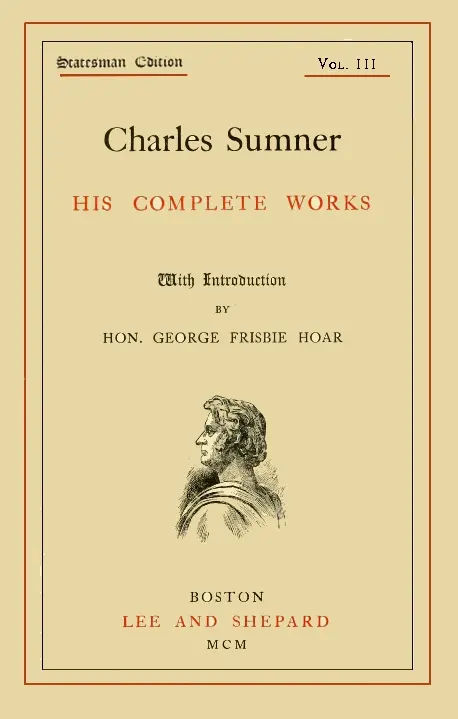
"Charles Sumner: his complete works, volume 03 (of 20)" by Charles Sumner is a historical collection written in the late 19th century. This volume of Sumner's works includes speeches, letters, and addresses primarily focused on the principles of liberty, equality, and the fight against slavery. Sumner, a prominent abolitionist and senator, addresses pivotal topics during a time of significant social and political upheaval in America. The opening of the volume introduces Sumner's impassioned commitment to the abolition of slavery and the importance of adhering to the Declaration of Independence. He expresses his regret for not being able to attend a public meeting celebrating the Ordinance of Freedom in Ohio, emphasizing the need for the national government to be emancipated from the control of slavery. In subsequent portions, he delivers a speech to the Free-Soil Party convention, reinforcing the idea that their party's core mission aligns with the ideals of freedom and human rights. Sumner's rhetoric is rich with historical references and appeals to moral responsibility, setting the stage for his influential arguments against the injustices of slavery and for the advancement of freedom in America.
Introduction adapted from the source catalogue; source summaries may be automatically generated.
Free to read · English · 105,117 words · No account needed
MAKE TIME FOR A GOOD BOOK
On by default. Untick to stop anonymous reading totals. Each page counts after 10 seconds in view. How this works.
Anonymous counting is on unless you have switched it off.
"The argument which my friend from Massachusetts has addressed to us to-day was not an assault upon the Constitution. It was a noble vindication of that great charter of government from the perversions of the advocates of the Fugitive Slave Act.... What has the Senator from Massachusetts asserted? That the fugitive servant clause of the Constitution is a clause of compact between the States, and confers no legislative power upon Congress. He has arrayed history and reason in support of this proposition; and I avow my conviction, now and here, that, logically and historically, his argument is impregnable, entirely impregnable....
"Let me add, Mr. President, that in my judgment the speech of my friend from Massachusetts will mark AN ERA in American history. It will distinguish the day when the advocates of that theory of governmental policy, constitutional construction, which he has so ably defended and so brilliantly illustrated, no longer content to stand on the defensive in the contest with Slavery, boldly attacked the very citadel of its power, in that doctrine of finality which two of the political parties of the country, through their national organizations, are endeavoring to establish as the impregnable defence of its usurpations."
On the close of the debate, the proposition of Mr. Sumner was rejected
by the following vote.
YEAS,--Messrs. Chase, Hale, Sumner, and Wade,--4.
NAYS,--Messrs. Adams, Badger, Bayard, Bell, Borland, Bradbury, Bright, Brodhead, Brooke, Butler, Cass, Charlton, Clarke, Clemens, Cooper, Dawson, De Saussure, Dodge, of Iowa, Douglas, Felch, Fish, Geyer, Gwin, Hamlin, Houston, Hunter, James, Jones, of Iowa, King, Mallory, Mangum, Mason, Meriwether, Miller, Morton, Pearce, Pratt, Rusk, Shields, Smith, Soulé, Spruance, Toucey, Underwood, Upham, Walker, and Weller,--47.
Mr. Seward was absent,--probably constrained by his prominence
as a supporter of General Scott.
This speech, when published, found an extensive echo. It was circulated not only through the press, but in large pamphlet editions, amounting to several hundred thousand. It was translated into German. Two or more editions appeared in England. In the preface to the English edition of "Uncle Tom's Cabin," Lord Carlisle associated the speech with that work, and signalized "the closeness of its logic and the masculine vigor of its eloquence." Lord Shaftesbury, in a letter to the London Times, wrote, "What noble eloquence!" Mr. Combe, the phrenologist, in a letter to a distinguished American, which was published at the time, said: "I have read every word of this speech with pleasure and with pain. The pain arose from the subject,--the pleasure from sympathy with and admiration of the speaker. I have long desired to know the merits of that most cruel and iniquitous enactment, and this speech has made them clear as day." The London Examiner said: "Apart from its noble and affecting eloquence, it is one of the closest and most convincing arguments we have ever read on the policy of the earlier and greater, as contrasted with that of the later and meaner statesmen of America." These testimonies might be accumulated. They are introduced only so far as may be important in giving an idea of the contemporaneous reception of this speech. The title had a vogue beyond the speech itself, as it became one of the countersigns of our politics.
Your reading position is saved on this browser. Take it to another device with a library code. Reading pages adapt to text, rather than matching a printed edition.
Charles Sumner

Charles Sumner

Charles Sumner

Charles Sumner
BEHIND THE BOOK
This eBook is for the use of anyone anywhere in the United States and most other parts of the world at no cost and with almost no restrictions whatsoever. You may copy it, give it away or re-use it under the terms of the Project Gutenberg License included with this eBook or online at www.gutenberg.org. If you are not located in the United States, you will have to check the laws of the country where you are located before using this eBook. Read the source licence.
The original source file, including credits and licence, is retained by this library. Request an original-format copy at no charge. Please include the book title and Project Gutenberg identifier #45637.
KEEP YOUR CURIOSITY GOING

David Patterson (Spirit) Hatch

David Patterson (Spirit) Hatch

David Patterson (Spirit) Hatch
Cécile Tormay

Moritz Busch
John L. Ransom