
Charles Sumner: his complete works, volume 20 (of 20)
Charles Sumner
THE CLASSIC COLLECTION · 1900
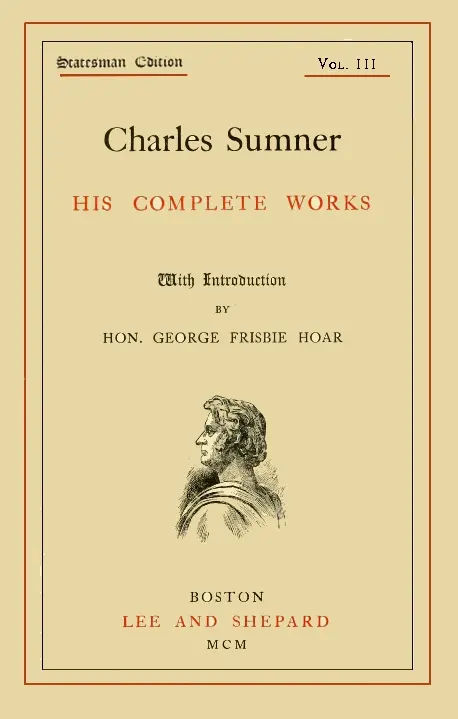
"Charles Sumner: his complete works, volume 03 (of 20)" by Charles Sumner is a historical collection written in the late 19th century. This volume of Sumner's works includes speeches, letters, and addresses primarily focused on the principles of liberty, equality, and the fight against slavery. Sumner, a prominent abolitionist and senator, addresses pivotal topics during a time of significant social and political upheaval in America. The opening of the volume introduces Sumner's impassioned commitment to the abolition of slavery and the importance of adhering to the Declaration of Independence. He expresses his regret for not being able to attend a public meeting celebrating the Ordinance of Freedom in Ohio, emphasizing the need for the national government to be emancipated from the control of slavery. In subsequent portions, he delivers a speech to the Free-Soil Party convention, reinforcing the idea that their party's core mission aligns with the ideals of freedom and human rights. Sumner's rhetoric is rich with historical references and appeals to moral responsibility, setting the stage for his influential arguments against the injustices of slavery and for the advancement of freedom in America.
Introduction adapted from the source catalogue; source summaries may be automatically generated.
Free to read · English · 105,117 words · No account needed
MAKE TIME FOR A GOOD BOOK
On by default. Untick to stop anonymous reading totals. Each page counts after 10 seconds in view. How this works.
Anonymous counting is on unless you have switched it off.
Our country has already been active in this work. Through a remarkable line of steam communications, chiefly by railroad, its whole population is now, or will be shortly, brought close to the borders of Iowa. Cities of the Southern seaboard, Charleston, Savannah, and Mobile, are already stretching their lines in this direction, soon to be completed conductors,--while the traveller from all the principal points of the Northern seaboard, from Portland, Boston, Providence, New York, Philadelphia, Baltimore, and Washington, now passes without impediment to this remote region, traversing a territory of unexampled resources, at once magazine and granary, the largest coal-field and at the same time the largest corn-field of the known globe, winding his way among churches and school-houses, among forests and gardens, by villages, towns, and cities, along the sea, along rivers and lakes, with a speed which may recall the gallop of the ghostly horseman in the ballad:--
"Fled past on right and left how fast
Each forest, grove, and bower!
On right and left fled past how fast
Each city, town, and tower!
"Tramp! tramp! along the land they rode,
Splash! splash! along the sea."
On the banks of the Mississippi he is now arrested. The proposed road in Iowa will bear the adventurer yet further, to the banks of the Missouri; and this remote giant stream, mightiest of the earth, leaping from its sources in the Rocky Mountains, will be clasped with the Atlantic in the same iron bracelet. In all this I see not only further opportunities for commerce, but a new extension to civilization and increased strength to our National Union.
A heathen poet, while picturing the Golden Age, perversely indicates the absence of long roads as creditable to that imaginary period in contrast with his own. "How well," exclaims the youthful Tibullus, "they lived while Saturn ruled,--before the earth was opened by long ways!"
"Quam bene Saturno vivebant rege, priusquam Tellus in longas est patefacta vias!"[88]
But the true Golden Age is before, not behind; and one of its tokens will be the opening of those long ways, by which villages, towns, counties, states, provinces, nations, are all to be associated and knit together in a fellowship that can never be broken.
[88] Eleg. Lib. I. iii. 35, 36.
The debate on the Iowa Railroad Bill was continued on successive days down to February 17th, when the speech of Mr. Sumner was particularly assailed by Mr. Hunter, of Virginia. To this he replied at once.
Your reading position is saved on this browser. Take it to another device with a library code. Reading pages adapt to text, rather than matching a printed edition.
Charles Sumner

Charles Sumner

Charles Sumner

Charles Sumner
BEHIND THE BOOK
This eBook is for the use of anyone anywhere in the United States and most other parts of the world at no cost and with almost no restrictions whatsoever. You may copy it, give it away or re-use it under the terms of the Project Gutenberg License included with this eBook or online at www.gutenberg.org. If you are not located in the United States, you will have to check the laws of the country where you are located before using this eBook. Read the source licence.
The original source file, including credits and licence, is retained by this library. Request an original-format copy at no charge. Please include the book title and Project Gutenberg identifier #45637.
KEEP YOUR CURIOSITY GOING

David Patterson (Spirit) Hatch

David Patterson (Spirit) Hatch

David Patterson (Spirit) Hatch
Cécile Tormay

Moritz Busch
John L. Ransom