
Charles Sumner: his complete works, volume 20 (of 20)
Charles Sumner
THE CLASSIC COLLECTION · 1900
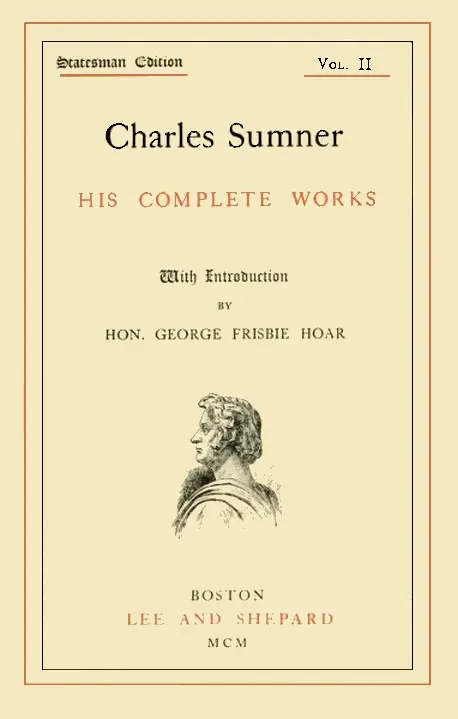
"Charles Sumner: his complete works, volume 02 (of 20)" by Charles Sumner is a historical collection of lectures, speeches, and writings written in the mid-19th century. This volume prominently tackles the theme of slavery, with particular focus on the injustices of both white slavery in the Barbary States and black slavery in America. It features a range of oratory efforts, advocating for human rights and the abolition of slavery as a moral and political imperative. The opening of this volume presents a lecture given by Sumner titled "White Slavery in the Barbary States," which elaborates on the historical context and moral implications of slavery both historically and in his contemporary society. He explores the origins and definitions of slavery, emphasizing that it is rooted in violence and force rather than justice or rights. Through this lens, he compares the plight of enslaved whites in North Africa to that of enslaved African Americans, revealing the complexities and shared horrors of servitude. The preliminary narrative sets the stage for a deeper investigation into the concepts of freedom, justice, and progress, positioning the fight against slavery as a universal human struggle.
Introduction adapted from the source catalogue; source summaries may be automatically generated.
Free to read · English · 122,700 words · No account needed
MAKE TIME FOR A GOOD BOOK
On by default. Untick to stop anonymous reading totals. Each page counts after 10 seconds in view. How this works.
Anonymous counting is on unless you have switched it off.
To secure their freedom, informal agencies were promptly established under the direction of our minister at Paris; and the Society of Redemption--whose beneficent exertions, commencing so early in modern history, were still continued--offered their aid. Our agents were blandly entertained by that great slave-dealer, the Dey of Algiers, who informed them that he was familiar with the exploits of Washington, and, never expecting to see him, expressed a hope, that, through Congress, he might receive a full-length portrait of this hero of freedom, to be displayed in his palace at Algiers. The Dey clung to his American slaves, holding them at prices considered exorbitant, being, in 1786, $6,000 for the master of a vessel, $4,000 for a mate, $4,000 for a passenger, and $1,400 for a seaman; while the agents were authorized to offer only $200 for each.[102] In 1790 the tariff seems to have fallen. Meanwhile one obtained his freedom through private means, others escaped, and others still were liberated by the great liberator, Death. The following list, if not interesting from the names of the captives, will at least be curious as evidence of prices at that time in the slave-market.
[102] Lyman's Diplomacy, Vol. II. pp. 353, 354.
Crew of the Ship Dolphin, of Philadelphia, captured July 30, 1785. Sequins. Richard O'Brien, master, price demanded 2,000 Andrew Montgomery, mate 1,500 Jacob Tessanier, French passenger 2,000 William Patterson, seaman (keeps a tavern) 1,500 Philip Sloan, " 725 Peleg Loring, " 725 John Robertson, " 725 James Hall, " 725
Crew of the Schooner Maria, of Boston, captured July 25, 1785.
Isaac Stevens, master (of Concord, Mass.) 2,000 Alexander Forsythe, mate 1,500 James Cathcart, seaman (keeps a tavern) 900 George Smith, " (in the Dey's house) 725 John Gregory, " 725 James Hermit, " 725 ------------ 16,475 Duty on the above sum, ten per cent 1,647½ Sundry gratifications to officers of the Dey's household 240⅓ ------------ Sequins 18,362⅚ This sum being equal to $34,792.[103]
[103] History of the War between the United States and Tripoli, pp. 64, 65. Lyman's Diplomacy, Vol. II. pp. 357, 358.
In 1793 no less than one hundred and fifteen of our fellow-citizens were groaning in Algerine slavery. Their condition excited the fraternal feeling of the whole people, while it occupied the anxious attention of Congress and the prayers of the clergy. A petition from these unhappy persons, dated at Algiers, December 29, 1793, was addressed to Congress. "Your petitioners," it says, "are at present captives in this city of bondage, employed daily in the most laborious work, without any respect to persons. They pray that you will take their unfortunate situation into consideration, and adopt such measures as will restore the American captives to their country, their friends, families, and connections; and your most humble petitioners will ever pray and be thankful."[104] The action of Congress was sluggish, compared with the patriot desires throbbing through the country.
[104] Lyman's Diplomacy, Vol. II. pp. 359, 360.
Your reading position is saved on this browser. Take it to another device with a library code. Reading pages adapt to text, rather than matching a printed edition.
Charles Sumner

Charles Sumner

Charles Sumner

Charles Sumner
BEHIND THE BOOK
This eBook is for the use of anyone anywhere in the United States and most other parts of the world at no cost and with almost no restrictions whatsoever. You may copy it, give it away or re-use it under the terms of the Project Gutenberg License included with this eBook or online at www.gutenberg.org. If you are not located in the United States, you will have to check the laws of the country where you are located before using this eBook. Read the source licence.
The original source file, including credits and licence, is retained by this library. Request an original-format copy at no charge. Please include the book title and Project Gutenberg identifier #45473.
KEEP YOUR CURIOSITY GOING

David Patterson (Spirit) Hatch

David Patterson (Spirit) Hatch

David Patterson (Spirit) Hatch
Cécile Tormay

Moritz Busch
John L. Ransom