
Charles Sumner: his complete works, volume 20 (of 20)
Charles Sumner
THE CLASSIC COLLECTION · 1900
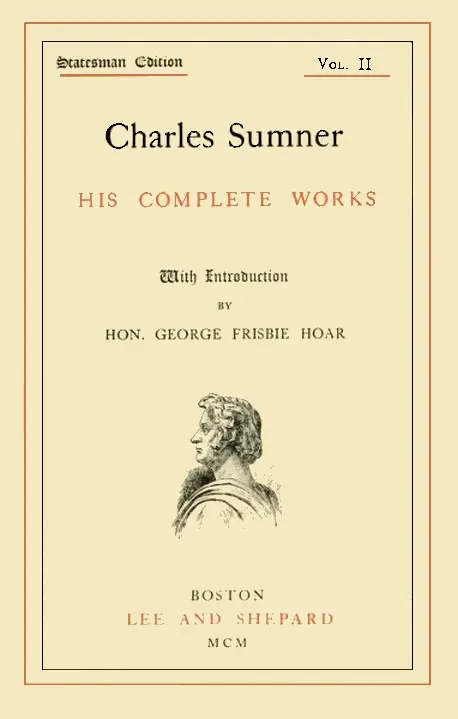
"Charles Sumner: his complete works, volume 02 (of 20)" by Charles Sumner is a historical collection of lectures, speeches, and writings written in the mid-19th century. This volume prominently tackles the theme of slavery, with particular focus on the injustices of both white slavery in the Barbary States and black slavery in America. It features a range of oratory efforts, advocating for human rights and the abolition of slavery as a moral and political imperative. The opening of this volume presents a lecture given by Sumner titled "White Slavery in the Barbary States," which elaborates on the historical context and moral implications of slavery both historically and in his contemporary society. He explores the origins and definitions of slavery, emphasizing that it is rooted in violence and force rather than justice or rights. Through this lens, he compares the plight of enslaved whites in North Africa to that of enslaved African Americans, revealing the complexities and shared horrors of servitude. The preliminary narrative sets the stage for a deeper investigation into the concepts of freedom, justice, and progress, positioning the fight against slavery as a universal human struggle.
Introduction adapted from the source catalogue; source summaries may be automatically generated.
Free to read · English · 122,700 words · No account needed
MAKE TIME FOR A GOOD BOOK
On by default. Untick to stop anonymous reading totals. Each page counts after 10 seconds in view. How this works.
Anonymous counting is on unless you have switched it off.
[79] At the time this Lecture was delivered, the Rev. Charles T. Torrey was a prisoner in the Penitentiary of Maryland, paying the penalty for aid to escaping slaves.
The efforts to escape from slavery in the Barbary States, so far as they can be traced, are full of interest. Each, also, has its lesson for us at the present hour. The following is in the exact words of an early writer. "One John Fox, an expert mariner, and a good, approved, and sufficient gunner, was (in the raigne of Queene Elizabeth) taken by the Turkes, and kept eighteene yeeres in most miserable bondage and slavery; at the end of which time he espied his opportunity (and God assisting him withall), that hee slew his keeper, and fled to the sea's side, where he found a gally with one hundred and fifty captive Christians, which hee speedily waying their anchor, set saile, and fell to worke like men, and safely arrived in Spaone, by which meanes he freed himselfe and a number of poore soules from long and intolerable servitude; after which the said John Fox came into England, and the Queene (being rightly informed of his brave exploit) did graciously entertaine him for her servant, and allowed him a yeerely pension."[80]
[80] Purchas's Pilgrims, Vol. II. p. 888.
There is also in the same early source a quaint description of what occurred to a ship from Bristol, captured by an Algerine corsair in 1621. The Englishmen were all taken out except four youths, over whom the Turks, as these barbarians are often called by early writers, put thirteen of their own men, to conduct the ship as prize to Algiers; and one of the pirates, "a strong, able, sterne, and resolute fellow," was appointed captain. "These foure poore youths," so the story proceeds, "being thus fallen into the hands of mercilesse infidels, began to studie and complot all the meanes they could for the obtayning of their freedomes. First, they considered the lamentable and miserable estates that they were like to be in,--as, to be debard for ever from seeing their friends and countrey, to be chained, beaten, made slaves, and to eate the bread of affliction in the gallies, all the remainder of their unfortunate lives, to have their heads shaven, to feed on course dyet, to have hard boords for beds, and, which was worst of all, never to be partakers of the heavenly word and sacraments. Thus being quite hopelesse, haplesse, and, for any thing they knew, for ever helplesse, they sayled five dayes and nights under the command of the pirats, when, on the fifth night, God, in his great mercy, shewed them a meanes for their wished for escape." A sudden wind arose, when, the captain coming to help take in the mainsail, two of the English youths "suddenly tooke him by the breech and threw him over-boord; but by fortune hee fell into the bunt of the sayle, where, quickly catching hold of a rope, he (being a very strong man) had almost gotten into the ship againe, which John Cooke perceiving leaped speedily to the pumpe and tooke off the pumpe brake or handle and cast it to William Ling, bidding him knocke him downe, which he was not long in doing, but, lifting up the woodden weapon, he gave him such a palt on the pate as made his braines forsake the possession of his head, with which his body fell into the sea." The corsair slave-dealers were overpowered. The four English youths drove them "from place to place in the ship, and having coursed them from the poope to the forecastle, they there valiantly killed two of them, and gave another a dangerous wound or two, who, to escape the further fury of their swords, leap'd suddenly over-boord to goe seeke his captaine." The other nine Turks ran between-decks, where they were securely fastened. The English now directed their course to St. Lucas, in Spain, and "in short time (by Gods ayde) happily and safely arrived at the said port, where they sold the nine Turkes for gally-slaves for a good summe of money, and, as I thinke, a great deale more then they were worth." "He that shall attribute such things as these to the arme of flesh and bloud," says the ancient historian, grateful for this triumph of freedom, "is forgetfull, ingratefull, and in a manner atheisticall."[81]
Your reading position is saved on this browser. Take it to another device with a library code. Reading pages adapt to text, rather than matching a printed edition.
Charles Sumner

Charles Sumner

Charles Sumner

Charles Sumner
BEHIND THE BOOK
This eBook is for the use of anyone anywhere in the United States and most other parts of the world at no cost and with almost no restrictions whatsoever. You may copy it, give it away or re-use it under the terms of the Project Gutenberg License included with this eBook or online at www.gutenberg.org. If you are not located in the United States, you will have to check the laws of the country where you are located before using this eBook. Read the source licence.
The original source file, including credits and licence, is retained by this library. Request an original-format copy at no charge. Please include the book title and Project Gutenberg identifier #45473.
KEEP YOUR CURIOSITY GOING

David Patterson (Spirit) Hatch

David Patterson (Spirit) Hatch

David Patterson (Spirit) Hatch
Cécile Tormay

Moritz Busch
John L. Ransom