
Charles Sumner: his complete works, volume 20 (of 20)
Charles Sumner
THE CLASSIC COLLECTION · 1900
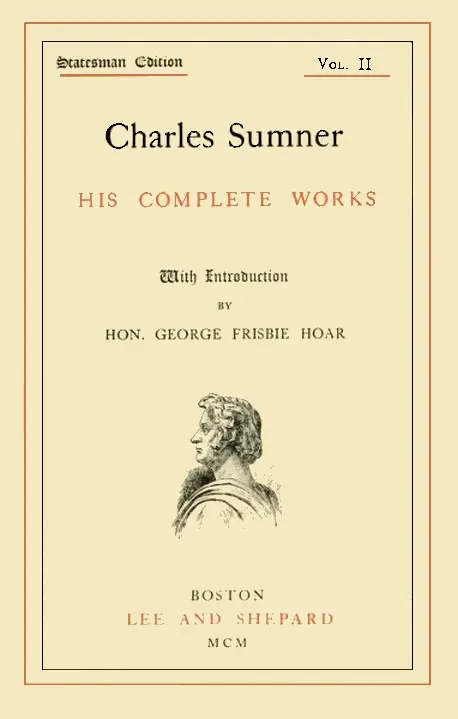
"Charles Sumner: his complete works, volume 02 (of 20)" by Charles Sumner is a historical collection of lectures, speeches, and writings written in the mid-19th century. This volume prominently tackles the theme of slavery, with particular focus on the injustices of both white slavery in the Barbary States and black slavery in America. It features a range of oratory efforts, advocating for human rights and the abolition of slavery as a moral and political imperative. The opening of this volume presents a lecture given by Sumner titled "White Slavery in the Barbary States," which elaborates on the historical context and moral implications of slavery both historically and in his contemporary society. He explores the origins and definitions of slavery, emphasizing that it is rooted in violence and force rather than justice or rights. Through this lens, he compares the plight of enslaved whites in North Africa to that of enslaved African Americans, revealing the complexities and shared horrors of servitude. The preliminary narrative sets the stage for a deeper investigation into the concepts of freedom, justice, and progress, positioning the fight against slavery as a universal human struggle.
Introduction adapted from the source catalogue; source summaries may be automatically generated.
Free to read · English · 122,700 words · No account needed
MAKE TIME FOR A GOOD BOOK
On by default. Untick to stop anonymous reading totals. Each page counts after 10 seconds in view. How this works.
Anonymous counting is on unless you have switched it off.
[322] Acte pour la Constitution Fédérative de l'Allemagne du 8 Juin, 1815, Art. XI. par. 4: Archives Diplomatiques, Vol. IV. p. 15.
Such are authentic, well-defined examples. This is not all. It is in the order of Providence, that individuals, families, tribes, and nations should tend, by means of association, to a final Unity. A law of mutual attraction, or affinity, first exerting its influence upon smaller bodies, draws them by degrees into well-established fellowship, and then, continuing its power, fuses the larger bodies into nations; and nations themselves, stirred by this same sleepless energy, are now moving towards that grand system of combined order which will complete the general harmony:--
"Spiritus intus alit, totamque infusa per artus Mens agitat molem, et magno se corpore miscet."[323]
History bears ample testimony to the potency of this attraction. Modern Europe, in its early periods, was filled with petty lordships, or communities constituting so many distinct units, acknowledging only a vague nationality, and maintaining, as we have already seen, the "liberty" to fight with each other. The great nations of our day have grown and matured into their present form by the gradual absorption of these political bodies.
[323] Æneid, Lib. VI. 726, 727.
Territories, once possessing an equivocal and turbulent independence, feel new power and happiness in peaceful association. Spain, composed of races dissimilar in origin, religion, and government, slowly ascended by progressive combinations among principalities and provinces, till at last, in the fifteenth century, by the crowning union of Castile and Aragon, the whole country, with its various sovereignties, was united under one common rule. Germany once consisted of more than three hundred different principalities, each with the right of war. These slowly coalesced, forming larger principalities; till at last the whole complex aggregation of states, embracing abbeys, bishoprics, archbishoprics, bailiwicks, counties, duchies, electorates, margraviates, and free imperial cities, was gradually resolved into the present Confederation, where each state expressly renounces the right of war with its associates. France has passed through similar changes. By a power of assimilation, in no nation so strongly marked, she has absorbed the various races and sovereignties once filling her territory with violence and conflict, and has converted them all to herself. The Roman or Iberian of Provence, the indomitable Celtic race, the German of Alsace, have all become Frenchmen,--while the various provinces, once inspired by such hostile passions, Brittany and Normandy, Franche-Comté and Burgundy, Gascony and Languedoc, Provence and Dauphiné, are now blended in one powerful, united nation. Great Britain, too, shows the influence of the same law. The many hostile principalities of England were first merged in the Heptarchy; and these seven kingdoms became one under the Saxon Egbert. Wales, forcibly attached to England under Edward the First, at last assimilated with her conqueror; Ireland, after a protracted resistance, was absorbed under Edward the Third, and at a later day, after a series of bitter struggles, was united, I do not say how successfully, under the Imperial Parliament; Scotland was connected with England by the accession of James the First to the throne of the Tudors, and these two countries, which had so often encountered in battle, were joined together under Queen Anne, by an act of peaceful legislation.
Your reading position is saved on this browser. Take it to another device with a library code. Reading pages adapt to text, rather than matching a printed edition.
Charles Sumner

Charles Sumner

Charles Sumner

Charles Sumner
BEHIND THE BOOK
This eBook is for the use of anyone anywhere in the United States and most other parts of the world at no cost and with almost no restrictions whatsoever. You may copy it, give it away or re-use it under the terms of the Project Gutenberg License included with this eBook or online at www.gutenberg.org. If you are not located in the United States, you will have to check the laws of the country where you are located before using this eBook. Read the source licence.
The original source file, including credits and licence, is retained by this library. Request an original-format copy at no charge. Please include the book title and Project Gutenberg identifier #45473.
KEEP YOUR CURIOSITY GOING

David Patterson (Spirit) Hatch

David Patterson (Spirit) Hatch

David Patterson (Spirit) Hatch
Cécile Tormay

Moritz Busch
John L. Ransom