
Charles Sumner: his complete works, volume 20 (of 20)
Charles Sumner
THE CLASSIC COLLECTION · 1900
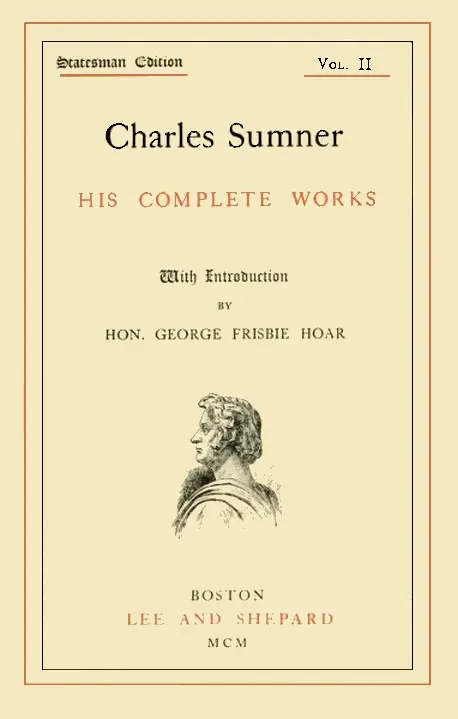
"Charles Sumner: his complete works, volume 02 (of 20)" by Charles Sumner is a historical collection of lectures, speeches, and writings written in the mid-19th century. This volume prominently tackles the theme of slavery, with particular focus on the injustices of both white slavery in the Barbary States and black slavery in America. It features a range of oratory efforts, advocating for human rights and the abolition of slavery as a moral and political imperative. The opening of this volume presents a lecture given by Sumner titled "White Slavery in the Barbary States," which elaborates on the historical context and moral implications of slavery both historically and in his contemporary society. He explores the origins and definitions of slavery, emphasizing that it is rooted in violence and force rather than justice or rights. Through this lens, he compares the plight of enslaved whites in North Africa to that of enslaved African Americans, revealing the complexities and shared horrors of servitude. The preliminary narrative sets the stage for a deeper investigation into the concepts of freedom, justice, and progress, positioning the fight against slavery as a universal human struggle.
Introduction adapted from the source catalogue; source summaries may be automatically generated.
Free to read · English · 122,700 words · No account needed
MAKE TIME FOR A GOOD BOOK
On by default. Untick to stop anonymous reading totals. Each page counts after 10 seconds in view. How this works.
Anonymous counting is on unless you have switched it off.
Time does not allow me to discuss the nature of these preparations; and I am the more willing to abridge what I am tempted to say, because, on another occasion, I have treated this part of the subject. But I cannot forbear to expose their inconsistency with the spirit of Christianity. From a general comprehension of the War System, we perceive the unchristian character of the preparations it encourages and requires, nay, which are the synonyms of the system, or at least its representatives. I might exhibit this character by an examination of the Laws of War, drawn from no celestial fount, but from a dark profound of Heathenism. This is unnecessary. The Constitution of our own country furnishes an illustration remarkable as a touch-stone of the whole system. No town, county, or state has the "liberty" to "declare War." The exercise of any proper self-defence, arising from actual necessity, requires no such "liberty." Congress is expressly authorized to "declare War,"--that is, to invoke the Arbitrament of Arms. And the Constitution proceeds to state, that all "giving aid and comfort" to the enemy shall be deemed traitors. Mark now what is said by a higher authority. "Love your enemies"; "If thine enemy hunger, feed him; if he thirst, give him drink." Under the War System, obedience to these positive injunctions may expose a person to the penalty of the highest crime known to the law. Can this be a Christian system? But so long as War exists as an Institution this terrible inconsistency must appear.
The character of these preparations is distinctly, though unconsciously, attested by the names of vessels in the British Navy. From the latest official list I select an illustrative catalogue. Most are steamships of recent construction. Therefore they represent the spirit of the British Navy in our day,--nay, of those War Preparations in which they play so conspicuous a part. Here are the champions: Acheron, Adder, Alecto, Avenger, Basilisk, Bloodhound, Bulldog, Crocodile, Erebus, Firebrand, Fury, Gladiator, Goliah, Gorgon, Harpy, Hecate, Hound, Jackal, Mastiff, Pluto, Rattlesnake, Revenge, Salamander, Savage, Scorpion, Scourge, Serpent, Spider, Spiteful, Spitfire, Styx, Sulphur, Tartar, Tartarus, Teazer, Terrible, Terror, Vengeance, Viper, Vixen, Virago, Volcano, Vulture, Warspite, Wildfire, Wolf, Wolverine!
Such is the Christian array of Victoria, Defender of the Faith! It may remind us of the companions of King John, at another period of English history,--"Falkes the Merciless," "Mauleon the Bloody," "Walter Buck, the Assassin,"[305]--or of that Pagan swarm, the savage warriors of our own continent, with the names of Black-Hawk, Man-Killer, and Wild-Boar. Well might they seem to be
"all the grisly legions that troop
Under the sooty flag of Acheron!"
Your reading position is saved on this browser. Take it to another device with a library code. Reading pages adapt to text, rather than matching a printed edition.
Charles Sumner

Charles Sumner

Charles Sumner

Charles Sumner
BEHIND THE BOOK
This eBook is for the use of anyone anywhere in the United States and most other parts of the world at no cost and with almost no restrictions whatsoever. You may copy it, give it away or re-use it under the terms of the Project Gutenberg License included with this eBook or online at www.gutenberg.org. If you are not located in the United States, you will have to check the laws of the country where you are located before using this eBook. Read the source licence.
The original source file, including credits and licence, is retained by this library. Request an original-format copy at no charge. Please include the book title and Project Gutenberg identifier #45473.
KEEP YOUR CURIOSITY GOING

David Patterson (Spirit) Hatch

David Patterson (Spirit) Hatch

David Patterson (Spirit) Hatch
Cécile Tormay

Moritz Busch
John L. Ransom