
Charles Sumner: his complete works, volume 20 (of 20)
Charles Sumner
THE CLASSIC COLLECTION · 1900
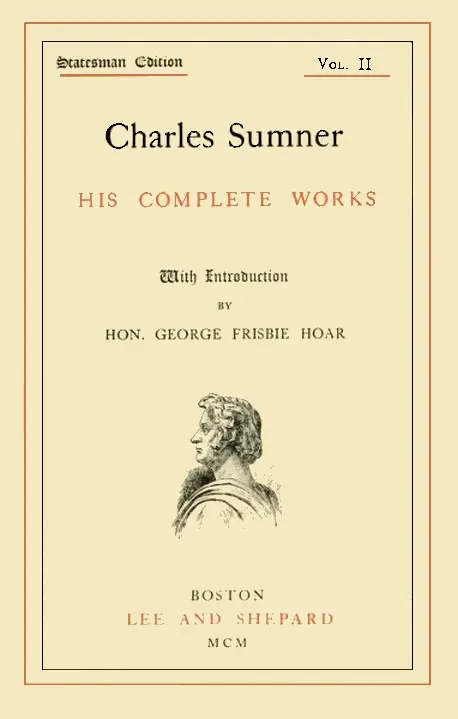
"Charles Sumner: his complete works, volume 02 (of 20)" by Charles Sumner is a historical collection of lectures, speeches, and writings written in the mid-19th century. This volume prominently tackles the theme of slavery, with particular focus on the injustices of both white slavery in the Barbary States and black slavery in America. It features a range of oratory efforts, advocating for human rights and the abolition of slavery as a moral and political imperative. The opening of this volume presents a lecture given by Sumner titled "White Slavery in the Barbary States," which elaborates on the historical context and moral implications of slavery both historically and in his contemporary society. He explores the origins and definitions of slavery, emphasizing that it is rooted in violence and force rather than justice or rights. Through this lens, he compares the plight of enslaved whites in North Africa to that of enslaved African Americans, revealing the complexities and shared horrors of servitude. The preliminary narrative sets the stage for a deeper investigation into the concepts of freedom, justice, and progress, positioning the fight against slavery as a universal human struggle.
Introduction adapted from the source catalogue; source summaries may be automatically generated.
Free to read · English · 122,700 words · No account needed
MAKE TIME FOR A GOOD BOOK
On by default. Untick to stop anonymous reading totals. Each page counts after 10 seconds in view. How this works.
Anonymous counting is on unless you have switched it off.
[46] Compassion towards Captives: urged and pressed in Three Sermons on Heb. xiii. 3, by Charles Fitz-Geffry, Oxford, 1637. Libertas, or Reliefe to the English Captives in Algier, by Henry Robinson, London, 1642. Letters relating to the Redemption of the Captives in Argier and Tunis, by Edmond Cason, London, 1647. A Relation of Seven Years Slavery under the Turks of Algier, suffered by an English Captive Merchant, etc., together with a Description of the Sufferings of the Miserable Captives under that Merciless Tyranny, etc., by Francis Knight, London, 1640. The last publication is preserved in the Collection of Voyages and Travels by Osborne, Vol. II. pp. 465-489.
[47] Hume says, "No English fleet, except during the Crusades, had ever before sailed in those seas." (History of England, Chap. LXI. Vol. VII. p. 529.) He forgot the expedition of Sir Robert Mansel, already mentioned (ante, p. 408), which was elaborately debated in the Privy Council as early as 1617, three years before it was finally undertaken, and was the subject of a special work. See Southey's Naval History of England, Vol. V. pp. 149-157.
[48] Thurloe's State Papers, Vol. III. p. 527.
[49] Carlyle's Letters and Speeches of Cromwell, Part IX. Speech V.
Vol. II. p. 235.
[50] Panegyric to my Lord Protector, st. 9.
His vigorous sway was succeeded by the voluptuous tyranny of Charles the Second, inaugurated by an unsuccessful expedition against Algiers under Lord Sandwich. This was soon followed by another, with more favorable result, under Admiral Lawson.[51] Then came a treaty, bearing date May 3, 1662, by which the piratical government stipulated, "that all subjects of the king of Great Britain, now slaves in Algiers, or any of the territories thereof, shall be set at liberty, and released, upon paying the price they were first sold for in the market; and for the time to come no subjects of His Majesty shall be bought or sold, or made slaves of, in Algiers or its territories."[52] This seems to have been short-lived. Other expeditions ensued, and other treaties in 1664, 1672, 1682, and 1686,--showing, by their constant iteration, the little impression produced upon these barbarians.[53] Insensible to justice and freedom, how could they be faithful to stipulations in restraint of robbery and slaveholding?
[51] Rapin, History of England, Book XXIII. Vol. II. pp. 858, 864.
[52] Recueil des Traitez de Paix, Tom. IV. p. 43.
[53] Ibid., pp. 307, 476, 703, 756.
Your reading position is saved on this browser. Take it to another device with a library code. Reading pages adapt to text, rather than matching a printed edition.
Charles Sumner

Charles Sumner

Charles Sumner

Charles Sumner
BEHIND THE BOOK
This eBook is for the use of anyone anywhere in the United States and most other parts of the world at no cost and with almost no restrictions whatsoever. You may copy it, give it away or re-use it under the terms of the Project Gutenberg License included with this eBook or online at www.gutenberg.org. If you are not located in the United States, you will have to check the laws of the country where you are located before using this eBook. Read the source licence.
The original source file, including credits and licence, is retained by this library. Request an original-format copy at no charge. Please include the book title and Project Gutenberg identifier #45473.
KEEP YOUR CURIOSITY GOING

David Patterson (Spirit) Hatch

David Patterson (Spirit) Hatch

David Patterson (Spirit) Hatch
Cécile Tormay

Moritz Busch
John L. Ransom