
Charles Sumner: his complete works, volume 20 (of 20)
Charles Sumner
THE CLASSIC COLLECTION · 1900
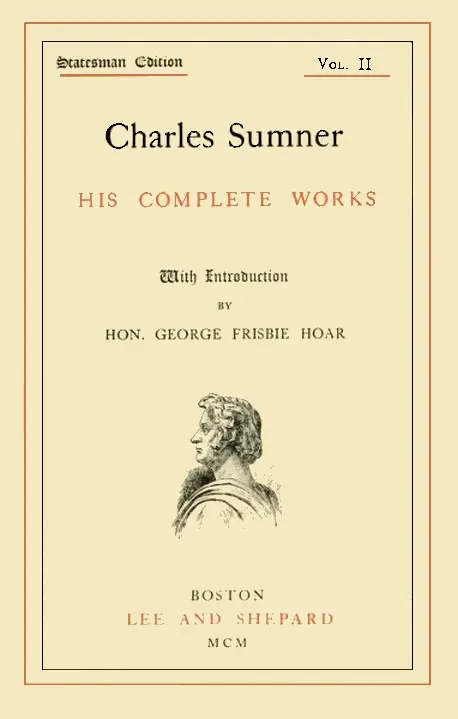
"Charles Sumner: his complete works, volume 02 (of 20)" by Charles Sumner is a historical collection of lectures, speeches, and writings written in the mid-19th century. This volume prominently tackles the theme of slavery, with particular focus on the injustices of both white slavery in the Barbary States and black slavery in America. It features a range of oratory efforts, advocating for human rights and the abolition of slavery as a moral and political imperative. The opening of this volume presents a lecture given by Sumner titled "White Slavery in the Barbary States," which elaborates on the historical context and moral implications of slavery both historically and in his contemporary society. He explores the origins and definitions of slavery, emphasizing that it is rooted in violence and force rather than justice or rights. Through this lens, he compares the plight of enslaved whites in North Africa to that of enslaved African Americans, revealing the complexities and shared horrors of servitude. The preliminary narrative sets the stage for a deeper investigation into the concepts of freedom, justice, and progress, positioning the fight against slavery as a universal human struggle.
Introduction adapted from the source catalogue; source summaries may be automatically generated.
Free to read · English · 122,700 words · No account needed
MAKE TIME FOR A GOOD BOOK
On by default. Untick to stop anonymous reading totals. Each page counts after 10 seconds in view. How this works.
Anonymous counting is on unless you have switched it off.
Tables speak sometimes as words cannot. From statistics of life, as recorded by Science, we learn the capacity for progress in the Human Family; the testimony is authentic, as it is interesting. A little more than two centuries have passed since Descartes predicted that improvement in human health which these figures exhibit. Could this seer of Science revisit the scene of his comprehensive labors and divine aspirations, he might well be astonished to learn how, in the lapse of so short a period in the life of Humanity, his glowing anticipations have been fulfilled. From the following tables[264] we learn that even the conqueror Death has been slowly driven back, and his inevitable triumph postponed.
[264] Supplied to me by the late Professor H.D. Rogers, from the
notes of his Lectures.
Table showing the Diminution of Mortality in different Countries.
Deaths in England, in 1690, 1 in 33, in 1848, 1 in 47. " France, in 1776, 1 in 25½, in 1848, 1 in 42. " Germany, in 1788, 1 in 32, in 1848, 1 in 40. " Sweden, in 1760, 1 in 34, in 1848, 1 in 41. " Roman States, in 1767, 1 in 21½, in 1829, 1 in 28.
Diminution of Mortality in Cities.
Deaths in London, in 1690, 1 in 24, in 1844, 1 in 44. " Paris, in 1650, 1 in 25, in 1829, 1 in 32. " Berlin, in 1755, 1 in 28, in 1827, 1 in 34. " Vienna, in 1750, 1 in 20, in 1829, 1 in 25. " Rome, in 1770, 1 in 21, in 1828, 1 in 31. " Geneva, in 1560, 1 in 18, in 1821, 1 in 40.
Glancing at the cradle of nations and races risen to grandeur, and observing the wretchedness by which they were originally surrounded, we learn that no lot is removed from the influence of this law. The Feejee Islander, the Bushman, the Hottentot, the Congo negro, is not too low for its care. No term of imagined "finality" can arrest it. The polished Briton, whose civilization we now admire, traces his long-descended lineage from one of those painted barbarians whose degradation still lives in the pages of Julius Cæsar. Slowly, and by degrees, he has reached the height where he now stands; but this is no "finality." The improvement of the Past is the earnest of yet further improvement in the long ages of the Future. And who can doubt, that, in the lapse of time, as the Christian Law is gradually fulfilled, the elevation of the Briton will be shared by all his fellow-men?
Your reading position is saved on this browser. Take it to another device with a library code. Reading pages adapt to text, rather than matching a printed edition.
Charles Sumner

Charles Sumner

Charles Sumner

Charles Sumner
BEHIND THE BOOK
This eBook is for the use of anyone anywhere in the United States and most other parts of the world at no cost and with almost no restrictions whatsoever. You may copy it, give it away or re-use it under the terms of the Project Gutenberg License included with this eBook or online at www.gutenberg.org. If you are not located in the United States, you will have to check the laws of the country where you are located before using this eBook. Read the source licence.
The original source file, including credits and licence, is retained by this library. Request an original-format copy at no charge. Please include the book title and Project Gutenberg identifier #45473.
KEEP YOUR CURIOSITY GOING

David Patterson (Spirit) Hatch

David Patterson (Spirit) Hatch

David Patterson (Spirit) Hatch
Cécile Tormay

Moritz Busch
John L. Ransom