
Charles Sumner: his complete works, volume 20 (of 20)
Charles Sumner
THE CLASSIC COLLECTION · 1900
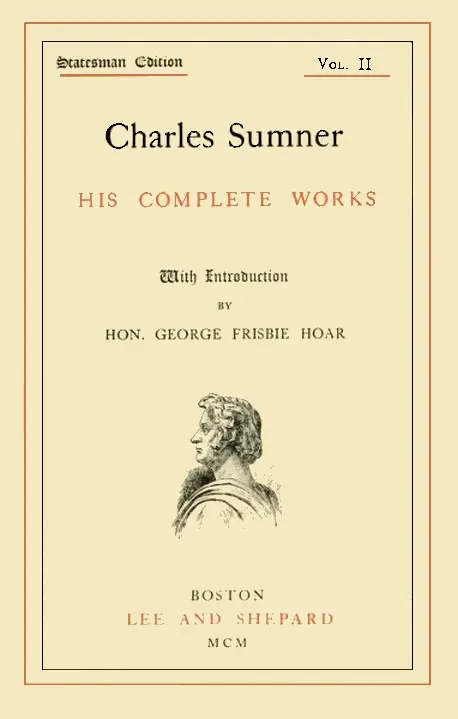
"Charles Sumner: his complete works, volume 02 (of 20)" by Charles Sumner is a historical collection of lectures, speeches, and writings written in the mid-19th century. This volume prominently tackles the theme of slavery, with particular focus on the injustices of both white slavery in the Barbary States and black slavery in America. It features a range of oratory efforts, advocating for human rights and the abolition of slavery as a moral and political imperative. The opening of this volume presents a lecture given by Sumner titled "White Slavery in the Barbary States," which elaborates on the historical context and moral implications of slavery both historically and in his contemporary society. He explores the origins and definitions of slavery, emphasizing that it is rooted in violence and force rather than justice or rights. Through this lens, he compares the plight of enslaved whites in North Africa to that of enslaved African Americans, revealing the complexities and shared horrors of servitude. The preliminary narrative sets the stage for a deeper investigation into the concepts of freedom, justice, and progress, positioning the fight against slavery as a universal human struggle.
Introduction adapted from the source catalogue; source summaries may be automatically generated.
Free to read · English · 122,700 words · No account needed
MAKE TIME FOR A GOOD BOOK
On by default. Untick to stop anonymous reading totals. Each page counts after 10 seconds in view. How this works.
Anonymous counting is on unless you have switched it off.
The cruelty and inhumanity which flourished in the Republic professing freedom enjoyed a natural home under Emperors who were the high-priests of despotism. Wealth increased, and with it the multitude of slaves. Some masters are said to have owned as many as ten thousand, while extravagant prices were often paid for them, according to fancy or caprice. Martial mentions handsome boys sold for as much as two hundred thousand sesterces each, or more than eight thousand dollars.[18] On the assassination of Pedanius Secundus by one of his slaves, no less than four hundred were put to death,--an orator in the Senate arguing that these hecatombs were in accordance with ancient custom.[19]
[18] Epig. III. 62.
[19] Tacitus, Ann., XIV. 43.
It is easy to believe that slavery, which prevailed so largely in Greece and Rome, must have existed in Africa. Here, indeed, it found a peculiar home. If we trace the progress of this unfortunate continent from those distant days of fable when Jupiter did not
"disdain to grace
The feasts of Æthiopia's blameless race,"[20]
the merchandise in slaves will be found to have contributed to the abolition of two hateful customs, once universal in Africa,--the eating of captives, and their sacrifice to idols. Thus, in the march of civilization, even the barbarism of slavery is an important stage of Human Progress. It is a point in the ascending scale from cannibalism.
[20] Iliad. tr. Pope, Book I., 556, 557.
In the early periods of modern Europe slavery was a general custom, which yielded only gradually to the humane influences of Christianity. It prevailed in all the countries of which we have any records. Fair-haired Saxon slaves from distant England arrested the attention of Pope Gregory in the markets of Rome, and were by him hailed as Angels. A law of so virtuous a king as Alfred ranks slaves with horses and oxen; and the Chronicles of William of Malmesbury show that in our mother country there was once a cruel slave-trade in whites. As we listen to this story, we shall be grateful again to that civilization which renders such outrage more and more impossible. "Directly opposite to the Irish coast," he says, "there is a seaport called Bristol, the inhabitants of which frequently sent into Ireland to sell those people whom they had bought up throughout England. They exposed to sale girls in a state of pregnancy, with whom they made a sort of mock marriage. There you might see with grief, fastened together by ropes, whole rows of wretched beings of both sexes, of elegant forms, and in the very bloom of youth,--a sight sufficient to excite pity even in barbarians,--daily offered for sale to the first purchaser. Accursed deed! infamous disgrace! that men, acting in a manner which brute instinct alone would have forbidden, should sell into slavery their relations, nay, even their own offspring!"[21] From still another chronicler we learn, that, in 1172, when Ireland was afflicted with public calamities, there was a great assembly of the principal men, chiefly of the clergy, who concluded, as well they might, that these evils were sent upon their country for the reason that they had formerly purchased English boys as slaves, contrary to the right of Christian liberty,--the poor English, to supply their wants, being "accustomed to sell even their own children, not to bring them up": wherefore, it is said, the English slaves were allowed to depart in freedom.[22] Earlier in Irish history a boy was stolen from Scotland, who, after six years of bondage, succeeded in reaching his home, when, entering the Church, he returned to Ireland, preached Christianity, and, as St. Patrick, became the patron saint of that beautiful land.[23]
Your reading position is saved on this browser. Take it to another device with a library code. Reading pages adapt to text, rather than matching a printed edition.
Charles Sumner

Charles Sumner

Charles Sumner

Charles Sumner
BEHIND THE BOOK
This eBook is for the use of anyone anywhere in the United States and most other parts of the world at no cost and with almost no restrictions whatsoever. You may copy it, give it away or re-use it under the terms of the Project Gutenberg License included with this eBook or online at www.gutenberg.org. If you are not located in the United States, you will have to check the laws of the country where you are located before using this eBook. Read the source licence.
The original source file, including credits and licence, is retained by this library. Request an original-format copy at no charge. Please include the book title and Project Gutenberg identifier #45473.
KEEP YOUR CURIOSITY GOING

David Patterson (Spirit) Hatch

David Patterson (Spirit) Hatch

David Patterson (Spirit) Hatch
Cécile Tormay

Moritz Busch
John L. Ransom