THE CLASSIC COLLECTION✦A dead man’s diaryCLASSIC FREE BOOKS
A dead man’s diary
Coulson Kernahan
THE CLASSIC COLLECTION · 1853
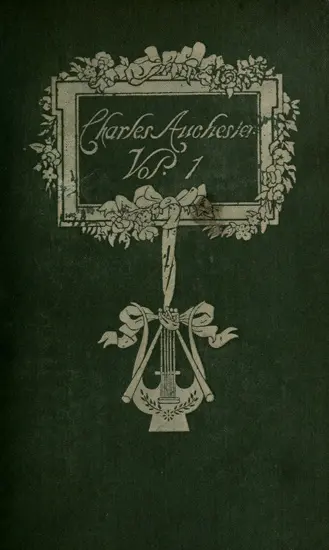
"Charles Auchester, Volume 1 (of 2)" by Elizabeth Sara Sheppard is a novel published in 1853. The story centers on a gifted circle of musicians in England and Germany, narrated by the title character. At its heart is the Chevalier Seraphael, an idealized portrait of composer Felix Mendelssohn, whose artistic and moral influence shapes his talented friends and students. Notable for its positive portrayal of Jewish musicality, the novel explores music's transformative power and remained popular for over seventy years.
Introduction adapted from the source catalogue; source summaries may be automatically generated.
Free to read · English · 91,758 words · No account needed
MAKE TIME FOR A GOOD BOOK
On by default. Untick to stop anonymous reading totals. Each page counts after 10 seconds in view. How this works.
Anonymous counting is on unless you have switched it off.
I knew enough of German to interpret these, at all events, and as I
stood they passed into my being by conviction, they being indeed
truth.
Clara approached me. "Are you satisfied? Music is medicine, though,
I think; do not you?"
She smiled with sweet mischief.
"Oh, Miss Benette, thank you a thousand times! for whether it is to be true or not, I think it is a very good fortune to be told. Has she told you yours?"
"Yes, often; at least as much as she told you about yourself, she has
revealed to me."
"Can she tell all people their fortunes?"
"I will ask her."
She turned to our bright Fate and spoke. On receiving a short, low reply, as Thone left the room, she again addressed me. "She says, 'I cannot prophesy for the pure English, if there be any, because the letters of their characters are not distinct. All I know in all, is how much there is of ours in each.'"
"I don't know what she means."
"No more do I."
"Oh, Miss Benette, you do!" For her arch smile fluttered over her
lips.
"So I do; but, Master Auchester, it is getting very late,--you must go, unless I may give you some tea. And your mother would like you to be home. Therefore, go now."
I wanted to shake hands with her, but she made no show of willingness, so I did not dare, and instantly I departed. What a wonderful spell it was that bound me to the dull lane at the end of the town! Certainly it is out of English life in England one must go for the mysteries and realities of existence. I was just in time for our tea. As I walked into the parlor the fire shone, and so did the kettle, singing to itself; for in our English life we eschewed urns. Clo was reading, Lydia at the board, Millicent was cutting great slices of homemade bread. I thought to myself, "How differently we all manage here! If Millicent did but dare, I know she would behave and talk like Miss Benette."
"How is the young lady this afternoon, Charles? I wish you to ask her to come and drink tea with us on Sunday after service."
"Yes, mother; is Mr. Davy coming?"
"He promised the other night."
"And Charles," added Clo, "do not forget that you must go with me to-morrow and be measured for a jacket."
"I am to wear one at last, then?"
"Yes, for now you are really growing too tall for frocks."
Your reading position is saved on this browser. Take it to another device with a library code. Reading pages adapt to text, rather than matching a printed edition.
BEHIND THE BOOK
This eBook is for the use of anyone anywhere in the United States and most other parts of the world at no cost and with almost no restrictions whatsoever. You may copy it, give it away or re-use it under the terms of the Project Gutenberg License included with this eBook or online at www.gutenberg.org. If you are not located in the United States, you will have to check the laws of the country where you are located before using this eBook. Read the source licence.
The original source file, including credits and licence, is retained by this library. Request an original-format copy at no charge. Please include the book title and Project Gutenberg identifier #38949.
KEEP YOUR CURIOSITY GOING
Coulson Kernahan

Maurice Baring
Frances Wright
Cécile Tormay

Frederic Jesup Stimson

W. H. P. (William Henry Pope) Jarvis