THE CLASSIC COLLECTION✦An American tragedy, v. 2CLASSIC FREE BOOKS
An American tragedy, v. 2
Theodore Dreiser
THE CLASSIC COLLECTION · 1927
"Chains: Lesser Novels and Stories" by Theodore Dreiser is a collection of narratives exploring themes of poverty, despair, and the human condition, likely written in the late 19th century. The book delves into the struggles of individuals trapped in dire circumstances, highlighting the difficulties faced by characters like Madeleine Kinsella, who navigates a harsh urban environment while grappling with her family's dysfunction and her own yearning for a better life. The opening of the book introduces Madeleine's grim existence in a rundown tenement, where the atmosphere is permeated by violence, drunkenness, and pervasive poverty. We learn about her oppressive family dynamics, marked by her father's alcoholism and her mother's neglect, which force her into a role of caretaker at an early age. As she grows, Madeleine's hope for a better life and love becomes evident; however, her encounters with the world are fraught with difficulties, leading her to questionable choices in search of escape. The narrative sets the stage for an exploration of her internal and external struggles as she faces the grim realities of her environment and the impacts of her circumstances on her future.
Introduction adapted from the source catalogue; source summaries may be automatically generated.
Free to read · English · 149,662 words · No account needed
MAKE TIME FOR A GOOD BOOK
On by default. Untick to stop anonymous reading totals. Each page counts after 10 seconds in view. How this works.
Anonymous counting is on unless you have switched it off.
“Yea, I have heard of such, in fairy-tales,” sighed Chudi, the baker, whose wife was as parchment that has cracked with age.
“And I, behind the walls of palaces and in far cities, but never here,” added Zad-el-Din, for neither his wife nor his daughters was any too fair to look upon. “They come not to Hodeidah.”
“Ay-ee, were any so beautiful,” sighed Al Tadjaz, “there would be no man worthy. But there are none.”
“Peace!” cried Ahmed. “Let us have the tale.”
“Yea, before he thinks him to plead for more anna,” muttered Hadjaz,
the sweeper, softly.
But Gazzar, not to be robbed of this evidence of interest, was already astir. Even as they talked he held out the tambour, crying: “Anna, anna, anna!” But so great was the opposition that he dared not persist.
“Dog!” cried Waidi. “Wilt thou never be satisfied? There is another for thee, but come no more.”
“Thou miser!” said Haifa, still greatly interested, “tell thy tale and
be done!”
“The thief has rupees and to spare, I warrant,” added Scudi,
contributing yet another anna.
And Zad-el-Din and Ahmed, because they were lustful of the great beauty of Yanee, each added an anna to his takings.
“Berate me not, O friends,” pleaded Gazzar tactfully, hiding his anna in his cloak, “for I am as poor as thou seest—a son of the road, a beggar, a wanderer, with nowhere to lay my head. Other than my tales I have nothing.” But seeing scant sympathy in the faces of his hearers, he resumed.
“Now at the time that Abou was in charge of the dark bazaar it chanced that the caliph, who annually arranged for the departure of his daughter for the mountains which are beyond Azol in Bactria, where he maintained a summer palace of great beauty, sent forth a vast company mounted upon elephants and camels out of Ullar and Cerf and horses of the rarest blood from Taif. This company was caparisoned and swathed in silks and thin wool and the braided and spun cloth of Esher and Bar with their knitted threads of gold. And it made a glorious spectacle indeed, and all paused to behold. But it also chanced that as this cavalcade passed through the streets of Baghdad, Abou, hearing a great tumult and the cries of the multitude and the drivers and the tramp of the horses’ feet and the pad of the camels’, came to the door of his bazaar, his robes of silk about him, a turban of rare cloth knitted with silver threads upon his head. He had now grown to be a youth of eighteen summers. His hair was as black as the wing of the duck, his eyes large and dark and sad from many thoughts as is the pool into which the moon falls. His face and hands were tinted as with henna when it is spread very thin, and his manners were graceful and languorous. As he paused within his doorway he looked wonderingly at the great company as it moved and disappeared about the curves of the long street. And it could not but occur to him, trained as he was, how rich would be the prize could one but seize upon such a company and take all the wealth that was here and the men and women as slaves.
Your reading position is saved on this browser. Take it to another device with a library code. Reading pages adapt to text, rather than matching a printed edition.
Theodore Dreiser
Theodore Dreiser
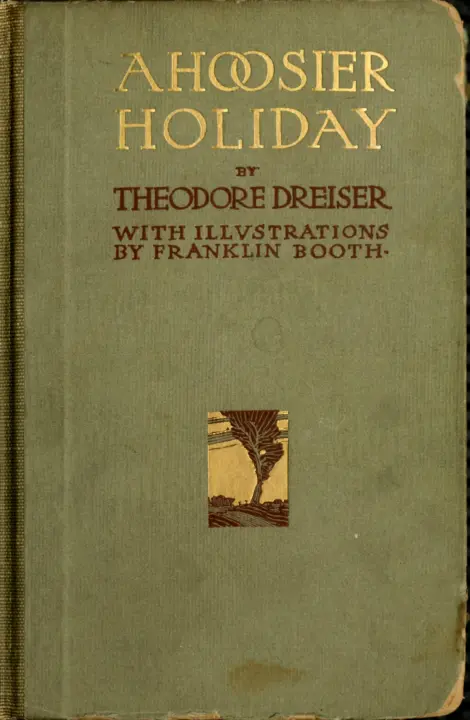
Theodore Dreiser

Theodore Dreiser
BEHIND THE BOOK
This eBook is for the use of anyone anywhere in the United States and most other parts of the world at no cost and with almost no restrictions whatsoever. You may copy it, give it away or re-use it under the terms of the Project Gutenberg License included with this eBook or online at www.gutenberg.org. If you are not located in the United States, you will have to check the laws of the country where you are located before using this eBook. Read the source licence.
The original source file, including credits and licence, is retained by this library. Request an original-format copy at no charge. Please include the book title and Project Gutenberg identifier #72326.
KEEP YOUR CURIOSITY GOING
Coulson Kernahan

Maurice Baring
Frances Wright
Cécile Tormay

Frederic Jesup Stimson

W. H. P. (William Henry Pope) Jarvis