THE CLASSIC COLLECTION✦An outlaw’s diary: the CommuneCLASSIC FREE BOOKS
An outlaw’s diary: the Commune
Cécile Tormay
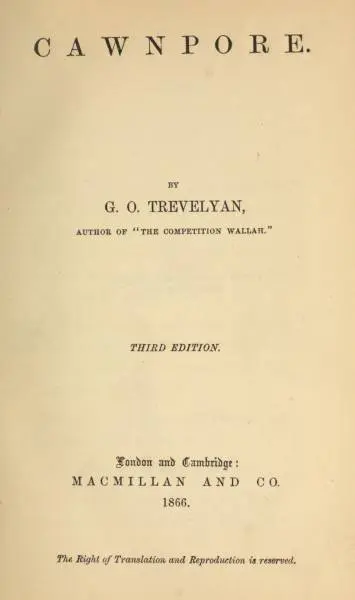
THE CLASSIC COLLECTION · 1866
"Cawnpore" by George Otto Trevelyan is a historical account written in the mid-19th century. The book delves into the events surrounding the violent upheaval at Cawnpore during the Indian Rebellion of 1857, focusing on the tensions between British colonial forces and local sepoy troops. Trevelyan's exploration is rich in details, particularly regarding the complexities of colonial power dynamics and human relationships in a time of growing unrest." "The opening of "Cawnpore" introduces the geographical and historical context of Cawnpore, emphasizing its significance as a military station and detailing the diverse population comprising British soldiers, civilians, and native troops. Trevelyan sets the stage for the looming crisis by discussing the uneasy state of relations between these groups, highlighting the underlying tensions festering among the sepoys. As the narrative unfolds, there are hints at unrest due to a combination of various grievances, including rumors about greased cartridges and other perceived insults to religious faiths, laying the groundwork for the insurrection that is to come."
Introduction adapted from the source catalogue; source summaries may be automatically generated.
Free to read · English · 82,027 words · No account needed
MAKE TIME FOR A GOOD BOOK
On by default. Untick to stop anonymous reading totals. Each page counts after 10 seconds in view. How this works.
Anonymous counting is on unless you have switched it off.
When the new-comers caught sight of the fortress which had hitherto baffled the ingenuity and courage of their associates, they expressed no small contempt for the generalship of the Nana, but bade him be at his ease, for that they would engage to put him in possession of the intrenchment after they had enjoyed a day's rest and surfeit. And so, on the eighteenth of June, at the hour when, exactly two and forty years before, the French tirailleurs were swarming through the woods of Hougoumont up to the loopholes of the wall which they never passed, the Oude mutineers charged in a mass across the plain, and over our rampart; bore down the defenders; overturned a gun; and seemed for a moment in a fair way of justifying their vaunt. A moment only: for, without waiting for orders, angry Sahibs came running from all sides to the rescue. Our people slewed round a nine-pounder; gave them first some stockingfuls of grape, and then an English rush; and sent them back to their master fewer and wiser than they came.
The rebel position presented an aspect animated and picturesque in a high degree. To the north of our fortification, between the Racket-court and the Chapel of Ease, was planted a battery well armed with mortars and twenty-four pounder cannon. In this region the command was taken by the Nunhey Nawab, the Mahomedan grandee, who, with Bakur Ali, and others, had been plundered and imprisoned by the Brahmins during their first outbreak of religious spite. The high-spirited Moslem soldiery at once refused to brook this outrage, and began to talk of setting up the Nawab's claim to royalty against that of the Maharaja: upon which the latter released his prisoners, and thenceforward behaved towards them rather as an equal than as a master. The Nana's rival showed both judgment and vigour. He beat up all the pensioned veterans of the neighbourhood who had formerly served in the artillery, and employed work-people of both sexes in keeping him supplied with red-hot shot. On one occasion an apprentice to the trade took it into his head to try the experiment of heating a loaded shell, and succeeded in blowing up a woman and five men, including, we may presume, himself. The Nawab passed most of his time in the gallery of the Racket-court, where, in the late afternoon of more quiet days, had lolled a cluster of chatty Englishmen; opening bottles of soda-water; chaffing the players with the threadbare raillery that suffices for the simple taste of a limited community; descending in parties of four, cheroot in mouth, when the cry of "game-ball all" warned them that their turn was come. Occasionally he would issue forth to see how his gunners were getting on, and to watch the effect of their practice through a telescope. A half-caste Christian, who had disguised himself as a Mahomedan with admirable skill, gives an interesting account of what passed in this quarter. He says, "I saw Nunhey Nawab coming to the batteries accompanied by a number of troopers, and sepoys, and his own attendants also; and I was told by the people that the Nawab had received a post of great dignity, and was in command of a battery. About one o'clock I came close to Major-General Wheeler's bungalow, and, finding a piece of mat in the compound, lay down on it, and saw several troopers going about, forcing people to carry water to the batteries. Hearing an uproar I rose from the place where I was, when a trooper, seeing me, told me that it was a great shame for a young Mussulman like me to be thus idling away my time, and that I should assist at the batteries. He also told me that a young man, the son of Kurrum Ali, the one-eyed, a pensioned soubahdar, was sent for by the Nawab, and had laid a gun so precisely that the shot carried away a portion of one of the barracks within the intrenchment, for which he received a reward of ninety rupees, and a shawl. I replied to this that I possessed no arms, and had never been a soldier." It was no wonder that a battery where the service was conducted on so open-handed a system soon became the popular resort. The lovely Azeezun made this spot her head-quarters. She appears to have exercised a strange fascination over our good friend Nanukchund, so frequently does she appear in the course of his narrative. Whether he cherished towards her a sneaking kindness; or a grudge for some past incivility; or, as is most probable, both the one and the other, he certainly never leaves her alone for many pages together. In his quaint way he writes:--"It shows great daring in Azeezun, that she is always armed and present in the batteries, owing to her attachment to the cavalry; and she takes her favourites among them aside, and entertains them with milk, &c. on the public road."
Your reading position is saved on this browser. Take it to another device with a library code. Reading pages adapt to text, rather than matching a printed edition.
BEHIND THE BOOK
This eBook is for the use of anyone anywhere in the United States and most other parts of the world at no cost and with almost no restrictions whatsoever. You may copy it, give it away or re-use it under the terms of the Project Gutenberg License included with this eBook or online at www.gutenberg.org. If you are not located in the United States, you will have to check the laws of the country where you are located before using this eBook. Read the source licence.
The original source file, including credits and licence, is retained by this library. Request an original-format copy at no charge. Please include the book title and Project Gutenberg identifier #51383.
KEEP YOUR CURIOSITY GOING
Cécile Tormay

Moritz Busch
John L. Ransom
Frances Wright
Cécile Tormay

Mabel Potter Daggett