THE CLASSIC COLLECTION✦An outlaw’s diary: the CommuneCLASSIC FREE BOOKS
An outlaw’s diary: the Commune
Cécile Tormay
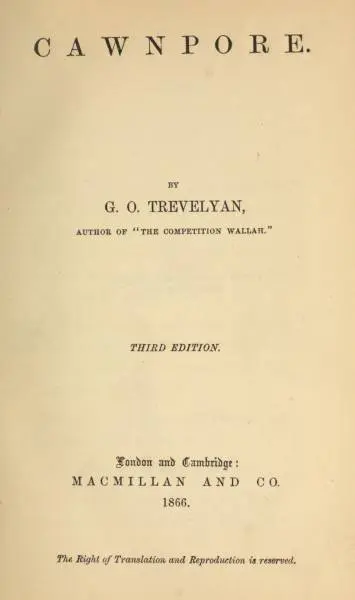
THE CLASSIC COLLECTION · 1866
"Cawnpore" by George Otto Trevelyan is a historical account written in the mid-19th century. The book delves into the events surrounding the violent upheaval at Cawnpore during the Indian Rebellion of 1857, focusing on the tensions between British colonial forces and local sepoy troops. Trevelyan's exploration is rich in details, particularly regarding the complexities of colonial power dynamics and human relationships in a time of growing unrest." "The opening of "Cawnpore" introduces the geographical and historical context of Cawnpore, emphasizing its significance as a military station and detailing the diverse population comprising British soldiers, civilians, and native troops. Trevelyan sets the stage for the looming crisis by discussing the uneasy state of relations between these groups, highlighting the underlying tensions festering among the sepoys. As the narrative unfolds, there are hints at unrest due to a combination of various grievances, including rumors about greased cartridges and other perceived insults to religious faiths, laying the groundwork for the insurrection that is to come."
Introduction adapted from the source catalogue; source summaries may be automatically generated.
Free to read · English · 82,027 words · No account needed
MAKE TIME FOR A GOOD BOOK
On by default. Untick to stop anonymous reading totals. Each page counts after 10 seconds in view. How this works.
Anonymous counting is on unless you have switched it off.
As soon as the Rubicon of insurrection had been passed; as soon as the gauntlet of sedition had been thrown; the first care of the mutineers was to get rid of all who had been the witnesses of their guilt, and who might hereafter be the judges. No sepoy felt secure of his neck and plunder as long as one solitary Englishman remained on Indian soil; for our revolted mercenaries shared to the full that strange mixture of veneration, bewilderment, aversion, and terror, with which our Eastern subjects still regard that extraordinary people who, in the course of a single decade, expanded from a handful of clerks and factors to a galaxy of warriors and proconsuls. It is hardly possible for a man brought up amidst European scenes and associations to realize the idea conceived of him and his countrymen by a thoroughbred Hindoo. On the one hand, the natives must acknowledge our vast superiority in the arts of war and rule. Our railways, and steamships, and Armstrong guns, are tangible facts which cannot be slighted. They must be perfectly alive to the knowledge that we have conquered them, and are governing them in a more systematic and downright manner than they have ever been governed before. But, on the other hand, many of our usages must appear in their eyes most debased and revolting. It is difficult to imagine the horror with which a punctilious and devout Brahmin cannot but regard a people who eat the flesh of cow and pig, and drink various sorts of strong liquors from morning till night. It is at least as hard for such a man to look up to us as his betters, morally and socially, as it would be for us to place among the most civilized nations of the world a population which was in the habit of dining on human flesh, and intoxicating itself daily with laudanum and salvolatile. The peculiar qualities which mark the Englishman are peculiarly distasteful to the Oriental, and are sure to be widely distorted when seen from his point of view. Our energy and earnestness appear oppressive and importunate to the languid, voluptuous aristocracy of the East. Our very honesty seems ostentatious and contemptible to the wily and tortuous Hindoo mind. That magnificent disregard of les convenances, which among Continental nations is held to be a distinguishing mark of our countrymen, is inexplicable and hateful to a race who consider external pomp and reticent solemnity to be the necessary accompaniments of rank, worth, and power. Add the mysterious awe by which we are shrouded in the eyes of the native population, which very generally attributes to magic our uniform success in everything we take in hand, and you will have some notion of the picture presented to the Brahmin imagination by an indefatigable, public-spirited, plain-spoken, beer-drinking, cigar-smoking, tiger-shooting, public servant. We should not be far wrong if we were content to allow that we are regarded by the natives of Hindostan as a species of quaint and somewhat objectionable demons, with a rare aptitude for fighting and administration; foul and degraded in our habits, though with reference to those habits not to be judged by the same standard as ordinary men; not altogether malevolent, but entirely wayward and unaccountable; a race of demi-devils, neither quite human, nor quite supernatural; not wholly bad, yet far from perfectly beneficent; who have been settled down in the country by the will of fate, and seem very much inclined to stay there by our own. With this impression on his mind the Bengal sepoy desired with a nervous and morbid anxiety to get quit of the Sahibs by fair means or foul. He did not care to expose us to unnecessary misery and humiliation; to torture our men, or to outrage our women. His sole object was to see the last of us: to get done with us for good and for ever. Ignorant beyond conception of European geography and statistics, he had convinced himself that, if once the Anglo-Indians of every sex and age were killed off, from the Governor General to the serjeant-major's baby, there did not exist the wherewithal to replace them. And therefore he said in his heart: "Come, and let us destroy them together. Let us cut them off from being a nation, that their name may be no more in remembrance." He conceived that Great Britain had been drained dry of men to recruit the garrison of our Asiatic empire; that our home population consisted of nurses and children, of invalids who had left the East for a while in quest of health, and veterans who had retired to live at ease on their share of the treasures of Hindostan. He fancied that the tidings of a general massacre of our people would render our island a home of helpless mourners: he found that those tidings changed it into a nest of reckless and pitiless avengers. He believed our power to be a chimera, and he discovered it to be a hydra. He learned too late that he had digged a pit for himself, and had fallen into the ditch which he had made; that his mischief and his violent dealings had come down upon his own head: that Englishmen were many, and that, when the occasion served, their feet too were not slow to shed blood: that our soldiers could kill within the year more heathen than our missionaries had converted in the course of a century: that our social science talk about the sacredness of human life, and our May Meeting talk concerning our duty towards those benighted souls for whom Christ died, meant that we were to forgive most of those who had never injured us, plunder none but such as were worth robbing, and seldom hang an innocent Hindoo if we could catch a guilty one: that the great principles of mercy and justice and charity must cease to be eternally true until the injured pride of a mighty nation had been satisfied, its wrath glutted, and its sway restored.
Your reading position is saved on this browser. Take it to another device with a library code. Reading pages adapt to text, rather than matching a printed edition.
BEHIND THE BOOK
This eBook is for the use of anyone anywhere in the United States and most other parts of the world at no cost and with almost no restrictions whatsoever. You may copy it, give it away or re-use it under the terms of the Project Gutenberg License included with this eBook or online at www.gutenberg.org. If you are not located in the United States, you will have to check the laws of the country where you are located before using this eBook. Read the source licence.
The original source file, including credits and licence, is retained by this library. Request an original-format copy at no charge. Please include the book title and Project Gutenberg identifier #51383.
KEEP YOUR CURIOSITY GOING
Cécile Tormay

Moritz Busch
John L. Ransom
Frances Wright
Cécile Tormay

Mabel Potter Daggett