THE CLASSIC COLLECTION✦An outlaw’s diary: the CommuneCLASSIC FREE BOOKS
An outlaw’s diary: the Commune
Cécile Tormay
THE CLASSIC COLLECTION · 1866
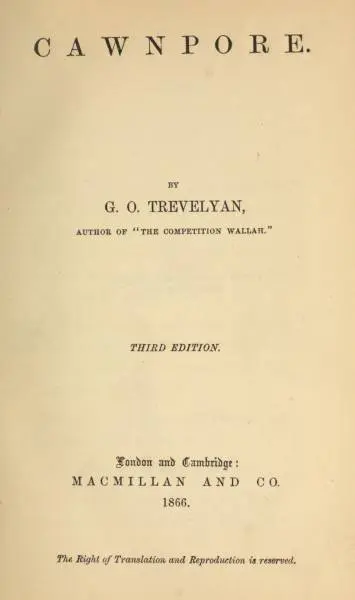
"Cawnpore" by George Otto Trevelyan is a historical account written in the mid-19th century. The book delves into the events surrounding the violent upheaval at Cawnpore during the Indian Rebellion of 1857, focusing on the tensions between British colonial forces and local sepoy troops. Trevelyan's exploration is rich in details, particularly regarding the complexities of colonial power dynamics and human relationships in a time of growing unrest." "The opening of "Cawnpore" introduces the geographical and historical context of Cawnpore, emphasizing its significance as a military station and detailing the diverse population comprising British soldiers, civilians, and native troops. Trevelyan sets the stage for the looming crisis by discussing the uneasy state of relations between these groups, highlighting the underlying tensions festering among the sepoys. As the narrative unfolds, there are hints at unrest due to a combination of various grievances, including rumors about greased cartridges and other perceived insults to religious faiths, laying the groundwork for the insurrection that is to come."
Introduction adapted from the source catalogue; source summaries may be automatically generated.
Free to read · English · 82,027 words · No account needed
MAKE TIME FOR A GOOD BOOK
On by default. Untick to stop anonymous reading totals. Each page counts after 10 seconds in view. How this works.
Anonymous counting is on unless you have switched it off.
There was no time to be lost. While the commanders of the various posts were choosing their parties, and placing their sentries, and dispensing their share of the arms and ammunition, already the roar of great guns, and the clouds of black smoke rising fast and frequent in the north-west quarter, told them that the warning of the Nana was no empty menace. As when, during some great hurricane, such as of late passed o'er pale Calcutta, the tidal wave comes surging up the river, unlooked for and irresistible, leaving in its track desolation and ruin, the wrecks of ships and the corpses of men--so on that morning, over doomed Cawnpore, swept the returning flood of mutiny and misrule. At break of day the whole rebel array poured down the Delhi road in a compact body, with the Maharaja at their head, who had good reason to be proud of his following. It was a force which would have done credit to any Mahratta chief in the palmiest days of that redoubted race. There was an entire regiment of excellent cavalry, well mounted and equipped. There was a detachment of gunners and drivers from the Oude Artillery, who had been despatched as a loan from Lucknow to Cawnpore, just in time to enable them to take part in the revolt. There were the Nana's own myrmidons, who made up by attachment to his cause what they wanted in military skill. Lastly, there were three fine battalions of Bengal sepoys, led by experienced sepoy officers, armed with English muskets, and trained by English discipline. When the mutineers arrived at the outskirts of the station, Teeka Sing, the General, postponing his private gain and malice to the public good, repaired at once to the magazine, and spent the morning in securing a fleet of thirty boats which lay beneath the walls, laden with shot, shell, and heavy cannon. The guns in serviceable order he sent off towards the intrenchment on carriages drawn by Government bullocks; and those which were not in condition for immediate use, he compelled the artificers of the establishment to brush up on the Government lathes. But the main body of the insurgents displayed no such foresight or self-control. They kept close order no longer, but spread themselves out to the right and left, and, robbing, burning, and murdering as they went, bore southwards over the civil quarter and the native city. Sir George Parker and a party of his friends, who, inobservant of the coming storm, were lingering over their last breakfast in his pleasant villa, had barely time to fly for their lives. Four office-clerks, who lived together in a shop on the banks of the canal, after a valiant resistance, were smoked out of their lodging, and slain as they fled. The troopers of the Second Cavalry galloped up and down the lanes of the black town, hunting for Englishmen; and the low-caste Mahomedans of the bazaar--the sword-polishers, the cotton-spinners, and the dealers in silver ornaments--joined eagerly in the chase. One European was run down and worried to death in a garden. Another, a gentleman advanced in age, had concealed himself in a hut near the posting-house, in company with his wife, his little daughter, and his son, a boy of sixteen years. The wretched family were tracked to their hiding-place, arrested, and dragged before the Nana, who ordered them for instant execution; and they were happy at least in this, that they died together, and without delay. Proclamation was made that every building in which shelter had been given to Europeans, Eurasians, or Christians of any extraction, should first be plundered, and then razed to the ground. This announcement provided the rebels with a pretext for breaking open and ransacking the dwellings of many respectable natives. Buddree Nath, the commissariat contractor, who was accused of secreting Lady Wheeler and her daughters, lost the savings of a lifetime in the course of a single hour. The scum of the city made the most of their period of licence, and, when any portable property came in their way, took good care not to inquire very closely into the creed of the owner. Among others, the King of Oude is supposed to have suffered a heavy loss. Forty thousand rupees belonging to a Hindoo merchant were taken from a cart which stood in the premises of the post-office, and removed into the most blackguard districts of the neighbourhood. A gang of cavalry soldiers went down the Street of Silver, the main thoroughfare of the town, beating in the doors of the cloth-merchants and money-changers, insulting the trembling tradesmen, and carrying off all the valuables on which they could lay their hands. Meanwhile, those mutineers whose religious spite overcame their desire for lucre, were deriving intense enjoyment from the occupation of cannonading the church. Another large company of Brahmin sepoys, whose orthodox indignation took a more practical turn, and could not content itself with the somewhat tame pastime of persecuting senseless brick and plaster, marched off to the Mahomedan quarter; bombarded the residence of the Nunhey Nawab, the most influential Mussulman noble of the vicinity; blew open the gates; smashed the glass-ware and the porcelain; appropriated the contents of the wardrobe and the plate-chest; and told the master of the house to consider himself a prisoner. They then proceeded to take into custody other leading gentlemen of the same persuasion, and returned to the Nana loaded with spoil, and followed by a line of sedan-chairs containing the persons of their captives.
Your reading position is saved on this browser. Take it to another device with a library code. Reading pages adapt to text, rather than matching a printed edition.
BEHIND THE BOOK
This eBook is for the use of anyone anywhere in the United States and most other parts of the world at no cost and with almost no restrictions whatsoever. You may copy it, give it away or re-use it under the terms of the Project Gutenberg License included with this eBook or online at www.gutenberg.org. If you are not located in the United States, you will have to check the laws of the country where you are located before using this eBook. Read the source licence.
The original source file, including credits and licence, is retained by this library. Request an original-format copy at no charge. Please include the book title and Project Gutenberg identifier #51383.
KEEP YOUR CURIOSITY GOING
Cécile Tormay

Moritz Busch
John L. Ransom
Frances Wright
Cécile Tormay

Mabel Potter Daggett