THE CLASSIC COLLECTION✦An outlaw’s diary: the CommuneCLASSIC FREE BOOKS
An outlaw’s diary: the Commune
Cécile Tormay
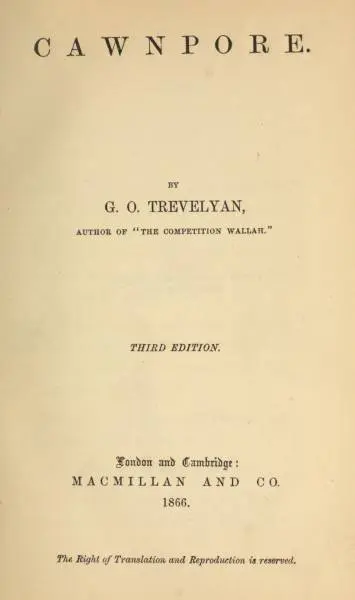
THE CLASSIC COLLECTION · 1866
"Cawnpore" by George Otto Trevelyan is a historical account written in the mid-19th century. The book delves into the events surrounding the violent upheaval at Cawnpore during the Indian Rebellion of 1857, focusing on the tensions between British colonial forces and local sepoy troops. Trevelyan's exploration is rich in details, particularly regarding the complexities of colonial power dynamics and human relationships in a time of growing unrest." "The opening of "Cawnpore" introduces the geographical and historical context of Cawnpore, emphasizing its significance as a military station and detailing the diverse population comprising British soldiers, civilians, and native troops. Trevelyan sets the stage for the looming crisis by discussing the uneasy state of relations between these groups, highlighting the underlying tensions festering among the sepoys. As the narrative unfolds, there are hints at unrest due to a combination of various grievances, including rumors about greased cartridges and other perceived insults to religious faiths, laying the groundwork for the insurrection that is to come."
Introduction adapted from the source catalogue; source summaries may be automatically generated.
Free to read · English · 82,027 words · No account needed
MAKE TIME FOR A GOOD BOOK
On by default. Untick to stop anonymous reading totals. Each page counts after 10 seconds in view. How this works.
Anonymous counting is on unless you have switched it off.
At the time of the mutiny the Nana was about thirty-six years of age. His complexion was sallow; his features strongly marked, and not unpleasing. Like all Mahrattas, both head and face were shaven clean. He was fat with that unhealthy corpulence which marks the Eastern voluptuary. The circumstances under which a young Rajah comes to maturity leave him a very scant chance of obtaining perfection, moral or physical. From his earliest years he is surrounded by flatterers and pandars. While still a child in the harem, it is the object of every one, beginning with his own mother, to obtain his ear by adulation, and by the freemasonry of corrupt discourse. During his boyhood he has no little peers on whom to exert his faculties for emulation and self-denial; and, when he has arrived at man's estate, he may look in vain for any object of honourable ambition amidst the dead level of national dependence. He never walks, save from his divan to his bath; never mounts one of the huge cream-coloured steeds, which on high feast-days amble behind his palanquin in melancholy cavalcade; never knows the sensation of honest fatigue and wholesome hunger. No whim ungratified; every propensity cherished and pampered; incapable of effort; incognizant of duty; he is vicious with deeper than Parisian immorality, and listless with more than Belgravian ennui. Long before the age at which a high-born Englishman makes his choice of Hercules between balls and blue-books, the effete sensuality of a Hindoo noble is reduced to seek gratification in the illicit charms of Indian hemp and French brandy. What wonder that in middle life he is flabby and gross beyond hope and compass; too feeble for manly exercise, too self-indulgent to practise a self-denying regimen?
The Maharaja of Bithoor exhibited a lively interest in the proceedings of our Government at home and abroad, in our history, our arts, our religion, and our customs; although he was entirely ignorant of our language. He subscribed to all the leading Anglo-Indian journals, which were translated to him daily by an individual who had been unlucky enough to exchange a situation on the East Indian Railroad for the post of English Professor in the household of the Nana. The Rajah played billiards admirably, while he was yet slim enough to bend over the table without inconvenience. He especially delighted in the game, because it afforded him an opportunity for mixing on familiar terms with the officers of the garrison. Nothing could exceed the cordiality which he constantly displayed in his intercourse with our countrymen. The persons in authority placed an implicit confidence in his friendliness and good faith, and the ensigns emphatically pronounced him a capital fellow. He had a nod or a kind word for every Sahib in the station. There were hunting-parties and jewellery for the men, and picnics and shawls for the ladies. If a subaltern's wife required change of air, the Rajah's carriage was at the service of the young couple, and the European apartments at Bithoor were put in order to receive them. If a civilian had overworked himself in court, he had but to speak the word, and the Rajah's elephants were sent on to the Oude jungles. But none the less did he never for an instant forget the grudge which he bore our nation. While his face was all smiles, in his heart of hearts he brooded over the judgment of the Company, and the wrong of his despised claim. From his hour of repulse to his hour of vengeance his life was one long irony. Thenceforward his story would more fitly be told in the wild and mysterious rhythms of the old Greek drama than in sober English prose; for in truth that story finds no parallel, save in the ghastly tales which hang like a mist of blood round the accursed house of Pelops. The lads who, with his sapphires and rubies glistening on their fingers, sat laughing round his Thyestean table, had one and all been doomed to die by a warrant that admitted of no appeal. He had sworn that the injustice should be expiated by the blood of women who had never heard his grievance named;--of babies who had been born years after the question of that grievance had passed into oblivion. The great crime of Cawnpore blackens the page of history with a far deeper stain than Sicilian Vespers, or September massacres: for this atrocious act was prompted, not by diseased and mistaken patriotism, nor by the madness of superstition, nor yet by incontrollable fear that knew not pity. The motives of the deed were as mean as the execution was cowardly and treacherous. Among the subordinate villains there might be some who were possessed by bigotry and class-hatred: but the chief of the gang was actuated by no higher impulses than ruffled pride and disappointed greed.
Your reading position is saved on this browser. Take it to another device with a library code. Reading pages adapt to text, rather than matching a printed edition.
BEHIND THE BOOK
This eBook is for the use of anyone anywhere in the United States and most other parts of the world at no cost and with almost no restrictions whatsoever. You may copy it, give it away or re-use it under the terms of the Project Gutenberg License included with this eBook or online at www.gutenberg.org. If you are not located in the United States, you will have to check the laws of the country where you are located before using this eBook. Read the source licence.
The original source file, including credits and licence, is retained by this library. Request an original-format copy at no charge. Please include the book title and Project Gutenberg identifier #51383.
KEEP YOUR CURIOSITY GOING
Cécile Tormay

Moritz Busch
John L. Ransom
Frances Wright
Cécile Tormay

Mabel Potter Daggett