THE CLASSIC COLLECTION✦An outlaw’s diary: the CommuneCLASSIC FREE BOOKS
An outlaw’s diary: the Commune
Cécile Tormay
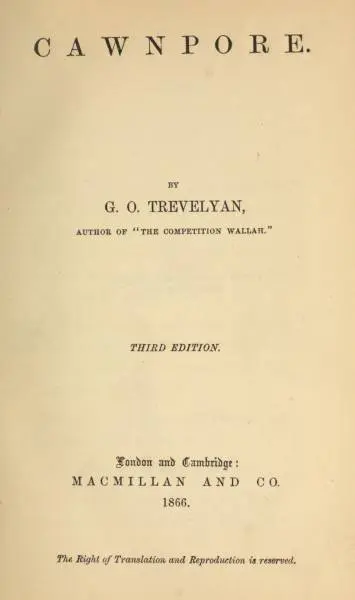
THE CLASSIC COLLECTION · 1866
"Cawnpore" by George Otto Trevelyan is a historical account written in the mid-19th century. The book delves into the events surrounding the violent upheaval at Cawnpore during the Indian Rebellion of 1857, focusing on the tensions between British colonial forces and local sepoy troops. Trevelyan's exploration is rich in details, particularly regarding the complexities of colonial power dynamics and human relationships in a time of growing unrest." "The opening of "Cawnpore" introduces the geographical and historical context of Cawnpore, emphasizing its significance as a military station and detailing the diverse population comprising British soldiers, civilians, and native troops. Trevelyan sets the stage for the looming crisis by discussing the uneasy state of relations between these groups, highlighting the underlying tensions festering among the sepoys. As the narrative unfolds, there are hints at unrest due to a combination of various grievances, including rumors about greased cartridges and other perceived insults to religious faiths, laying the groundwork for the insurrection that is to come."
Introduction adapted from the source catalogue; source summaries may be automatically generated.
Free to read · English · 82,027 words · No account needed
MAKE TIME FOR A GOOD BOOK
On by default. Untick to stop anonymous reading totals. Each page counts after 10 seconds in view. How this works.
Anonymous counting is on unless you have switched it off.
And so it came to pass that to be sent back to head-quarters was "a shame," regimental duty was "a bore," and the sepoys were "niggers." That hateful word, which is now constantly on the tongue of all Anglo-Indians except civilians and missionaries, made its first appearance in decent society during the years which immediately preceded the mutiny. The immorality of the term is only equalled by the absurdity. To call the inhabitants of Hindostan "niggers," is just as unreasonable as it would be for Austrian officials to designate the subject populations of Venetia and Hungary by the collective title of "serfs." In the eyes of an English planter, or railway-contractor, there is no distinction of race or rank. Khoonds and Punjabees, Pariahs and Coolin Brahmins, bazaar-porters and Rajahs with a rent-roll of half a million, and a genealogy longer than that of Howards and Stanleys, are "niggers" alike, one and all, with the prefix of that profane epithet, which has been the Shibboleth of the Englishmen abroad since the days of Philip de Comines. And so, in a Bengal corps,--whether he were a grey-bearded Mahomedan soubahdar, the arbiter and exponent of regimental custom and tradition, or the high-caste Rajpoot, or a Sikh veteran marked with the scars of Sobraon,--every man knew well that he was dubbed "nigger" by some slip of an ensign, who could not tell his right hand from his left in any Oriental language. In such an atmosphere how could mutual attachment exist, or mutual confidence? How could there not exist dislike and disaffection; the bitterness of injured pride, and of feelings misunderstood or heedlessly contemned?
There were usually some eight or nine officers actually doing duty with a battalion. A colonel and doctor, three or four captains and lieutenants, and three or four ensigns, formed what was in those days considered to be a very respectable complement. The other members of the mess were far away from head-quarters, inditing minutes at Calcutta, deciding suits in some distant non-regulation province, or tracking the course of the Nile through the deserts of Nubia. Such, however, was not universally the case. Here and there might be found a corps where the regimental tone (that unwritten and impalpable law, not passed in words, nor enforced by overt penalties, but obeyed in silence and without question), had ordained that staff employment was not a legitimate object of ambition. The officers plumed themselves upon keeping all together, and rising one with another in the ordinary course of promotion. They shot tigers, and speared hogs, and played whist and billiards, and meanwhile looked well after their companies, and contrived to know something about the private history and character of every man under their command. They voted it unfashionable to attempt the pass examination in Hindoostanee, success in which was an indispensable qualification for the staff: an ordeal familiarly known as the P.H.; that pair of consonants which are seldom far from the lips, and never out of the thoughts, of the more aspiring subalterns of the Bengal army. And yet, averse as they were to grammars and dictionaries, these men spoke the vernacular languages with rare facility. But not even to such officers as these was breathed a syllable of that fearful secret, which England would have cheaply bought at the price of a million pounds for a single letter. Their soldiers entertained towards them a strong and genuine regard. It was not among the ranks which they commanded that the spirit of sedition was born and nurtured. But in the day of wrath there was no distinction of person. When the baneful sirocco of mutiny, called by the imaginative Hindoo "the Devil's Wind," was abroad in the air, all milder influences yielded before its withering blast. The consciousness of the authority of the "Fouj ki Bheera," or "general will of the army," was to individual men, or regiments, almost irresistible. Some troopers in Fisher's Irregular Cavalry performed a signal act of gallantry at Lucknow, during the early days of the outbreak, for which they received a handsome reward. While waiting for their money in the verandah of the commissioner's house, they fell into conversation with certain of their fellow-villagers among his servants. "We like our colonel," said they, "and will not allow him to be harmed; but, if the whole army turns, we must turn too." A week elapsed, and these men looked quietly on from their saddles, while Colonel Fisher was shot to death by a scoundrel in the lines of the military police. Then they threw aside all semblance of discipline; murdered the second in command; and shouted to the adjutant, who was a general favourite, to ride and begone, if he desired to spare them the pain of taking his life. At one large station the men were in open mutiny, and the officers had grouped themselves in front of the battalion, expecting every moment the fatal volley. They agreed, however, not to abandon hope until they had witnessed the effect produced by the presence of a captain of old standing in the service, who was apparently loved and trusted by the whole regiment, and especially by the grenadier company, to which he had been attached for many years. When his approach was announced, every eye turned towards his bungalow, which stood on the parade-ground, close to that flank where the grenadiers were stationed. He had not gone ten paces down the line before he fell dead, pierced by a bullet from the ranks of his own command.
Your reading position is saved on this browser. Take it to another device with a library code. Reading pages adapt to text, rather than matching a printed edition.
BEHIND THE BOOK
This eBook is for the use of anyone anywhere in the United States and most other parts of the world at no cost and with almost no restrictions whatsoever. You may copy it, give it away or re-use it under the terms of the Project Gutenberg License included with this eBook or online at www.gutenberg.org. If you are not located in the United States, you will have to check the laws of the country where you are located before using this eBook. Read the source licence.
The original source file, including credits and licence, is retained by this library. Request an original-format copy at no charge. Please include the book title and Project Gutenberg identifier #51383.
KEEP YOUR CURIOSITY GOING
Cécile Tormay

Moritz Busch
John L. Ransom
Frances Wright
Cécile Tormay

Mabel Potter Daggett