THE CLASSIC COLLECTION✦An outlaw’s diary: the CommuneCLASSIC FREE BOOKS
An outlaw’s diary: the Commune
Cécile Tormay
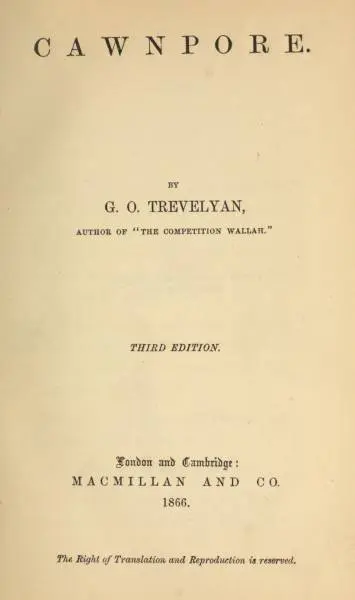
THE CLASSIC COLLECTION · 1866
"Cawnpore" by George Otto Trevelyan is a historical account written in the mid-19th century. The book delves into the events surrounding the violent upheaval at Cawnpore during the Indian Rebellion of 1857, focusing on the tensions between British colonial forces and local sepoy troops. Trevelyan's exploration is rich in details, particularly regarding the complexities of colonial power dynamics and human relationships in a time of growing unrest." "The opening of "Cawnpore" introduces the geographical and historical context of Cawnpore, emphasizing its significance as a military station and detailing the diverse population comprising British soldiers, civilians, and native troops. Trevelyan sets the stage for the looming crisis by discussing the uneasy state of relations between these groups, highlighting the underlying tensions festering among the sepoys. As the narrative unfolds, there are hints at unrest due to a combination of various grievances, including rumors about greased cartridges and other perceived insults to religious faiths, laying the groundwork for the insurrection that is to come."
Introduction adapted from the source catalogue; source summaries may be automatically generated.
Free to read · English · 82,027 words · No account needed
MAKE TIME FOR A GOOD BOOK
On by default. Untick to stop anonymous reading totals. Each page counts after 10 seconds in view. How this works.
Anonymous counting is on unless you have switched it off.
The Rajah came to the conclusion that a change of domicile was essential to the security of our countrymen, about the time that they were growing sated of laughing at sepoy bluster, and watching the Brahmins of the household ring bells and sprinkle flowers with holy water. They accordingly retired to the seclusion of a hamlet bordering on the river, where they amused themselves as best they could with a volume bearing the inscription "53rd Regiment Native Infantry Book Club;" which had been picked out of the stream by one among their attendants, as it floated by amidst a quantity of torn papers and smashed furniture: so many indications of the minute and searching character of the mischief that was being wrought above. After the lapse of a week, the Rajah sent them across to a landholder of his acquaintance, who lived on the south bank, and who undertook to hand them on to the nearest European encampment. They took leave of their chivalrous preserver with many expressions of unaffected regret, and a silent resolution never to rest until he had received some tangible mark of their gratitude and regard. On reaching the other shore their new patron packed them off towards Allahabad by a cross-road, in a bullock-cart without springs, preceded by an escort of four armed retainers. After bumping along for an hour the driver stopped, and informed them, in low and agitated tones, that there were guns ahead, planted athwart their path. And so they alighted, those way-worn fugitives, solicitous to learn whether they should again have to run, and swim, and lurk, and starve; and they crept stealthily along the edge of the road, and, turning the corner, found themselves within a few yards of the white and freckled face of an English sentry.
Five years subsequently Murphy left his old regiment, and volunteered for India in another corps. Presently it began to be rumoured at mess that there was a man in the ranks who had gone through the siege and the slaughter of Cawnpore. The Colonel made all necessary inquiries, and reported the matter to the Commander-in-chief: who at once appointed Murphy custodian of the Memorial Gardens. Here he may be seen, in the balmy forenoons of the cold weather, sauntering about in a pith helmet and linen jacket; a decent little Irishman, very ready to give a feeling and intelligent account of what took place under his immediate observation, and insisting much on the fact that he and the gunner, unable to speak a syllable of "Moors," would have been helpless but for the knowledge of Hindoostanee possessed by the sepoy officers. He retains a lively impression of the eagerness with which the English privates whom they encountered on the Allahabad highway contributed their allowances of liquor to treat the men who had not tasted beer for eight summer weeks. He points out the stone beneath which reposes poor Sullivan, who died of fatigue and debility, taking the form of cholera, within a fortnight of his restoration to safety. Delafosse lived once more to play the man, fighting under Chamberlain in the passes of the Hindoo Koosh: and Thomson to compose the story of what he had seen and undergone, so told that it may be read by a Christian without horror, and by an educated person without disgust. He was of opinion that a soldier who had performed his duty should not stoop to the vocabulary of a hangman. This man, scarred from head to heel with sepoy bullets,--who had carried his life in his hand for months together,--who had lost friends, possessions, and health in the frightful mêlée,--could still write like a modest and tolerant gentleman: while officers, to whom the rebellion had brought nothing except promotion and chance of distinction, were declaiming and printing about battues, and fine bags, and tucking up niggers, and polishing off twenty brace of Pandies. He made it his care that the worthy Rajah of Moorar Mhow should be rewarded with a handsome pension; that the faithful sepoys of his own battalion should obtain credit for their loyalty; that a fitting monument should be erected to the memory of his dead comrades; and that the services of his living companions in arms should not pass unrecorded. He left it for others to exult when shopkeepers and bankers, whose property had been confiscated by the Nana, and plundered by our own mutinous troops, were condemned and executed for having acknowledged a de facto monarch; when pedlars and bazaar-porters were strung up by scores to a gallows planted across the mouth of the funereal well: truly a graceful tribute to the manes of gentle English women.[4]
Your reading position is saved on this browser. Take it to another device with a library code. Reading pages adapt to text, rather than matching a printed edition.
BEHIND THE BOOK
This eBook is for the use of anyone anywhere in the United States and most other parts of the world at no cost and with almost no restrictions whatsoever. You may copy it, give it away or re-use it under the terms of the Project Gutenberg License included with this eBook or online at www.gutenberg.org. If you are not located in the United States, you will have to check the laws of the country where you are located before using this eBook. Read the source licence.
The original source file, including credits and licence, is retained by this library. Request an original-format copy at no charge. Please include the book title and Project Gutenberg identifier #51383.
KEEP YOUR CURIOSITY GOING
Cécile Tormay

Moritz Busch
John L. Ransom
Frances Wright
Cécile Tormay

Mabel Potter Daggett