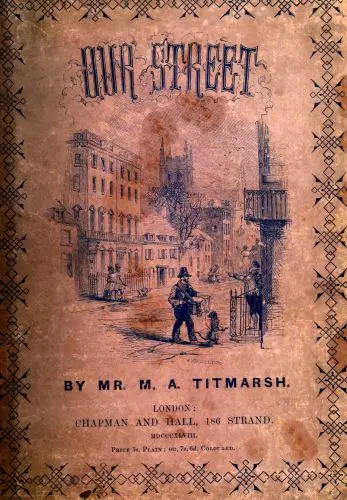
“Our Street”
William Makepeace Thackeray
THE CLASSIC COLLECTION · 1869
"Catherine: A Story" by William Makepeace Thackeray is a novel serialized between 1839 and 1840. Written as a deliberate critique of popular crime fiction that romanticized criminals, Thackeray based his story on Catherine Hayes, a real eighteenth-century woman executed for murdering her husband. His goal was to portray criminals as utterly vile and unredeemable. Yet despite his intentions, Thackeray developed an unexpected sympathy for his heroine, and the novel's rogues emerged as oddly appealing—a result the author considered a failure.
Introduction adapted from the source catalogue; source summaries may be automatically generated.
Free to read · English · 67,769 words · No account needed
MAKE TIME FOR A GOOD BOOK
On by default. Untick to stop anonymous reading totals. Each page counts after 10 seconds in view. How this works.
Anonymous counting is on unless you have switched it off.
In the meantime she considered herself free as the wind, and permitted herself all the innocent gaieties which that “chartered libertine,” a coquette, can take. She flirted with all the bachelors, widowers, and married men, in a manner which did extraordinary credit to her years: and let not the reader fancy such pastimes unnatural at her early age. The ladies--Heaven bless them!--are, as a general rule, coquettes from babyhood upwards. Little SHE'S of three years old play little airs and graces upon small heroes of five; simpering misses of nine make attacks upon young gentlemen of twelve; and at sixteen, a well-grown girl, under encouraging circumstances--say, she is pretty, in a family of ugly elder sisters, or an only child and heiress, or a humble wench at a country inn, like our fair Catherine--is at the very pink and prime of her coquetry: they will jilt you at that age with an ease and arch infantine simplicity that never can be surpassed in maturer years.
Miss Catherine, then, was a franche coquette, and Mr. John Hayes was miserable. His life was passed in a storm of mean passions and bitter jealousies, and desperate attacks upon the indifference-rock of Mrs. Catherine's heart, which not all his tempest of love could beat down. O cruel cruel pangs of love unrequited! Mean rogues feel them as well as great heroes. Lives there the man in Europe who has not felt them many times?--who has not knelt, and fawned, and supplicated, and wept, and cursed, and raved, all in vain; and passed long wakeful nights with ghosts of dead hopes for company; shadows of buried remembrances that glide out of their graves of nights, and whisper, “We are dead now, but we WERE once; and we made you happy, and we come now to mock you:--despair, O lover, despair, and die”?--O cruel pangs!--dismal nights!--Now a sly demon creeps under your nightcap, and drops into your ear those soft hope-breathing sweet words, uttered on the well-remembered evening: there, in the drawer of your dressing-table (along with the razors, and Macassar oil), lies the dead flower that Lady Amelia Wilhelmina wore in her bosom on the night of a certain ball--the corpse of a glorious hope that seemed once as if it would live for ever, so strong was it, so full of joy and sunshine: there, in your writing-desk, among a crowd of unpaid bills, is the dirty scrap of paper, thimble-sealed, which came in company with a pair of muffetees of her knitting (she was a butcher's daughter, and did all she could, poor thing!), begging “you would ware them at collidge, and think of her who”--married a public-house three weeks afterwards, and cares for you no more now than she does for the pot-boy. But why multiply instances, or seek to depict the agony of poor mean-spirited John Hayes? No mistake can be greater than that of fancying such great emotions of love are only felt by virtuous or exalted men: depend upon it, Love, like Death, plays havoc among the pauperum tabernas, and sports with rich and poor, wicked and virtuous, alike. I have often fancied, for instance, on seeing the haggard pale young old-clothesman, who wakes the echoes of our street with his nasal cry of “Clo'!”--I have often, I said, fancied that, besides the load of exuvial coats and breeches under which he staggers, there is another weight on him--an atrior cura at his tail--and while his unshorn lips and nose together are performing that mocking, boisterous, Jack-indifferent cry of “Clo', clo'!” who knows what woeful utterances are crying from the heart within? There he is, chaffering with the footman at No. 7 about an old dressing-gown: you think his whole soul is bent only on the contest about the garment. Psha! there is, perhaps, some faithless girl in Holywell Street who fills up his heart; and that desultory Jew-boy is a peripatetic hell! Take another instance:--take the man in the beef-shop in Saint Martin's Court. There he is, to all appearances quite calm: before the same round of beef--from morning till sundown--for hundreds of years very likely. Perhaps when the shutters are closed, and all the world tired and silent, there is HE silent, but untired--cutting, cutting, cutting. You enter, you get your meat to your liking, you depart; and, quite unmoved, on, on he goes, reaping ceaselessly the Great Harvest of Beef. You would fancy that if Passion ever failed to conquer, it had in vain assailed the calm bosom of THAT MAN. I doubt it, and would give much to know his history.
Your reading position is saved on this browser. Take it to another device with a library code. Reading pages adapt to text, rather than matching a printed edition.
William Makepeace Thackeray
William Makepeace Thackeray
Charles Dickens & William Makepeace Thackeray
William Makepeace Thackeray
BEHIND THE BOOK
This eBook is for the use of anyone anywhere in the United States and most other parts of the world at no cost and with almost no restrictions whatsoever. You may copy it, give it away or re-use it under the terms of the Project Gutenberg License included with this eBook or online at www.gutenberg.org. If you are not located in the United States, you will have to check the laws of the country where you are located before using this eBook. Read the source licence.
The original source file, including credits and licence, is retained by this library. Request an original-format copy at no charge. Please include the book title and Project Gutenberg identifier #1969.
KEEP YOUR CURIOSITY GOING
Cécile Tormay

Moritz Busch
Coulson Kernahan
John L. Ransom

Maurice Baring
Frances Wright