
Love Letters of a Violinist, and Other Poems
Eric Mackay
THE CLASSIC COLLECTION · 1634
"Castara" by William Habington is a collection of poems and prose inspired by themes of love, courtship, and virtue, written in the early 17th century. The work navigates the experiences of romantic longing and moral consideration reflecting the societal values of its time, particularly highlighting the ideal of chastity and the complexities of love. The central figure, Castara, serves not only as a muse for the author but also embodies the virtues of purity and grace that the poems seek to celebrate. The opening of "Castara" establishes a rich context, introducing the author’s reflections on love and poetry while emphasizing his commitment to a chaste muse. Habington presents a series of character sketches and poems dedicated to Castara, underscoring her beauty, innocence, and moral superiority. In these initial sections, he navigates through metaphors and heartfelt vows, expressing both the joy and heartache that accompany deep affection. The author portrays his admiration and quest for purity while acknowledging the societal pressures and expectations placed upon love, making it clear that his poetic ambition is rooted in both personal devotion and a broader commentary on virtue.
Introduction adapted from the source catalogue; source summaries may be automatically generated.
Free to read · English · 36,597 words · No account needed
MAKE TIME FOR A GOOD BOOK
On by default. Untick to stop anonymous reading totals. Each page counts after 10 seconds in view. How this works.
Anonymous counting is on unless you have switched it off.
To a friend inquiring her name, whom he loved.
Fond Love himselfe hopes to disguise
From view, if he but covered lies,
Ith' veile of my transparent eyes.
Though in a smile himselfe he hide,
Or in a sigh, thou art so tride
In all his arts, hee'le be discride.
I must confesse (Deare friend) my flame,
Whose boasts Castara so doth tame,
That not thy faith, shall know her name.
Twere prophanation of my zeale,
If but abroad one whisper steale,
They love betray, who him reveale.
In a darke cave which never eye
Could by his subtlest ray descry,
It doth like a rich minerall lye.
Which is she with her flame refine,
I'de force it from that obscure Mine,
And then it like pure should shine.
A Dialogue betweene HOPE and FEARE.
FEARE. Checke thy forward thoughts, and know
Hymen onely joynes their hands;
Who with even paces goe,
Shee in gold, he rich in lands.
HOPE. But Castara's purer fire,
When it meetes a noble flame:
Shuns the smoke of such desire,
Joynes with love, and burnes the same.
FEARE. Yet obedience must prevaile,
They who o're her actions sway:
Would have her in th' Ocean saile,
And contemne thy narrow sea.
HOPE. Parents lawes must beare no weight
When they happinesse prevent.
And our sea is not so streight,
But it roome hath for content.
FEARE. Thousand hearts as victims stand,
At the Altar of her eyes.
And will partiall she command,
Onely thine for sacrifice?
HOPE. Thousand victims must returne;
Shee the purest will designe:
Choose Castara which shall burne,
Choose the purest, that is, mine.
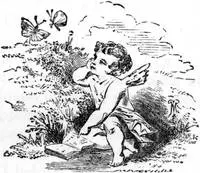
To CUPID,
Upon a dimple in CASTARA'S cheeke.
Nimble boy in thy warme flight,
What cold tyrant dimm'd thy sight?
Hadst thou eyes to see my faire,
Thou wouldst sigh thy selfe to ayre:
Fearing to create this one,
Nature had her selfe undone.
But if you when this you heare
Fall downe murdered through your eare,
Begge of Jove that you may have
In her cheeke a dimpled grave.
Lilly, Rose, and Violet,
Shall the perfum'd Hearse beset
While a beauteous sheet of Lawne,
O're the wanton corps is drawne:
And all lovers use this breath;
"Here lies Cupid blest in death."
Upon CUPID'S death and buriall in CASTARA'S cheeke.
Your reading position is saved on this browser. Take it to another device with a library code. Reading pages adapt to text, rather than matching a printed edition.
BEHIND THE BOOK
This eBook is for the use of anyone anywhere in the United States and most other parts of the world at no cost and with almost no restrictions whatsoever. You may copy it, give it away or re-use it under the terms of the Project Gutenberg License included with this eBook or online at www.gutenberg.org. If you are not located in the United States, you will have to check the laws of the country where you are located before using this eBook. Read the source licence.
The original source file, including credits and licence, is retained by this library. Request an original-format copy at no charge. Please include the book title and Project Gutenberg identifier #47462.
KEEP YOUR CURIOSITY GOING
Eric Mackay
Edmund Gosse
Sophia Margaretta Hensley
Gilbert Parker
George MacDonald

Elizabeth Bibesco