THE CLASSIC COLLECTION✦Common Sense About WomenCLASSIC FREE BOOKS
Common Sense About Women
Thomas Wentworth Higginson
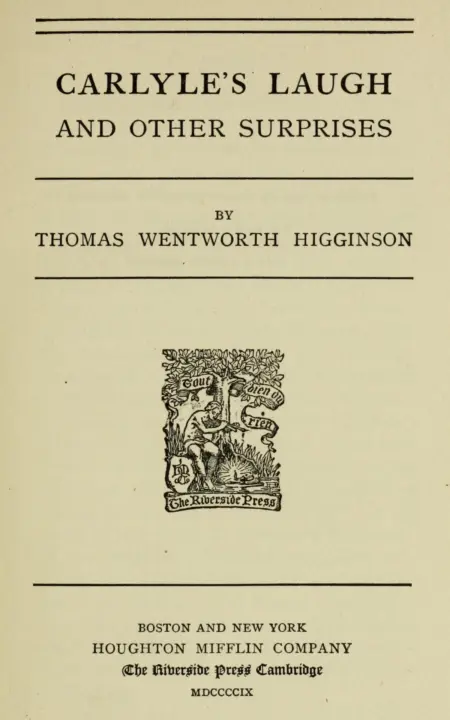
THE CLASSIC COLLECTION · 1909
"Carlyle's Laugh and Other Surprises" by Thomas Wentworth Higginson is a collection of essays and sketches, likely written in the early 20th century. The work explores various literary and historical subjects, focusing on notable figures and topics in American literature. Through Higginson's personal anecdotes and reflections, the book delves into the nuances of different authors, particularly the essence of Thomas Carlyle as experienced by the author. The opening of the book establishes a personal connection between Higginson and the renowned author Thomas Carlyle, highlighting the striking quality of Carlyle's laugh, which Higginson describes as a revealing aspect of his character. The narrative recounts Higginson's initial reluctance to meet Carlyle, influenced by his perceived harsh demeanor, but upon their encounter, he discovers a warm, genuine side that contrasts with Carlyle's public image. This introduction sets the stage for a broader examination of literary personalities and cultural commentary, demonstrating how humor and humanity underlie the complexity of well-known figures in literature.
Introduction adapted from the source catalogue; source summaries may be automatically generated.
Free to read · English · 71,637 words · No account needed
MAKE TIME FOR A GOOD BOOK
On by default. Untick to stop anonymous reading totals. Each page counts after 10 seconds in view. How this works.
Anonymous counting is on unless you have switched it off.
These three variations, all of which are interesting, are the only ones I have noted as uncanceled in this particular poem, beyond those recorded by Professor Woodberry. But there are many cases where the manuscript shows, in Shelley’s own handwriting, variations subsequently canceled by him; and these deserve study by all students of the poetic art. His ear was so exquisite and his sense of the balance of a phrase so remarkable, that it is always interesting to see the path by which he came to the final utterance, whatever that was. I have, therefore, copied a number of these modified lines, giving, first, Professor Woodberry’s text, and then the original form of language, as it appears in Shelley’s handwriting, italicizing the words which vary, and giving the pages of Professor Woodberry’s edition. The cancelation or change is sometimes made in pen, sometimes in pencil; and it is possible that, in a few cases, it may have been made by Mrs. Shelley.
“Gazed through clear dew on the tender sky.”
“Gazed through its tears on the tender sky.”
“The beams which dart from many a star
Of the flowers whose hues they bear afar.”
“The beams which dart from many a sphere Of the starry flowers whose hues they bear.”
“The unseen clouds of the dew, which lie Like fire in the flowers till the sun rides high, Then wander like spirits among the spheres Each cloud faint with the fragrance it bears.”
“The unseen clouds of the dew, which lay
Like fire in the flowers till dawning day,
Then walk like spirits among the spheres
Each one faint with the odor it bears.”
“Like windless clouds o’er a tender sky.”
“Like windless clouds in a tender sky.”
“Whose waves never mark, though they ever impress.”
“Whose waves never wrinkle, though they impress.”
“Was as God is to the starry scheme,”
“Was as is God to the starry scheme.”
“As if some bright spirit for her sweet sake Had deserted heaven while the stars were awake.”
“As some bright spirit for her sweet sake Had deserted the heaven while the stars were awake.”
“The freshest her gentle hands could pull.”
“The freshest her gentle hands could cull.”
“The sweet lips of the flowers and harm not, did she.”
“The sweet lips of flowers,” etc.
“Edge of the odorous cedar bark.”
“Edge of the odorous cypress bark.”
“Sent through the pores of the coffin plank.”
“Ran through,” etc.
“Between the time of the wind and the snow.”
“Between the term,” etc. [probably accidental].
“Dammed it up with roots knotted like water-snakes.”
Your reading position is saved on this browser. Take it to another device with a library code. Reading pages adapt to text, rather than matching a printed edition.
Thomas Wentworth Higginson
Thomas Wentworth Higginson
Thomas Wentworth Higginson
Thomas Wentworth Higginson
BEHIND THE BOOK
This eBook is for the use of anyone anywhere in the United States and most other parts of the world at no cost and with almost no restrictions whatsoever. You may copy it, give it away or re-use it under the terms of the Project Gutenberg License included with this eBook or online at www.gutenberg.org. If you are not located in the United States, you will have to check the laws of the country where you are located before using this eBook. Read the source licence.
The original source file, including credits and licence, is retained by this library. Request an original-format copy at no charge. Please include the book title and Project Gutenberg identifier #68129.
KEEP YOUR CURIOSITY GOING

David Patterson (Spirit) Hatch

David Patterson (Spirit) Hatch

David Patterson (Spirit) Hatch
Cécile Tormay

Moritz Busch
John L. Ransom