THE CLASSIC COLLECTION✦Common Sense About WomenCLASSIC FREE BOOKS
Common Sense About Women
Thomas Wentworth Higginson
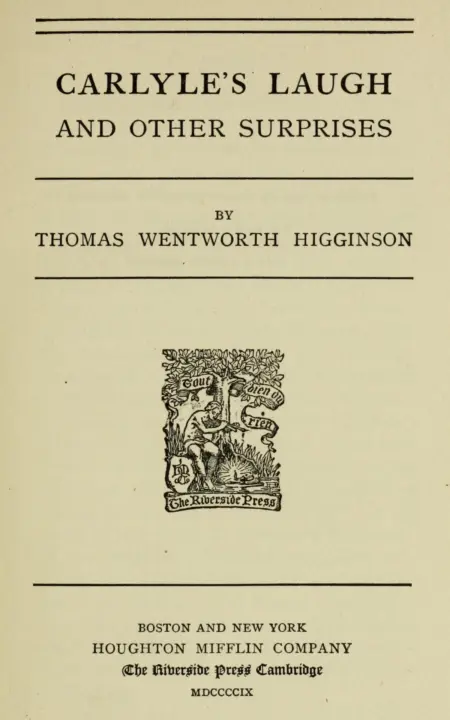
THE CLASSIC COLLECTION · 1909
"Carlyle's Laugh and Other Surprises" by Thomas Wentworth Higginson is a collection of essays and sketches, likely written in the early 20th century. The work explores various literary and historical subjects, focusing on notable figures and topics in American literature. Through Higginson's personal anecdotes and reflections, the book delves into the nuances of different authors, particularly the essence of Thomas Carlyle as experienced by the author. The opening of the book establishes a personal connection between Higginson and the renowned author Thomas Carlyle, highlighting the striking quality of Carlyle's laugh, which Higginson describes as a revealing aspect of his character. The narrative recounts Higginson's initial reluctance to meet Carlyle, influenced by his perceived harsh demeanor, but upon their encounter, he discovers a warm, genuine side that contrasts with Carlyle's public image. This introduction sets the stage for a broader examination of literary personalities and cultural commentary, demonstrating how humor and humanity underlie the complexity of well-known figures in literature.
Introduction adapted from the source catalogue; source summaries may be automatically generated.
Free to read · English · 71,637 words · No account needed
MAKE TIME FOR A GOOD BOOK
On by default. Untick to stop anonymous reading totals. Each page counts after 10 seconds in view. How this works.
Anonymous counting is on unless you have switched it off.
The last afternoon that my father lived, though with no premonition, I preferred to be with him, and invented an absence for mother, Vinnie [her sister] being asleep. He seemed peculiarly pleased, as I oftenest stayed with myself; and remarked, as the afternoon withdrew, he “would like it to not end.”
His pleasure almost embarrassed me, and my brother coming, I suggested they walk. Next morning I woke him for the train, and saw him no more.
His heart was pure and terrible, and I think no other like it
exists.
I am glad there is immortality, but would have tested it myself, before entrusting him. Mr. Bowles was with us. With that exception, I saw none. I have wished for you, since my father died, and had you an hour unengrossed, it would be almost priceless. Thank you for each kindness....
Later she wrote:—
When I think of my father’s lonely life and lonelier death,
there is this redress—
Take all away;
The only thing worth larceny
Is left—the immortality.
My earliest friend wrote me the week before he died, “If I live, I will go to Amherst; if I die, I certainly will.”
Is your house deeper off?
A year afterwards came this:—
DEAR FRIEND,—Mother was paralyzed Tuesday, a year from the evening father died. I thought perhaps you would care.
With this came the following verse, having a curious seventeenth-century
flavor:—
“A death-blow is a life-blow to some,
Who, till they died, did not alive become;
Who, had they lived, had died, but when
They died, vitality begun.”
And later came this kindred memorial of one of the oldest and most faithful friends of the family, Mr. Samuel Bowles, of the Springfield “Republican”:—
DEAR FRIEND,—I felt it shelter to speak to you.
My brother and sister are with Mr. Bowles, who is buried this
afternoon.
The last song that I heard—that was, since the birds—was “He leadeth me, he leadeth me; yea, though I walk”—then the voices stooped, the arch was so low.
After this added bereavement the inward life of the diminished household became only more concentrated, and the world was held farther and farther away. Yet to this period belongs the following letter, written about 1880, which has more of what is commonly called the objective or external quality than any she ever wrote me; and shows how close might have been her observation and her sympathy, had her rare qualities taken a somewhat different channel:—
Your reading position is saved on this browser. Take it to another device with a library code. Reading pages adapt to text, rather than matching a printed edition.
Thomas Wentworth Higginson
Thomas Wentworth Higginson
Thomas Wentworth Higginson
Thomas Wentworth Higginson
BEHIND THE BOOK
This eBook is for the use of anyone anywhere in the United States and most other parts of the world at no cost and with almost no restrictions whatsoever. You may copy it, give it away or re-use it under the terms of the Project Gutenberg License included with this eBook or online at www.gutenberg.org. If you are not located in the United States, you will have to check the laws of the country where you are located before using this eBook. Read the source licence.
The original source file, including credits and licence, is retained by this library. Request an original-format copy at no charge. Please include the book title and Project Gutenberg identifier #68129.
KEEP YOUR CURIOSITY GOING

David Patterson (Spirit) Hatch

David Patterson (Spirit) Hatch

David Patterson (Spirit) Hatch
Cécile Tormay

Moritz Busch
John L. Ransom