THE CLASSIC COLLECTION✦Common Sense About WomenCLASSIC FREE BOOKS
Common Sense About Women
Thomas Wentworth Higginson
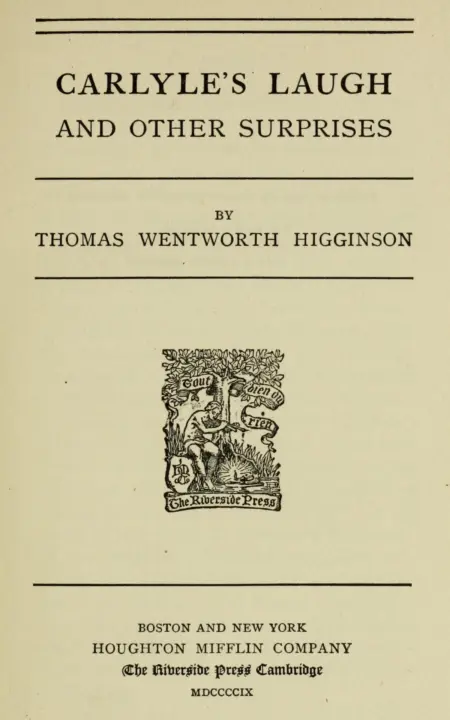
THE CLASSIC COLLECTION · 1909
"Carlyle's Laugh and Other Surprises" by Thomas Wentworth Higginson is a collection of essays and sketches, likely written in the early 20th century. The work explores various literary and historical subjects, focusing on notable figures and topics in American literature. Through Higginson's personal anecdotes and reflections, the book delves into the nuances of different authors, particularly the essence of Thomas Carlyle as experienced by the author. The opening of the book establishes a personal connection between Higginson and the renowned author Thomas Carlyle, highlighting the striking quality of Carlyle's laugh, which Higginson describes as a revealing aspect of his character. The narrative recounts Higginson's initial reluctance to meet Carlyle, influenced by his perceived harsh demeanor, but upon their encounter, he discovers a warm, genuine side that contrasts with Carlyle's public image. This introduction sets the stage for a broader examination of literary personalities and cultural commentary, demonstrating how humor and humanity underlie the complexity of well-known figures in literature.
Introduction adapted from the source catalogue; source summaries may be automatically generated.
Free to read · English · 71,637 words · No account needed
MAKE TIME FOR A GOOD BOOK
On by default. Untick to stop anonymous reading totals. Each page counts after 10 seconds in view. How this works.
Anonymous counting is on unless you have switched it off.
With this came the poem since published in one of her volumes and entitled “Renunciation”; and also that beginning “Of all the sounds dispatched abroad,” thus fixing approximately the date of those two. I must soon have written to ask her for her picture, that I might form some impression of my enigmatical correspondent. To this came the following reply, in July, 1862:—
Could you believe me without? I had no portrait, now, but am small, like the wren; and my hair is bold like the chestnut bur; and my eyes, like the sherry in the glass, that the guest leaves. Would this do just as well?
It often alarms father. He says death might occur and he has moulds of all the rest, but has no mould of me; but I noticed the quick wore off those things, in a few days, and forestall the dishonor. You will think no caprice of me.
You said “Dark.” I know the butterfly, and the lizard, and the orchis. Are not those your countrymen?
I am happy to be your scholar, and will deserve the kindness I
cannot repay.
If you truly consent, I recite now. Will you tell me my fault, frankly as to yourself, for I had rather wince than die. Men do not call the surgeon to commend the bone, but to set it, sir, and fracture within is more critical. And for this, preceptor, I shall bring you obedience, the blossom from my garden, and every gratitude I know.
Perhaps you smile at me. I could not stop for that. My business is circumference. An ignorance, not of customs, but if caught with the dawn, or the sunset see me, myself the only kangaroo among the beauty, sir, if you please, it afflicts me, and I thought that instruction would take it away.
Because you have much business, beside the growth of me, you
will appoint, yourself, how often I shall come, without your
inconvenience.
And if at any time you regret you received me, or I prove a different fabric to that you supposed, you must banish me.
When I state myself, as the representative of the verse, it does not mean me, but a supposed person.
You are true about the “perfection.” To-day makes Yesterday
mean.
You spoke of “Pippa Passes.” I never heard anybody speak of “Pippa Passes” before. You see my posture is benighted.
To thank you baffles me. Are you perfectly powerful? Had I a pleasure you had not, I could delight to bring it.
This was accompanied by this strong poem, with its breathless conclusion. The title is of my own giving:—
Your reading position is saved on this browser. Take it to another device with a library code. Reading pages adapt to text, rather than matching a printed edition.
Thomas Wentworth Higginson
Thomas Wentworth Higginson
Thomas Wentworth Higginson
Thomas Wentworth Higginson
BEHIND THE BOOK
This eBook is for the use of anyone anywhere in the United States and most other parts of the world at no cost and with almost no restrictions whatsoever. You may copy it, give it away or re-use it under the terms of the Project Gutenberg License included with this eBook or online at www.gutenberg.org. If you are not located in the United States, you will have to check the laws of the country where you are located before using this eBook. Read the source licence.
The original source file, including credits and licence, is retained by this library. Request an original-format copy at no charge. Please include the book title and Project Gutenberg identifier #68129.
KEEP YOUR CURIOSITY GOING

David Patterson (Spirit) Hatch

David Patterson (Spirit) Hatch

David Patterson (Spirit) Hatch
Cécile Tormay

Moritz Busch
John L. Ransom