
American nights entertainment
Grant M. (Grant Martin) Overton
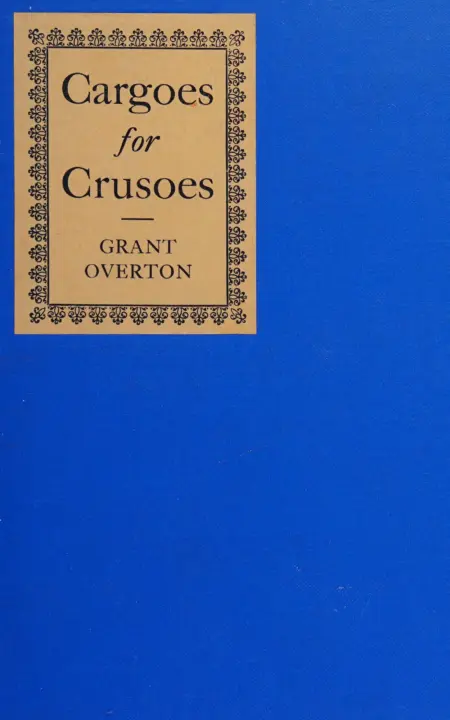
THE CLASSIC COLLECTION · 1924
"Cargoes for Crusoes" by Grant M. Overton is a collection of literary essays written in the early 20th century. The book explores a range of topics related to literature and the authors of the time, mixing both analytical reviews and insights into the works of contemporary writers. In this volume, Overton reflects on the joys of reading and the impact of literature on personal experience and growth, emphasizing the adventures found within the pages of books." The opening of "Cargoes for Crusoes" introduces a fascinating premise: the fictional Robinson Crusoe recounts how he survived his island loneliness through the unexpected arrival of a shipwrecked cargo of books. Expressing joy at discovering this literary treasure, he immerses himself in reading, claiming it has saved him from boredom. The narrator emphasizes the profound effect that literature has had on his life, engaging with various characters and authors as companions in his solitude. The preface sets the tone for an exploration of the value of books and their ability to offer both instruction and entertainment, leading into the following essays that delve into the works of various authors he admires.
Introduction adapted from the source catalogue; source summaries may be automatically generated.
Free to read · English · 116,221 words · No account needed
MAKE TIME FOR A GOOD BOOK
On by default. Untick to stop anonymous reading totals. Each page counts after 10 seconds in view. How this works.
Anonymous counting is on unless you have switched it off.
What, then, is the character of a man barely thirty whose horoscope belongs to 1894? His sisters and his cousins and his aunts are not to be left out of the reckoning any more than those of W. S. Gilbert’s admiral. Brought up to admire Wordsworth, Mr. Huxley has lived to enjoy him;[34] a child of eminent Victorians, he has a perspicacious eye for the limitations of Lytton Strachey as a biographer.[35] The inner truth, of course, is something more important than these details of taste, which might be accidental. The inner truth is itself an accident—quite possibly an accident in design. And it is due to the shape of Huxley’s head, not the outer shape but the shape inside—as we have said, all curious vaultings, pointed arches, mediæval, constructed for all the rites of a ceremonious mysticism but constrained by the circumstances of his era and the exigencies of daily living to be used rather as a laboratory than a cathedral. One must eat. When Grandfather Huxley gave over eating meat, he was unable to think, and his grandson, obliged to use a beautiful brain in journalism and letters, can hardly dedicate it to worship.
“Worship.” The word may seem strange to be used in speaking of the author of Antic Hay, in which there is much genial blasphemy; but what the careless reader may not see is the bitter cry beneath the surface of a stony contempt. The cry is there, nor is it always embittered. “God as a sense of warmth about the heart, God as exultation, God as tears in the eyes, God as a rush of power or thought—that was all right,” reflected Theodore Gumbril Junior. “But God as truth, God as 2 plus 2 = 4—that wasn’t so clearly all right.”[36] And a few moments later the young man is recalling, with passion and pain, the death of his mother. Those familiar with the story of the two dwarfs, Sir Hercules and Filomena, in Crome Yellow[37] know what pathos and tenderness Huxley can command in a narrative of entire simplicity undisturbed by the self-conscious tendency of much of his work. For it is true, as Michael Sadleir said some time ago, that there are (have been?) several Huxleys.[38] But although the artificer in words who is “almost omnipresent” will never vanish, the “amateur in garbage, pierrot lunaire, the cynic in ragtime, the fastidious sensualist” are numbered of days. The young man in his twenties who provoked “consternation and respect” knows as well as Mr. Sadleir that he has no time to waste. His position is clear, being that of a man whose time is being wasted, not by himself but by others; and a man whose impatience is becoming very great. The portrait of Coleman in Antic Hay is perhaps the most concentrated expression of that ... impatience. Of the several attitudes assumed in the world today by gifted writers whose core of feeling is mystical, Huxley’s, I think, has the most courage to commend it. Mr. Sinclair Lewis clicks the shutter of a mental camera; Mr. James Branch Cabell tries to glue our eyes to a series of romantically-colored stereoscopic slides; Mr. Joseph Hergesheimer paints in oils; Mr. James Joyce uses chalk on the sidewalks or even on the walls of less advertised, but not less public, places. Huxley, however, has learned from Dickens the art of caricature. As he draws, his really vast erudition comes crowding through the aisles of his strange and beautiful mind. Like little imps, like twisted gargoyles come to life, figures of the past fling themselves on the haft of his pen, to move it this way and that. A heavier stroke here, to show the semblance of a satyr; this curve a little thinned by pity; a blot here for the spirit made flesh.... So you have gradually assembled his company, grotesque, exaggerated, wretched, bizarre, inhuman-human, like drawings by Cruikshank or Phiz, like illustrations to a new Nicholas Nickleby, or Pickwick, repulsively true, their meaninglessness carrying their deepest meaning. That meaning is so significant that only a mystic can be expected to grasp it. It goes back to the struggle between paganism and Christianity which led into what we call the Dark Ages. Mr. Huxley has looked at his world and seen with disgust—but also with anguish and pity—how the wheel has come full circle, how for the mystical mind a Dark Age is again come upon us. Must, then, the old and crucial warfare be waged all over again? If we are to worship at Greek shrines, he will remind us that Priapus was the god of gardens. And he quotes the Latin of Odo of Cluny[39] to show how excess breeds counter-excess. The whole point with Huxley is his perfect grasp of the historical analogy to the present mood and tense—or tension. He is savage in his picture of London, the modern city, in Antic Hay; unsparing in his representation of the manifestations of the spirit we affect—jazz, prevailing dances, rages in new art, stupidities in experimental science. Possibly his comprehension of the last is his most relentlessly hostile view; he is the grandson of a scientist, a very great thinker, pathetically dependent upon a flesh diet for intellectual accomplishment. Grandfather’s thinking, though possibly not futile, seems to have got no farther than the God of 2 plus 2 = 4. For such a God, the grandson has little use; for such an age as impends over us, he has even less.
Your reading position is saved on this browser. Take it to another device with a library code. Reading pages adapt to text, rather than matching a printed edition.
Grant M. (Grant Martin) Overton
Grant M. (Grant Martin) Overton
Grant M. (Grant Martin) Overton
Grant M. (Grant Martin) Overton
BEHIND THE BOOK
This eBook is for the use of anyone anywhere in the United States and most other parts of the world at no cost and with almost no restrictions whatsoever. You may copy it, give it away or re-use it under the terms of the Project Gutenberg License included with this eBook or online at www.gutenberg.org. If you are not located in the United States, you will have to check the laws of the country where you are located before using this eBook. Read the source licence.
The original source file, including credits and licence, is retained by this library. Request an original-format copy at no charge. Please include the book title and Project Gutenberg identifier #68092.
KEEP YOUR CURIOSITY GOING

David Patterson (Spirit) Hatch

David Patterson (Spirit) Hatch

David Patterson (Spirit) Hatch
Cécile Tormay

Moritz Busch
John L. Ransom