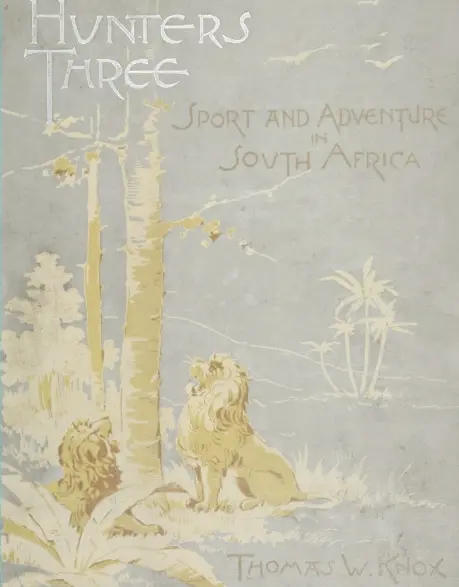
Hunters three: Sport and adventure in South Africa
Thomas Wallace Knox
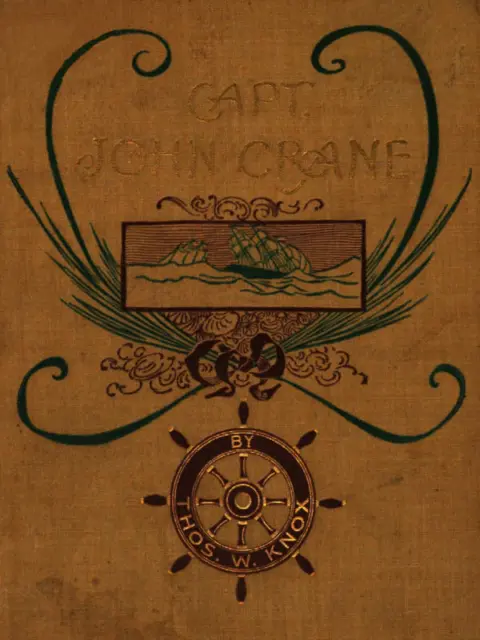
THE CLASSIC COLLECTION · 1895
"Captain John Crane, 1800-1815" by Thomas W. Knox is a historical account written in the late 19th century. The narrative revolves around the life and experiences of Captain John Crane, detailing his journey from a modest upbringing in New Hampshire to the tumultuous world of maritime adventures and challenges during the early 1800s. The book aims to illuminate early 19th-century life at sea and the conflicts that arose from the tensions between the United States and Great Britain. The opening of the story introduces us to John Crane, who reflects on his bashful nature despite his assertive role as a sea captain. It recounts his early life, familial background, and his longing for a seafaring life, prompting him to leave home with a friend to seek a life on the ocean. As Crane prepares for his journey, he grapples with emotions tied to leaving his family, presenting a contrast between his ambitious outlook and the affection he bears for his parents. Finally, he and his companion David Taylor undertake a challenging walk to Boston, where they hope to secure positions on a ship, setting the stage for adventures and trials at sea.
Introduction adapted from the source catalogue; source summaries may be automatically generated.
Free to read · English · 70,534 words · No account needed
MAKE TIME FOR A GOOD BOOK
On by default. Untick to stop anonymous reading totals. Each page counts after 10 seconds in view. How this works.
Anonymous counting is on unless you have switched it off.
The stranger came up and hove to within little more than a hundred yards of us. Then she hailed us, saying,--
"What ship is that?"
Our captain answered that it was the Washington, of and from Boston,
and bound to Gibraltar and a market. Haying given this answer he
asked,--
"What ship is that?"
To this the stranger made no reply other than to say, "I'll send a boat
on board!"
A boat containing an officer and four men came alongside the Washington, and the officer quickly ascended to the deck by means of the rope which had been lowered for him.
"What do you mean by running away from us?" was his first question as
his feet touched the deck.
"I ran away because I didn't want to meet you," our captain replied; "that's all there is about it."
"Keep a civil tongue in your cheek," said the British officer, "or
you'll be sorry you didn't."
"Perfectly civil," replied our captain; "you asked a plain question, and I answered it, didn't I?"
"Yes, you did," said the officer; "but be careful about the rest of your answers. Call all hands, and let me see your crew!"
I believe, from the appearance of our captain's face, that if he had not realized the consequence of such an act, he would have seized the nearest handspike and laid the Britisher flat on the deck. His color came and went, and it seemed to me that for fully a minute he stood perfectly still, and made no reply. At the end of a long pause he nodded to the mate, and said, "Call all hands."
The mate passed the order to Haines, who went to the forecastle gangway, and yelled down into the interior of the ship, "All hands ahoy!" The performance was a useless one, as everybody was on deck at the time, all having become excited over the presence of the British war-ship, and knowing perfectly well there was no way of escaping inspection.
I said everybody was on deck, but in that I was mistaken, though I did not notice it at the moment. One of our sailors had disappeared, but our captain seemed to be as ignorant of the fact as I was, as he told the officer the crew was all before him, and he could look them over.
The men were lined up against the weather rail, and the officer walked slowly along in front of them, scanning each face very closely. When he came to Haines, he asked his name and where he came from.
"My name's Bill Haines," was the answer, "and I come from Salem, in
Massachusetts."
Your reading position is saved on this browser. Take it to another device with a library code. Reading pages adapt to text, rather than matching a printed edition.
Thomas Wallace Knox

Thomas Wallace Knox
Thomas Wallace Knox
Thomas Wallace Knox & Henry M. (Henry Morton) Stanley
BEHIND THE BOOK
This eBook is for the use of anyone anywhere in the United States and most other parts of the world at no cost and with almost no restrictions whatsoever. You may copy it, give it away or re-use it under the terms of the Project Gutenberg License included with this eBook or online at www.gutenberg.org. If you are not located in the United States, you will have to check the laws of the country where you are located before using this eBook. Read the source licence.
The original source file, including credits and licence, is retained by this library. Request an original-format copy at no charge. Please include the book title and Project Gutenberg identifier #61715.
KEEP YOUR CURIOSITY GOING
Cécile Tormay

Moritz Busch
Coulson Kernahan
John L. Ransom

Maurice Baring
Frances Wright