THE CLASSIC COLLECTION✦A dead man’s diaryCLASSIC FREE BOOKS
A dead man’s diary
Coulson Kernahan
THE CLASSIC COLLECTION · 1902
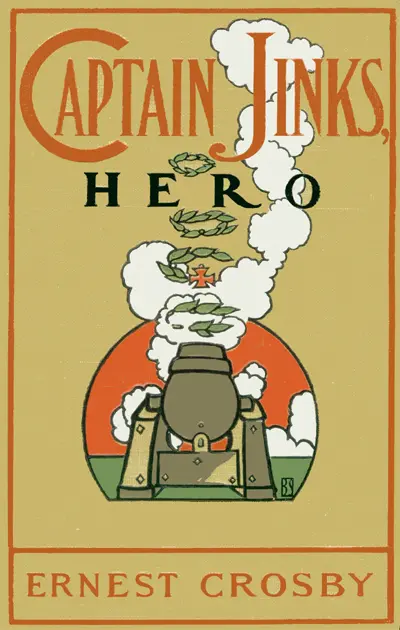
"Captain Jinks, Hero" by Ernest Crosby is a novel written in the early 20th century. The story revolves around Colonel Jinks, an amiable farmer with a military title, and his son Sam, who aspires to become a hero much like the toy soldiers gifted to him for his birthday. The narrative explores themes of military ambition and a young boy's journey into the world of soldiers, touching on Sam's profound admiration for authority and valor, all set against the backdrop of war and societal expectations. The opening portion introduces us to Colonel Jinks, who buys a box of toy soldiers for his son Sam, igniting the boy's imagination and dreams of grandeur. Sam's affection for his new toys quickly morphs into an intense aspiration to become a "hero," as he becomes enthralled with military life. Soon, the family relocates to a nearby town where Sam joins the local Boys' Brigade, fully embracing his military ambitions. As he grows older, he dreams of attending a military academy and eventually joining the army, which sets the stage for his evolving identity amidst the themes of war, heroism, and the societal constructs surrounding them.
Introduction adapted from the source catalogue; source summaries may be automatically generated.
Free to read · English · 67,739 words · No account needed
MAKE TIME FOR A GOOD BOOK
On by default. Untick to stop anonymous reading totals. Each page counts after 10 seconds in view. How this works.
Anonymous counting is on unless you have switched it off.
This was an unpatriotic thought, and Sam was ashamed of it. Yet it was true, he would gladly have found himself one of His Majesty's subjects and a member of his incomparable army. Then he recalled his memorable interview with the Emperor, and rejoiced in the remembrance that he had deserved and received his commendation. He tried to imagine how it would feel to be one of his officers, or even one of his privates. If he had been selected as one of the squad to show the perfection of their discipline, how gladly he would have taken his place in line with the rest! He would have obeyed without flinching, he was sure of it. He put himself in the place of one of the squad. He is ordered to take his position opposite one of the condemned. He looks and sees that it is his Uncle George. Would he obey the order to shoot? Most certainly. The musket goes off and his uncle falls. He goes through the list of his friends and relations. He does not quite like to shoot the girls, but he does it. It is his duty. His commander-in-chief, who represents his Creator, has ordered it. He can rely implicitly on his wisdom. Then he thinks of Cleary. Yes, he would shoot Cleary down without hesitation. And then comes the turn of his father and mother. He has no trouble with the former, for he is sure that his father as a man must understand his feelings, and he sees a smile of approval on his face as he, too, falls prostrate. With his mother it is more difficult. There had not been much sympathy between them in recent years, yet he recalled his early boyhood on the farm, and it went against him to aim his piece at her. But after all it was his duty, and with an inaudible sigh he pulled the trigger. It was done. No one could have noticed his reluctance. It was quite likely that some of the soldiers that afternoon felt as much compunction as that. But as Sam went over all this long list of tests and passed them successfully, he felt, almost unconsciously, that he was coming to a precipice. His sense of happiness had left him, and he began to dread the end of his cogitations. There was a trial in store that he was afraid of facing. In order to postpone it he went over all his friends and relations again, and added mere acquaintances to the list. He busied himself in this way for an hour or two, but at last the final question forced itself upon him and insisted upon an answer. Would he be willing to shoot Marian under orders? It was with misgivings that he began to imagine this episode. As before, he marched to his place and lifted his rifle to aim. He sees before him the figure which had been haunting his dreams ever since he left East Point. She is bound; a handkerchief is tied over her eyes, but he sees the mouth and longs to kiss it. He has a strong impulse to run forward and throw his arms around her. The command "Fire!" is given, but--he does not shoot. He can not. He has disobeyed orders! He, the man whose one aim in life has been to become a perfect soldier, who only just now was considering himself fit to be a soldier of the war-lord, had disobeyed orders; he had shown himself a mutineer, a deserter, a traitor; he had lost his patriotism and loyalty; he had dishonored the flag; he had trampled under foot all the gods that he had worshiped now for many years. He had flatly broken the only code of morals that he knew--he was a coward, a hypocrite, a mere civilian, masquerading in the uniform of an officer! Sam buried his face in his hands and the tears trickled down through his fingers. Then he sprang up and walked to and fro for a long time. At last he took Marian's photograph from his pocket and put it on his dressing-table. He must be a man. He must hold true to his faith. He screwed up his courage and went through the forms of the afternoon in his room dimly lighted by lanterns in the street. He stood up in the line before the Emperor, and again listened to his inspiring speech. Now he felt sure that he would not fail. He placed himself opposite the photograph when the order was given. He raised an imaginary gun and aimed with assurance--but just then his eye fell upon the face which he could barely distinguish. He saw Marian again as she had been when he bade her farewell. True, she was as much a believer in the military scheme of life as he was, but he knew by instinct that she would draw the line somewhere. She was not created to be a martyr to her faith. The order "Fire!" came, but Sam, instead of obeying, threw down his musket and ran forward, seized the photograph and kissed it. He looked up, half expecting to see a crowd of spectators eying him with derision. He cast himself upon his bed with his clothes on and tossed about for a long time, until at last sleep came to his relief.
Your reading position is saved on this browser. Take it to another device with a library code. Reading pages adapt to text, rather than matching a printed edition.
BEHIND THE BOOK
This eBook is for the use of anyone anywhere in the United States and most other parts of the world at no cost and with almost no restrictions whatsoever. You may copy it, give it away or re-use it under the terms of the Project Gutenberg License included with this eBook or online at www.gutenberg.org. If you are not located in the United States, you will have to check the laws of the country where you are located before using this eBook. Read the source licence.
The original source file, including credits and licence, is retained by this library. Request an original-format copy at no charge. Please include the book title and Project Gutenberg identifier #19353.
KEEP YOUR CURIOSITY GOING
Coulson Kernahan

Maurice Baring
Frances Wright
Cécile Tormay

Frederic Jesup Stimson

W. H. P. (William Henry Pope) Jarvis