THE CLASSIC COLLECTION✦A dead man’s diaryCLASSIC FREE BOOKS
A dead man’s diary
Coulson Kernahan
THE CLASSIC COLLECTION · 1902
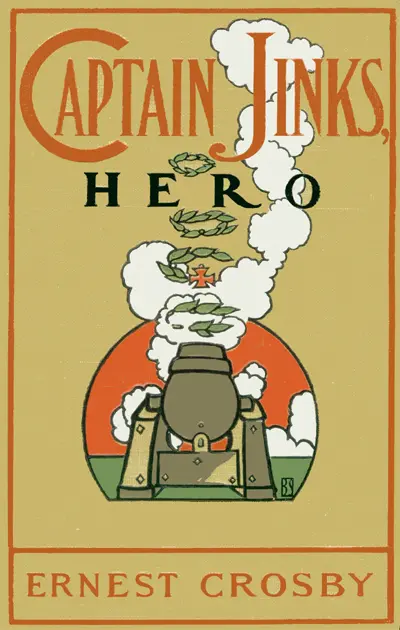
"Captain Jinks, Hero" by Ernest Crosby is a novel written in the early 20th century. The story revolves around Colonel Jinks, an amiable farmer with a military title, and his son Sam, who aspires to become a hero much like the toy soldiers gifted to him for his birthday. The narrative explores themes of military ambition and a young boy's journey into the world of soldiers, touching on Sam's profound admiration for authority and valor, all set against the backdrop of war and societal expectations. The opening portion introduces us to Colonel Jinks, who buys a box of toy soldiers for his son Sam, igniting the boy's imagination and dreams of grandeur. Sam's affection for his new toys quickly morphs into an intense aspiration to become a "hero," as he becomes enthralled with military life. Soon, the family relocates to a nearby town where Sam joins the local Boys' Brigade, fully embracing his military ambitions. As he grows older, he dreams of attending a military academy and eventually joining the army, which sets the stage for his evolving identity amidst the themes of war, heroism, and the societal constructs surrounding them.
Introduction adapted from the source catalogue; source summaries may be automatically generated.
Free to read · English · 67,739 words · No account needed
MAKE TIME FOR A GOOD BOOK
On by default. Untick to stop anonymous reading totals. Each page counts after 10 seconds in view. How this works.
Anonymous counting is on unless you have switched it off.
"He's a connoisseur of every foreign vintage,
From the claret of the fat and juicy Boer
To the thicker nigger brand
That he spills upon the sand,
When he draws his 'arf-and-'arf in blood and gore.
Blood and gore,
When he draws his 'arf-and-'arf in blood and gore."
"Fine, isn't it!" exclaimed Sam's neighbor, the captain, who was standing by him, as they all joined in hearty applause. "I tell you Bludyard Stripling ought to be our poet laureate. He's the laureate of the Empire, at any rate. Why, a song like that binds a nation together. You haven't any poet like that, have you?"
"No-o," answered Sam, thinking in shame of Shortfellow, Slowell, and Pittier. "I'm afraid all our poets are old women and don't understand us soldiers."
"Stripling understands everything," said the captain. "He never makes a mistake. He is a universal genius."
"I don't think we ever drink cocktails with a straw," ventured Sam.
"Oh, yes, you must. He never makes a mistake. You may be sure that, before he wrote that, he drank each one of those drinks, one after another."
"Quite likely," whispered Cleary to Sam, as he came up on the other
side.
"I wish I could hear it sung in Lunnon," said the captain. "A chorus of duchesses are singing it at one of the biggest music-halls every evening, and then they pass round their coronets, lined with velvet, you know, and take up a collection of I don't know how many thousand pounds for the wounded in South Africa. It stirs my blood every time I hear it sung."
The party broke up at a late hour, and Sam and Cleary walked back
together to the hotel.
"Interesting, wasn't it?" said Cleary.
"Yes," said Sam.
"Canon is a good title for that parson, isn't it? He's a fighter. They ought to promote him. 'Bombshell Gleed' would sound better than 'Canon Gleed,'" said Cleary.
"'M," said Sam.
"And that old general looked rather queer in that red and gilt bob-tailed Eton jacket," said Cleary.
"Yes, rather."
"Convenient for spanking, I suppose."
"The captain next to me told me a lot about Bobbets," said Sam. "Wasn't he nearly kidnaped in South Africa?"
"Yes; that comes of sending generals away from home who only weigh ninety-five pounds. We hadn't any such trouble with Laughter. They'd have had to kidnap him with a derrick."
"I never thought of that," said Sam. "Perhaps that's the real reason they selected him. I shouldn't wonder."
"Of course it was," responded Cleary.
"What sort of a chap was the one with the V.C. next to you?" asked Sam.
Your reading position is saved on this browser. Take it to another device with a library code. Reading pages adapt to text, rather than matching a printed edition.
BEHIND THE BOOK
This eBook is for the use of anyone anywhere in the United States and most other parts of the world at no cost and with almost no restrictions whatsoever. You may copy it, give it away or re-use it under the terms of the Project Gutenberg License included with this eBook or online at www.gutenberg.org. If you are not located in the United States, you will have to check the laws of the country where you are located before using this eBook. Read the source licence.
The original source file, including credits and licence, is retained by this library. Request an original-format copy at no charge. Please include the book title and Project Gutenberg identifier #19353.
KEEP YOUR CURIOSITY GOING
Coulson Kernahan

Maurice Baring
Frances Wright
Cécile Tormay

Frederic Jesup Stimson

W. H. P. (William Henry Pope) Jarvis