THE CLASSIC COLLECTION✦Notes of a Gold Digger, and Gold Diggers’ GuideCLASSIC FREE BOOKS
Notes of a Gold Digger, and Gold Diggers’ Guide
James Bonwick
THE CLASSIC COLLECTION · 1901
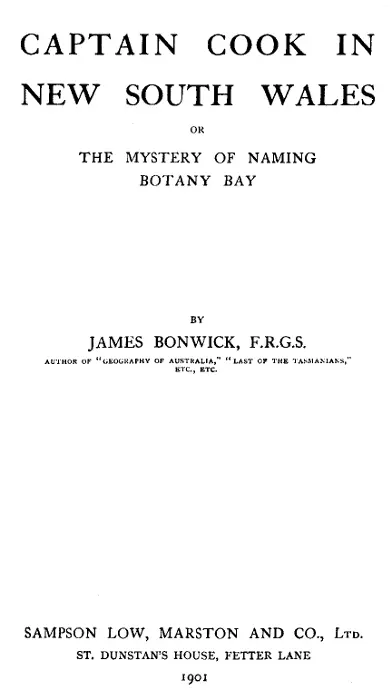
"Captain Cook in New South Wales; Or, The Mystery of Naming Botany Bay" by James Bonwick is a historical account written in the early 20th century. The book investigates the discrepancies and controversies surrounding Captain Cook's voyages, particularly focusing on the naming of significant locations such as Botany Bay. It delves into the sources and accuracy of the narrative presented by Dr. Hawkesworth, who documented Cook's voyage aboard the HMS Endeavour, raising questions about the authorship and credibility of historical records. In this detailed examination, Bonwick meticulously analyzes various logs, journals, and accounts relating to Cook's exploration of New South Wales. He contends that several original documents, particularly those written by Cook and his crew, do not support the official narrative that identifies Botany Bay and New South Wales, suggesting that these names were adopted later without proper attribution. Throughout the text, Bonwick seeks to uncover the truth behind the historical narrative, the motivations of the authors, and the influences that may have distorted the representation of Cook's contributions to the discovery of Australia.
Introduction adapted from the source catalogue; source summaries may be automatically generated.
Free to read · English · 9,733 words · No account needed
MAKE TIME FOR A GOOD BOOK
On by default. Untick to stop anonymous reading totals. Each page counts after 10 seconds in view. How this works.
Anonymous counting is on unless you have switched it off.
The PALLISER LOG, presented by Cook himself to his old American Commander and patron, Admiral Sir Hugh Palliser, was examined by me in Sunderland, when invited there by its owner for some days, Mr. R. W. Hudson, the northern shipowner. His lady, a Palliser, assured me the book had never been out of the possession of the family since Cook's gift.
I read therein:--
"This Book was a Present from Captain Cook to Sir Hugh Palliser, containing his Logg from the 27th May, 1768, to the 11th June, 1771, during his voyage on board the Endeavour Bark, sent to make observations on the Transit of Venus in the South Seas, and afterwards to make discoveries in the Southern Hemisphere."
The book was bound in red morocco, gold bordered, with a fancy back, and
marked:--
Though not, as I saw at once, wholly in Cook's handwriting, the record had no knowledge either of Botany Bay or of New South Wales, but had the Cook's style of spelling, as: "severell smokes were seen," and "saw smokes upon the shore." What was afterwards known as Botany Bay is there called "Sting Ray Harbour."
Apart from the Museum Logs, this one is undoubtedly the best
authenticated Cook's Log.
Among the profound Endeavour mysteries must be cited the extraordinary disappearance of the Log books of officers in the ship.
It was according to naval rule that any so compiled should, at the expiration of the voyage, be deposited with the naval authorities. After a hundred years or so a number of Endeavour Logs were discovered behind some wainscotting at the Deptford Victualling Yard. They were safely conveyed to the good custody of the officers of the London Record Office, Chancery Lane. They could not have been seen by Dr. Hawkesworth any more than those of Cook himself.
The one by Lieutenant Hickes was kept from May 27, 1768, to March 14, 1771. Third Lieutenant Gore became Second Lieutenant March 26, 1770. Bootie's Log was from May 17, 1768, to September 3, 1770; Forward's, May 17, 1768, to September 26, 1770; Green, astronomer, September 24, 1763, to October 3, 1770; C. Clerke's, August 26, 1768, to October 3, 1770; Wilkinson's, June 22, 1768, to August 3, 1770; Pickersgill's, June 10, 1768, to September 29, 1770; Lieutenant Gore's from July 3, 1768, to December 7, 1769. An unsigned Log was from May 27, 1768, to September 28, 1770; a second from August 26, 1768, to July 15, 1769; a third, May 27, 1768, to September 28, 1770; and a fourth from May 27, 1768, to January 9, 1770.
George Nowell was Carpenter; Samuel Evans, Boatswain. The Quarter-master Thierman, and Widowson came from New York. James Magra, afterwards Matra, of New York, volunteered as seaman, but rose to be Midshipman, and the special friend, through many years, of Sir Joseph Banks, whose correspondence is in the Museum. Not one of the Deptford Logs knows Botany Bay or New South Wales.
Your reading position is saved on this browser. Take it to another device with a library code. Reading pages adapt to text, rather than matching a printed edition.
BEHIND THE BOOK
This eBook is for the use of anyone anywhere in the United States and most other parts of the world at no cost and with almost no restrictions whatsoever. You may copy it, give it away or re-use it under the terms of the Project Gutenberg License included with this eBook or online at www.gutenberg.org. If you are not located in the United States, you will have to check the laws of the country where you are located before using this eBook. Read the source licence.
The original source file, including credits and licence, is retained by this library. Request an original-format copy at no charge. Please include the book title and Project Gutenberg identifier #57344.
KEEP YOUR CURIOSITY GOING
Cécile Tormay

Moritz Busch
John L. Ransom
Frances Wright
Cécile Tormay

Mabel Potter Daggett