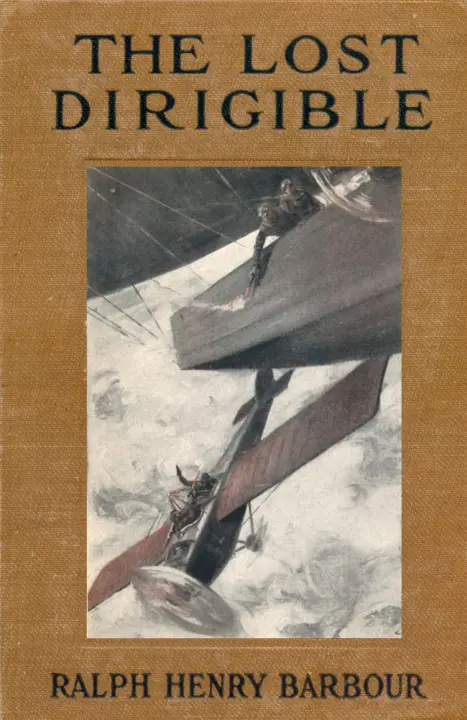
The lost dirigible
Ralph Henry Barbour
THE CLASSIC COLLECTION · 1908
"Captain Chub" by Ralph Henry Barbour is a novel written in the early 20th century. The story primarily revolves around young Tom "Chub" Eaton and his friends as they embark on an adventurous summer trip aboard a houseboat called the "Jolly Roger". Their journey is filled with youthful exuberance, camaraderie, and various light-hearted challenges as they navigate the waters and their relationships. The opening portion of the book introduces readers to a pivotal baseball game where Chub makes a key contribution to his team's victory, establishing his character as energetic and determined. Following this excitement, the narrative shifts to a relaxed scene where Chub and his friend Roy discuss summer plans and the potential acquisition of the houseboat for their upcoming adventure. The tone is playful and lively, highlighting the friendships among the boys as they prepare for a memorable summer filled with fun, exploration, and the inevitable misadventures that come with youth and friendship.
Introduction adapted from the source catalogue; source summaries may be automatically generated.
Free to read · English · 68,990 words · No account needed
MAKE TIME FOR A GOOD BOOK
On by default. Untick to stop anonymous reading totals. Each page counts after 10 seconds in view. How this works.
Anonymous counting is on unless you have switched it off.
“What’s the good of being huffy?” asked Roy. “It’s nothing but a lark,
anyway.”
“But look at the time,” said Dick. “Six o’clock already, and I’m as hungry as a bear. And the doctor will wonder what’s become of us.”
“That’s so. I say, Harry, you’d better run along to the boat and bring the doctor and Chub with you. There’s no use in missing our supper just to please this old galoot.”
“Well, I will,” answered Harry. “I guess when papa comes he will have something to say to this man!” She shot a vindictive look at the unperturbed Mr. Ewing. “If you’ll kindly unlock the door,” she announced, haughtily, “I’ll go.”
“Very well,” said the farmer, “but you fellers just stay where you be;
understand?”
“Yes, we understand,” replied Roy. “We won’t try to rush you. Don’t you suppose we could get out of here if we wanted to try?”
“Maybe; maybe not,” answered Mr. Ewing, as he unlocked the door. “Anyhow, you’d better not try it.”
“Good-by,” called Harry. “I’ll bring papa right back.”
“Oh, take your time,” replied Roy, with a wave of his hand. “We’re quite comfortable. Besides, we have the inestimable pleasure of Mr. Ewing’s society.”
The door closed again, and the farmer returned the key grimly to his pocket. After a few minutes Mrs. Peel returned.
“Not a thing’s gone from the house, James,” she announced.
“Are you certain sure?” asked Mr. Ewing.
“Of course I am,” she replied, tartly.
“Well, now you take a look around the store.”
Mrs. Peel proceeded to do so. When she came to the money-drawer she found the check which Harry had placed there. She brought it to Mr. Ewing, and the latter looked it all over carefully.
“It looks perfectly good, don’t it, James?” she asked, anxiously.
“Yes, it looks all right,” he acknowledged, grudgingly, “but it’s the best-lookin’ checks that’s the worthlessest. Horace Collins, over to Highwood, took a check like this from a stranger once, and it wa’n’t a bit of good. Came back to him marked right across the face of it, ‘No funds.’ You can’t ever tell by lookin’ at a check what it’s worth, Amanda.”
Roy and Dick sat on the edge of the counter and swung their heels and
grinned.
Mrs. Peel continued her investigation, and when she was through she did some figuring, dipping the little stump of a pencil at frequent intervals into the corner of her mouth. Finally:
Your reading position is saved on this browser. Take it to another device with a library code. Reading pages adapt to text, rather than matching a printed edition.
Ralph Henry Barbour
Ralph Henry Barbour
Ralph Henry Barbour
Ralph Henry Barbour
BEHIND THE BOOK
This eBook is for the use of anyone anywhere in the United States and most other parts of the world at no cost and with almost no restrictions whatsoever. You may copy it, give it away or re-use it under the terms of the Project Gutenberg License included with this eBook or online at www.gutenberg.org. If you are not located in the United States, you will have to check the laws of the country where you are located before using this eBook. Read the source licence.
The original source file, including credits and licence, is retained by this library. Request an original-format copy at no charge. Please include the book title and Project Gutenberg identifier #55435.
KEEP YOUR CURIOSITY GOING
Coulson Kernahan

Maurice Baring
Frances Wright
Cécile Tormay

Frederic Jesup Stimson

W. H. P. (William Henry Pope) Jarvis