THE CLASSIC COLLECTION✦My diaries, being a personal narrative of events 1888-1914, Part 2 (1900-1914)CLASSIC FREE BOOKS
My diaries, being a personal narrative of events 1888-1914, Part 2 (1900-1914)
Wilfrid Scawen Blunt
THE CLASSIC COLLECTION · 1879
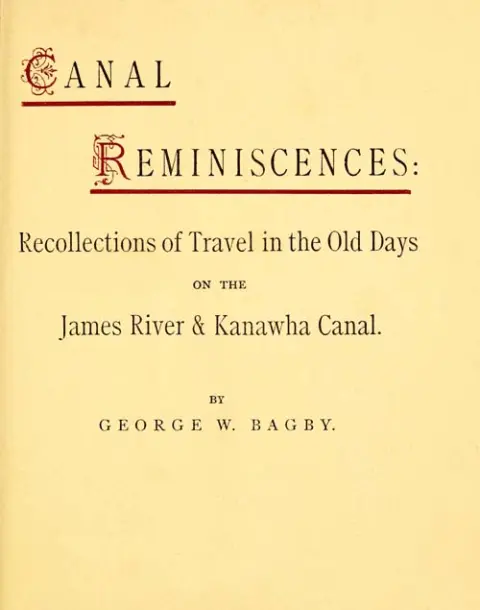
"Canal Reminiscences" by George William Bagby is a historical account written in the late 19th century. This book presents a nostalgic reflection on travel along the James River and Kanawha Canal during a bygone era, recounting the experiences and observations of the author as he navigates the waterways of Virginia. It serves as a personal exploration of the culture, society, and transportation methods of the time. Bagby's reminiscences capture the charm and slower pace of life during his travels in the 1830s to 1850s, detailing the characters he encountered, such as the skilled batteau-men who expertly maneuvered their vessels through natural obstacles. He shares vivid descriptions of the landscapes, the joyful gatherings at plantations along the canal, and the camaraderie of fellow passengers aboard the packet boats. As he reminisces about the transition from canal travel to the rise of railroads, Bagby reflects on the changes in society, economy, and lifestyle, bringing both humor and poignancy to his recollections. The book serves as a valuable window into a specific historical period, illustrating not only the logistics of canal travel but also the social dynamics and personal anecdotes interwoven with the journey.
Introduction adapted from the source catalogue; source summaries may be automatically generated.
Free to read · English · 5,944 words · No account needed
MAKE TIME FOR A GOOD BOOK
On by default. Untick to stop anonymous reading totals. Each page counts after 10 seconds in view. How this works.
Anonymous counting is on unless you have switched it off.
Arrived in Lynchburg, the effect of the canal was soon seen in the array of freight boats, the activity and bustle at the packet landing. New names and new faces, from the canal region of New York, most likely, were seen and heard. I became acquainted with the family of Capt. Huntley, who commanded one of the boats, and was for some years quite intimate with his pretty daughters, Lizzie, Harriet and Emma. Capt. H. lived on Church street, next door to the Reformed, or as it was then called, the Radical Methodist Church, and nearly opposite to Mr. Peleg Seabury. He was for a time connected in some way with the Exchange hotel, but removed with his family to Cincinnati, since when I have never but once heard of them. Where are they all, I wonder? Then, there was a Mr. Watson, who lived with Boyd, Edmond & Davenport, married first a Miss ----, and afterwards, Mrs. Christian, went into the tobacco business in Brooklyn, then disappeared, leaving no trace, not the slightest. Then there was a rare fellow, Charles Buckley, who lived in the same store with Watson, had a fine voice, and without a particle of religion in the ordinary sense, loved dearly to sing at revivals. I went with him; we took back seats, and sang with great fervor. This was at night. Besides Captain Huntley, I remember among the captains of a later date, Captain Jack Yeatman; and at a date still later his brother, Captain C. E. Yeatman, both of whom are still living. There was still another captain whose name was Love---- something, a very handsome man; and these are all.
In 1849, having graduated in Philadelphia, I made one of my last through-trips on the canal, the happy owner of a diploma in a green tin case, and the utterly miserable possessor of a dyspepsia which threatened my life. I enjoyed the night on deck, sick as I was. The owl’s “long hoot,” the “plaintive cry of the whippoorwill;” the melody--for it is by association a melody, which the Greeks have but travestied with their brek-ke-ex, ko-ex--of the frogs, the mingled hum of insect life, the “stilly sound” of inanimate nature, the soft respiration of sleeping earth, and above all, the ineffable glory of the stars. Oh! heaven of heavens, into which the sick boy, lying alone on deck, then looked, has thy charm fled, too, with so many other charms? Have thirty years of suffering, of thought, of book-reading, brought only the unconsoling knowledge, that yonder twinkling sparks of far-off fire are not lamps that light the portals of the palace of the King and Father, but suns like our sun, surrounded by earths full of woe and doubt like our own; and that heaven, if heaven there be, is not in the sky; not in space, vast as it is; not in time, endless though it be--where then? “Near thee, in thy heart!” Who feels this, who will say this of himself? Away thou gray-haired, sunken-cheeked sceptic, away! Come back to me, come back to me, wan youth; there on that deck, with the treasure of thy faith, thy trust in men, thy worship of womankind, thy hope, that sickness could not chill, in the sweet possibilities of life. Come back to me!--’Tis a vain cry. The youth lies there on the packet’s deck, looking upward to the stars, and he will not return.
Your reading position is saved on this browser. Take it to another device with a library code. Reading pages adapt to text, rather than matching a printed edition.
BEHIND THE BOOK
This eBook is for the use of anyone anywhere in the United States and most other parts of the world at no cost and with almost no restrictions whatsoever. You may copy it, give it away or re-use it under the terms of the Project Gutenberg License included with this eBook or online at www.gutenberg.org. If you are not located in the United States, you will have to check the laws of the country where you are located before using this eBook. Read the source licence.
The original source file, including credits and licence, is retained by this library. Request an original-format copy at no charge. Please include the book title and Project Gutenberg identifier #62708.
KEEP YOUR CURIOSITY GOING
Wilfrid Scawen Blunt
Wilfrid Scawen Blunt

E. W. (Edgar Watson) Howe
Cécile Tormay

Moritz Busch
John L. Ransom