THE CLASSIC COLLECTION✦An outlaw’s diary: the CommuneCLASSIC FREE BOOKS
An outlaw’s diary: the Commune
Cécile Tormay
THE CLASSIC COLLECTION · 1910
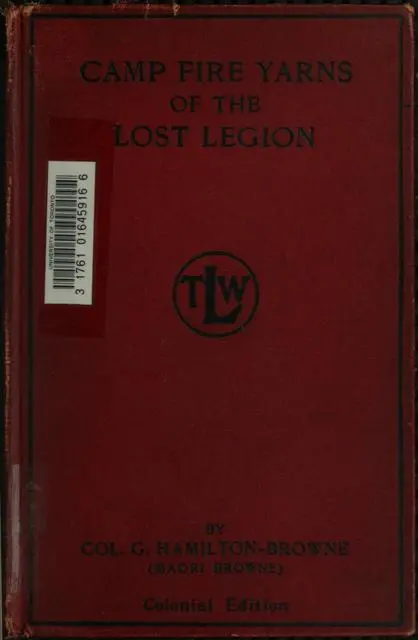
"Camp Fire Yarns of the Lost Legion" by Colonel G. Hamilton-Browne is a collection of personal narratives and historical accounts written in the late 19th century. The stories reflect on the author's experiences during his military service with the Lost Legion, particularly focusing on his encounters with the Maori people in New Zealand and the tumultuous conflicts of that era. The book aims to capture the essence of camaraderie, culture, and the hardships faced by soldiers and their indigenous counterparts during this significant period. The opening of the narrative introduces the author's nostalgic reflections as he recalls his time spent in New Zealand, longing for the days of adventure and the spirit of companionship that marked his military career. He discusses the Maori's complex character as both courageous warriors and hospitable individuals, sharing insights into their culture and conflicts, particularly during the wars that raged from the 1860s to the 1870s. With a blend of personal anecdotes and broader historical context, Browne sets the stage for a series of yarns that celebrate bravery, explore cultural exchanges, and delve into the rich tapestry of life on the frontier during a gripping time in history.
Introduction adapted from the source catalogue; source summaries may be automatically generated.
Free to read · English · 85,399 words · No account needed
MAKE TIME FOR A GOOD BOOK
On by default. Untick to stop anonymous reading totals. Each page counts after 10 seconds in view. How this works.
Anonymous counting is on unless you have switched it off.
Next morning he brought two sticks, when he came to my room, which he crossed on the fire hearth, and when he turned up at night-time he had evidently been to the canteen, for he was pot-valiant and I could see he had a bottle with him.
"I suppose you will be afraid to stay in the rooms alone," I said, as
I left for dinner.
"I will not," said he; but I saw the blue funk rising in him. It was a
Friday.
"Did you eat meat to-day?" I asked.
"I did that," he replied, "and I will."
"Well, God help you," I said. "It's great danger you are in this
night."
It was midnight when the lieutenant, fully got up in a most perfect fancy dress, and looking his part to perfection, appeared in the mess hut. In his hand he carried a few inches of time fuse, and also a huge fork, known in the service as the tormentor. The cook uses it to take the men's meat out of the boilers. We all crept up to my quarters, which consisted of a hut with two rooms in it, in the front one of which was the victim. To light the fuse and pass it under the door was the work of a moment, then to open the latter and step in took no longer. Mike, who had been absorbing courage from the bottle, had fallen asleep, but was waked up by a prod from the tormentor. He woke with a growl of rage, that changed into a yell of consternation, when he saw the terrific figure regarding him through the sulphury smoke of the fuse.
"Mike O'Leary," said a deep voice, "I've come for you."
Poor Mike, who had fallen back open-mouthed, with the sweat of fear
trickling off him, whimpered: "Oh no, good Mr Devil; wait for the
master."
"No," thundered the voice; "it's you I want, not your good, kind master, who's been a friend to you, and who you sneer at, insult and deride, and who, Protestant as he is, tries to stop your greedy sin of eating meat on fast days. Come on!"
And he made a pass at Mike with the tormentor, which Mike dodged by going over backwards, chair and all.
"I'll never cheek him again, by this, and by that, I won't!" yelled Mike, as he got another prod in a fleshy part, "and I'll never touch meat again, I won't." But at that he fainted. He soon came round, and was on his knees telling his beads when we entered the room, as if we were going to have a parting smoke before turning in.
Your reading position is saved on this browser. Take it to another device with a library code. Reading pages adapt to text, rather than matching a printed edition.
BEHIND THE BOOK
This eBook is for the use of anyone anywhere in the United States and most other parts of the world at no cost and with almost no restrictions whatsoever. You may copy it, give it away or re-use it under the terms of the Project Gutenberg License included with this eBook or online at www.gutenberg.org. If you are not located in the United States, you will have to check the laws of the country where you are located before using this eBook. Read the source licence.
The original source file, including credits and licence, is retained by this library. Request an original-format copy at no charge. Please include the book title and Project Gutenberg identifier #42228.
KEEP YOUR CURIOSITY GOING
Cécile Tormay

Moritz Busch
John L. Ransom
Frances Wright
Cécile Tormay

Mabel Potter Daggett