
The Dream of Gerontius
John Henry Newman
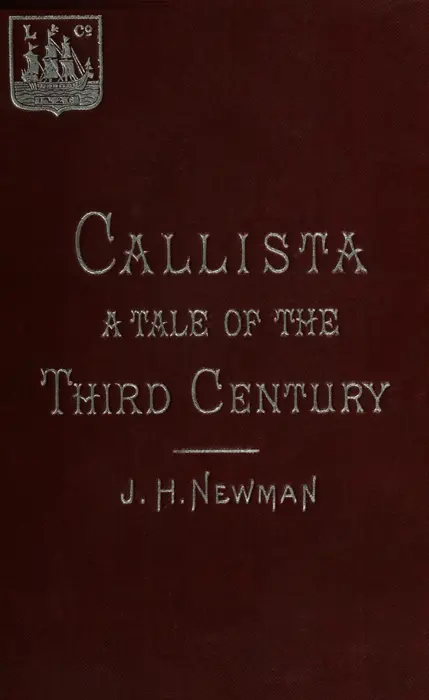
THE CLASSIC COLLECTION · 1855
"Callista: A Tale of the Third Century" by John Henry Newman is a historical novel written in the mid-19th century. This fiction explores the complex interactions and emotional landscapes of Christians and pagans during the third century in the Roman Empire, primarily focusing on the titular character, Callista, and those around her. The narrative seeks to illuminate the spiritual and societal dilemmas faced by individuals caught between these two worlds. The opening of the tale introduces the lush and vibrant setting of Sicca Veneria, a Roman colony in North Africa, vividly described with its beautiful landscapes and stark contrasts between decadence and tranquility. We meet Agellius, a young man grappling with his faith and the tension of living in a pagan society, as he interacts with a variety of characters, including his brother Juba who is indifferent to the faith. This initial part establishes the backdrop for upcoming conflicts, setting the stage for deeper explorations of faith, identity, and the overarching presence of Christianity in a predominantly pagan world.
Introduction adapted from the source catalogue; source summaries may be automatically generated.
Free to read · English · 96,963 words · No account needed
MAKE TIME FOR A GOOD BOOK
On by default. Untick to stop anonymous reading totals. Each page counts after 10 seconds in view. How this works.
Anonymous counting is on unless you have switched it off.
The second document is a fragment of the Acta Proconsularia of her Passion. If, indeed, it could be trusted to the letter, as containing Callista’s answers word for word, it would have a distinctly sacred character, in consequence of our Lord’s words, “It shall be given you in that hour what to speak.” However, we attach no such special value to this document, since it comes to us through heathen notaries, who may not have been accurate reporters; not to say that before we did so we ought to look very carefully into its genuineness. As it is, we believe it to be as true as any part of our narrative, and not truer. It runs as follows:—
“Cneius Messius Decius Augustus II., and Gratus, Consuls, on the seventh before the Calends of August, in Sicca Veneria, a colony, in the Secretary at the Tribunal, Martianus, procurator, sitting; Callista, a maker of images, was brought up by the Commentariensis on a charge of Christianity, and when she was placed,
“MARTIANUS, the procurator, said: This folly has been too long; you have made images, and now you will not worship them.
“CALLISTA answered: For I have found my true Love, whom before I knew not.
“MARTIANUS, the procurator, said: Your true love is, I ween, your last love; for all were true in their time.
“CALLISTA said: I worship my true Love, who is the Only True; and He is the Son of God, and I know none but Him.
“MARTIANUS, the procurator, said: You will not worship the gods, but you are willing to love their sons.
“CALLISTA said: He is the true Son of the True God; and I am His, and He
is mine.
“MARTIANUS, the procurator, said: Let alone your loves, and swear by the genius of the emperor.
“CALLISTA said: I have but one Lord, the King of kings, the Ruler of all.
“MARTIANUS, the procurator, turned to the lictor and said: This folly is madness; take her hand, put incense in it, and hold it over the flame.
“CALLISTA said: You may compel me by your great strength, but my own true Lord and Love is stronger.
“MARTIANUS, the procurator, said: You are bewitched; but we must undo the spell. Take her to the Lignum (the prison for criminals).
“CALLISTA said: He has been there before me, and He will come to me there.
“MARTIANUS, the procurator, said: The jailer will see to that. Let her be brought up to-morrow.
“On the day following, Martianus, the procurator, sitting at the tribunal, called up Callista. He said: Honour our lord, and sacrifice to the gods.
Your reading position is saved on this browser. Take it to another device with a library code. Reading pages adapt to text, rather than matching a printed edition.
John Henry Newman

John Henry Newman
John Henry Newman
John Henry Newman
BEHIND THE BOOK
This eBook is for the use of anyone anywhere in the United States and most other parts of the world at no cost and with almost no restrictions whatsoever. You may copy it, give it away or re-use it under the terms of the Project Gutenberg License included with this eBook or online at www.gutenberg.org. If you are not located in the United States, you will have to check the laws of the country where you are located before using this eBook. Read the source licence.
The original source file, including credits and licence, is retained by this library. Request an original-format copy at no charge. Please include the book title and Project Gutenberg identifier #30664.
KEEP YOUR CURIOSITY GOING
Cécile Tormay

Moritz Busch
Coulson Kernahan
John L. Ransom

Maurice Baring
Frances Wright