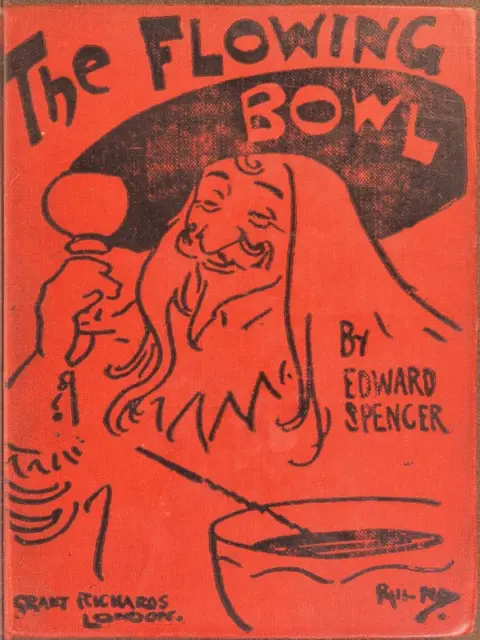
The Flowing Bowl A Treatise on Drinks of All Kinds and of All Periods, Interspersed with Sundry Anecdotes and Reminiscences
Edward Spencer

THE CLASSIC COLLECTION · 1897
"Cakes & Ale" by Edward Spencer is a collection of essays on food and banquets written in the late 19th century. The work explores the art of gastronomy, interspersed with various anecdotes and recipes, showcasing the culinary traditions and social customs surrounding meals in England." The opening of "Cakes & Ale" presents a humorous preface that reflects on the author's journey to write a book on food after encouragement from a publisher. He recounts the ambivalence he feels about his cooking skills while humorously addressing the notion of what constitutes good food and the social importance of meals, particularly breakfast. The narrative introduces us to the eccentricities of dining, touching on historical practices, different meal customs across eras, and a gentle critique of contemporary dining manners and practices in England, setting the tone for a culinary exploration that combines knowledge, anecdote, and humor.
Introduction adapted from the source catalogue; source summaries may be automatically generated.
Free to read · English · 69,231 words · No account needed
MAKE TIME FOR A GOOD BOOK
On by default. Untick to stop anonymous reading totals. Each page counts after 10 seconds in view. How this works.
Anonymous counting is on unless you have switched it off.
This is a difficult task to build up; for a sort of Cleopatra's Needle, or pyramid, of cooked vegetables, herbs, pickles, etc., has to be erected on a flat dish. Carrots, turnips, green peas, asparagus, French beans, beetroot, capers, pickled cucumbers, and horse-radish, form the solid matter of which the pyramid is built.
Lay a stratum on the dish, and anoint the stratum with Tartare sauce. Each layer must be similarly anointed, and must be of less circumference than the one underneath, till the top layer consists of one caper. Garnish with bombs of caviare, sliced lemon, crayfish, olives, and salted cucumber; and then give the salad to the policeman on fixed-point duty. At least, if you take my advice.
Anchovy Salad.
This is usually eaten at the commencement of dinner, as a hors
d'oeuvre.
Some shreds of anchovy should be arranged "criss-cross" in a flat glass dish. Surround it with small heaps of chopped truffles, yolk and white of hard-boiled eggs, capers, and a stoned olive or two. Mix all the ingredients together with a little Chili vinegar, and twice the quantity of oil.
The mixture is said to be invaluable as an appetiser; but the modest oyster on the deep shell--if he has not been fattened at the bolt-hole of the main sewer--is to be preferred.
Cooked vegetables, for salad purposes, are not, nor will they ever be, popular in England, Nine out of ten Britains will eat the "one sauce" with asparagus, in preference to the oiled butter, or plain salad dressing, of mustard, vinegar, pepper, salt, and oil; whilst 'tis almost hopeless to attempt to dissuade madame the cook from smothering her cauliflowers with liquefied paste, before sending them to table. Many a wild weed which foreign nations snatch greedily from the soil, prior to dressing it, is passed by with scorn by our islanders, including the dandelion, which is a favourite of our lively neighbours, for salad purposes, and is doubtless highly beneficial to the human liver. So is the cauliflower; and an eminent medical authority once gave out that the man who ate a parboiled cauliflower, as a salad, every other day, need never send for a doctor. Which sounds rather like fouling his own nest.
Fruit Salad.
This is simply a French compôte of cherries, green almonds, pears, limes, peaches, apricots in syrup slightly flavoured with ginger; and goes excellent well with any cold brown game. Try it.
Orange Salad.
Peel your orange, and cut it into thin slices. Arrange these in a glass dish, and sugar them well. Then pour over them a glass of sherry, a glass of brandy, and a glass of maraschino.
Orange Sauce.
Your reading position is saved on this browser. Take it to another device with a library code. Reading pages adapt to text, rather than matching a printed edition.
BEHIND THE BOOK
This eBook is for the use of anyone anywhere in the United States and most other parts of the world at no cost and with almost no restrictions whatsoever. You may copy it, give it away or re-use it under the terms of the Project Gutenberg License included with this eBook or online at www.gutenberg.org. If you are not located in the United States, you will have to check the laws of the country where you are located before using this eBook. Read the source licence.
The original source file, including credits and licence, is retained by this library. Request an original-format copy at no charge. Please include the book title and Project Gutenberg identifier #43278.
KEEP YOUR CURIOSITY GOING

David Patterson (Spirit) Hatch

David Patterson (Spirit) Hatch

David Patterson (Spirit) Hatch

Ralph Waldo Emerson

Maurice Baring

Oscar Wilde & James McNeill Whistler