THE CLASSIC COLLECTION✦An outlaw’s diary: the CommuneCLASSIC FREE BOOKS
An outlaw’s diary: the Commune
Cécile Tormay
THE CLASSIC COLLECTION · 1909
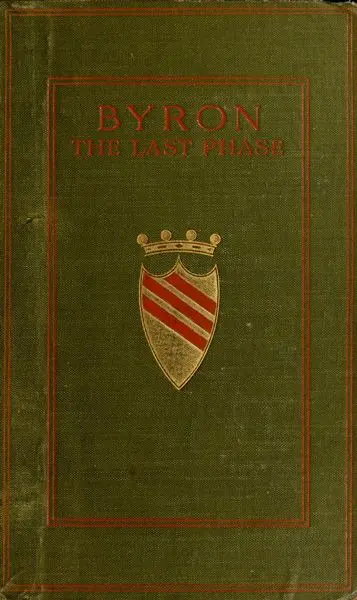
"Byron: The Last Phase" by Richard Edgcumbe is a historical account written in the early 20th century. The work delves into the latter years of the life of Lord Byron, revealing how his experiences and personal transformations, especially during his time in Italy and Greece, diverged from the notorious public persona he had acquired earlier in his life. The narrative particularly focuses on unexplored elements of Byron's character and relationships, particularly involving his friends and lovers. The opening of this biography sets the scene in Pisa around 1821, where Byron has recently arrived with an entourage that includes not just servants but also various pets. Edgcumbe introduces the reader to a contrasting view of Byron—he is described as being visibly changed from the man he once was, showing a disposition more sociable and compassionate. The text meticulously details Byron's physical appearance through the eyes of those who met him, while also hinting at the tumultuous nature of his personal life, including references to his estranged relationships and the lingering impact of his separation from his wife. The introduction builds intrigue around Byron's psychological state and contributions to the Greek War of Independence, setting the stage for a detailed exploration of his character during this pivotal period.
Introduction adapted from the source catalogue; source summaries may be automatically generated.
Free to read · English · 129,526 words · No account needed
MAKE TIME FOR A GOOD BOOK
On by default. Untick to stop anonymous reading totals. Each page counts after 10 seconds in view. How this works.
Anonymous counting is on unless you have switched it off.
'"Who the devil is Mr. Bentham?" was my rough reply; "I never heard of him before." Many of my readers may still be in the same state of ignorance, and it will be acceptable to them, I hope, to hear of the philosopher.
'"Mr. Bentham," said Mr. Bowring, "is one of the greatest men of the age, and for the honour now offered to you, I waited impatiently many a long day--I believe for more than two years."
'"Great or little, I never heard of him before; but if he wants to see
me, why I'll go."
'It was accordingly arranged that I should visit Mr. Bentham, and that Mr. Bowring should see him to fix the time, and then inform me. In a day or two afterwards, I received a note from the honorary secretary to say I was to breakfast with Mr. Bentham on Saturday. It happened that I lived at a distance from town, and having heard something of the primitive manner of living and early hours of philosophers, I arranged with my wife overnight that I would get up very early on the Saturday morning, that I might not keep Mr. Bentham waiting. Accordingly, I rose with the dawn, dressed myself in haste, and brushed off for Queen's Square, Westminster, as hard as my legs could carry me. On reaching the Strand, fearing I might be late, being rather corpulent, and not being willing to go into the presence of so very great a man, as I understood Mr. Jeremy Bentham to be, puffing and blowing, I took a hackney-coach and drove up to his door about eight o'clock. I found a servant girl afoot, and told her I came to breakfast with Mr. Bentham by appointment.
'She ushered me in, and introduced me to two young men, who looked no more like philosophers, however, than my own children. I thought they might be Mr. Bentham's sons, but this, I understood, was a mistake. I showed them the note I had received from Mr. Bowring, and they told me Mr. Bentham did not breakfast till three o'clock. This surprised me much, but they told me I might breakfast with them, which I did, though I was not much flattered by the honour of sitting down with Mr. Bentham's clerks, when I was invited by their master. Poor Mr. Bowring! thought I, he must be a meek-spirited young man if it was for this he waited so impatiently. I supposed the philosopher himself did not get up till noon, as he did not breakfast till so late, but in this I was also mistaken. About ten o'clock I was summoned to his presence, and mustered up all my courage and all my ideas for the meeting. His appearance struck me forcibly. His thin white locks, cut straight in the fashion of the Quakers, and hanging, or rather floating, on his shoulders; his garments something of Quaker colour and cut, and his frame rather square and muscular, with no exuberance of flesh, made up a singular-looking and not an inelegant old man. He welcomed me with a few hurried words, but without any ceremony, and then conducted me into several rooms to show me his ammunition and materials of war. One very large room was nearly filled with books, and another with unbound works, which, I understood, were the philosopher's own composition. The former, he said, furnished him his supplies; and there was a great deal of labour required to read so many volumes. I said inadvertently, "I suppose you have quite forgotten what is said in the first before you read the last." Mr. Bentham, however, took this in good part, and, taking hold of my arm, said we would proceed on our journey. Accordingly, off we set, accompanied by one of his young men carrying a portfolio, to keep, I suppose, a log of our proceedings.
Your reading position is saved on this browser. Take it to another device with a library code. Reading pages adapt to text, rather than matching a printed edition.
BEHIND THE BOOK
This eBook is for the use of anyone anywhere in the United States and most other parts of the world at no cost and with almost no restrictions whatsoever. You may copy it, give it away or re-use it under the terms of the Project Gutenberg License included with this eBook or online at www.gutenberg.org. If you are not located in the United States, you will have to check the laws of the country where you are located before using this eBook. Read the source licence.
The original source file, including credits and licence, is retained by this library. Request an original-format copy at no charge. Please include the book title and Project Gutenberg identifier #41809.
KEEP YOUR CURIOSITY GOING
Cécile Tormay

Moritz Busch
John L. Ransom
Frances Wright
Cécile Tormay

Mabel Potter Daggett