THE CLASSIC COLLECTION✦An outlaw’s diary: the CommuneCLASSIC FREE BOOKS
An outlaw’s diary: the Commune
Cécile Tormay
THE CLASSIC COLLECTION · 1909
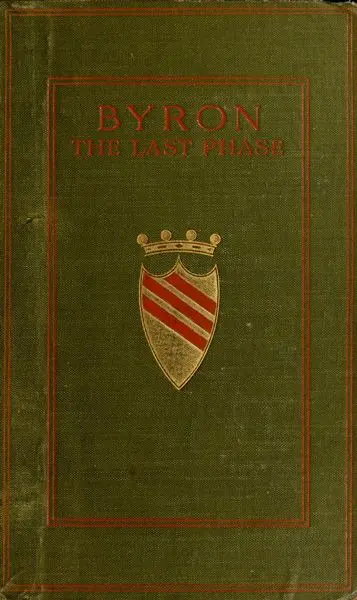
"Byron: The Last Phase" by Richard Edgcumbe is a historical account written in the early 20th century. The work delves into the latter years of the life of Lord Byron, revealing how his experiences and personal transformations, especially during his time in Italy and Greece, diverged from the notorious public persona he had acquired earlier in his life. The narrative particularly focuses on unexplored elements of Byron's character and relationships, particularly involving his friends and lovers. The opening of this biography sets the scene in Pisa around 1821, where Byron has recently arrived with an entourage that includes not just servants but also various pets. Edgcumbe introduces the reader to a contrasting view of Byron—he is described as being visibly changed from the man he once was, showing a disposition more sociable and compassionate. The text meticulously details Byron's physical appearance through the eyes of those who met him, while also hinting at the tumultuous nature of his personal life, including references to his estranged relationships and the lingering impact of his separation from his wife. The introduction builds intrigue around Byron's psychological state and contributions to the Greek War of Independence, setting the stage for a detailed exploration of his character during this pivotal period.
Introduction adapted from the source catalogue; source summaries may be automatically generated.
Free to read · English · 129,526 words · No account needed
MAKE TIME FOR A GOOD BOOK
On by default. Untick to stop anonymous reading totals. Each page counts after 10 seconds in view. How this works.
Anonymous counting is on unless you have switched it off.
'Don Juan' was begun in the autumn of 1818. That poem, Byron tells us, was inspired almost entirely by his own personal experience. Perhaps he drew a portrait of Mary Chaworth when he described Julia:
'And she
Was married, charming, chaste, and twenty-three.'
When they parted in 1809, that was exactly Mary's age.
'Her eye was large and dark, suppressing half its fire until she spoke. Her glossy hair was clustered over a brow bright with intelligence. Her cheek was purple with the beam of youth, mounting at times to a transparent glow; and she had an uncommon grace of manner. She was tall of stature. Her husband was a good-looking man, neither much loved nor disliked. He was of a jealous nature, though he did not show it. They lived together, as most people do, suffering each other's foibles.'
On a summer's eve in the month of June, Juan and Julia met:
'How beautiful she looked! her conscious heart Glowed in her cheek, and yet she felt no wrong.'
For her husband she had honour, virtue, truth, and love. The sun had set, and the yellow moon arose high in the heavens:
'There is a dangerous silence in that hour, A stillness which leaves room for the full soul.'
Several weeks had passed away:
'Julia, in fact, had tolerable grounds,--
Alfonso's loves with Inez were well known.'
Then came the parting note:
'They tell me 'tis decided you depart:
'Tis wise--'tis well, but not the less a pain;
I have no further claim on your young heart,
Mine is the victim, and would be again:
To love too much has been the only art
I used.'
Julia tells Juan that she loved him, and still loves him tenderly:
'I loved, I love you, for this love have lost State, station, Heaven, mankind's, my own esteem, And yet cannot regret what it hath cost, So dear is still the memory of that dream.'
'All is o'er
For me on earth, except some years to hide
My shame and sorrow deep in my heart's core.'
The seal to this letter was a sunflower--Elle vous suit partout. It may be mentioned here that Byron had a seal bearing this motto.
When Juan realized that the parting was final, he exclaims:
'No more--no more--oh! never more, my heart,
Canst thou be my sole world, my universe!
Once all in all, but now a thing apart,
Thou canst not be my blessing or my curse:
The illusion's gone for ever.'
In the third canto we have a hint of Byron's feelings after his wife had
left him:
Your reading position is saved on this browser. Take it to another device with a library code. Reading pages adapt to text, rather than matching a printed edition.
BEHIND THE BOOK
This eBook is for the use of anyone anywhere in the United States and most other parts of the world at no cost and with almost no restrictions whatsoever. You may copy it, give it away or re-use it under the terms of the Project Gutenberg License included with this eBook or online at www.gutenberg.org. If you are not located in the United States, you will have to check the laws of the country where you are located before using this eBook. Read the source licence.
The original source file, including credits and licence, is retained by this library. Request an original-format copy at no charge. Please include the book title and Project Gutenberg identifier #41809.
KEEP YOUR CURIOSITY GOING
Cécile Tormay

Moritz Busch
John L. Ransom
Frances Wright
Cécile Tormay

Mabel Potter Daggett