THE CLASSIC COLLECTION✦The dark year of DundeeCLASSIC FREE BOOKS
The dark year of Dundee
Deborah Alcock
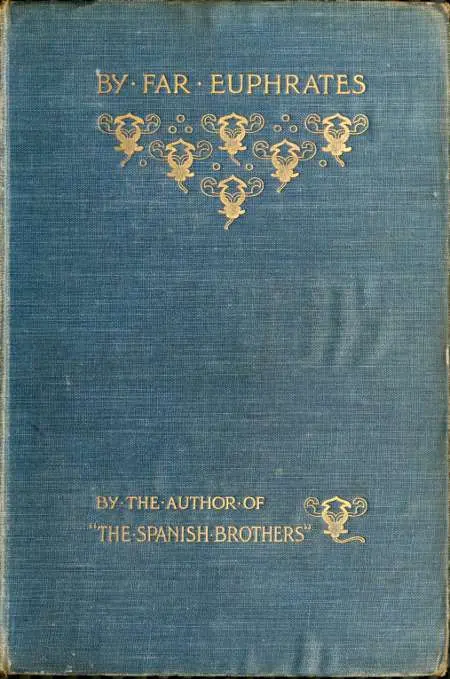
THE CLASSIC COLLECTION · 1897
"By Far Euphrates: A Tale" by Deborah Alcock is a historical novel written in the late 19th century. The narrative follows young John Grayson, an English lad traveling with his father, Mr. Grayson, through the tumultuous regions along the Euphrates River. The novel explores themes of faith, heroism, and the harsh realities faced by Christians in the Middle East, as well as John’s personal transformative journey amidst a backdrop of cultural and political strife. At the start of the tale, we meet John Grayson and his father as they camp near the Euphrates River. Young John is ignited by a sense of adventure and curiosity, yearning to explore the historic river that is emblematic of countless stories from the past. However, his initial excitement gives way to disappointment upon seeing the river's dull and muddy waters. This moment of disillusionment deepens when they encounter the struggles and tragedies of the local Armenian community, introducing John to the dire conditions faced by those around him. As the narrative unfolds, the bond between father and son strengthens through their shared experiences, setting the stage for John to confront the realities of his new world, including the themes of sacrifice and faith as his journey progresses.
Introduction adapted from the source catalogue; source summaries may be automatically generated.
Free to read · English · 82,345 words · No account needed
MAKE TIME FOR A GOOD BOOK
On by default. Untick to stop anonymous reading totals. Each page counts after 10 seconds in view. How this works.
Anonymous counting is on unless you have switched it off.
Some were steadfast and comparatively serene. Others wavered, and two or three seemed disposed to give way. All prayed much and often. Most of them could sing, and, led by a few of the braver spirits, they made the gloomy walls resound with Psalms and hymns, especially with that favourite of the Armenians,--
"Jesus, I my cross have taken."
Once John Grayson's voice broke down in singing it, for he heard Shushan saying to him, "The cross of Christ has been laid on us together." Only, if it could be, that he might bear the heaviest end, and that she need never know of all this!
Meanwhile, Thomassian never spoke, and scarcely ever moved from the place where he sat, or lay, his face turned away from the rest. He ate little, and they could not see that he slept. Once or twice they noticed that his tears were falling silently. But not even a groan or sigh told of the anguish of his soul.
The days seemed unending, but still they drew towards an end. Ay, and far too quickly for those who looked forward with unutterable dread to what was to come after! The only breaks in the monotony were the jailor's daily visits with bread and water. Generally he came and went without a word; but on the evening of their last day of grace he broke the silence.
"You Giaours had better be learning your 'La illaha ill Allah' to-night," he said, "for if you have not got it off by to-morrow morning, you die like the dogs you are."
Then he shut the door, and left them to themselves.
There was a long silence, only interrupted by a few sorrowful "Amaans!"
It was broken at last by the youngest in the room, a lad of some eighteen years. "I would not be afraid," he said plaintively, "if I thought they would kill us at once. Were it only a shot or a sword-thrust, that were easy to bear. But to be killed slowly--cut in little pieces--or perhaps like some----"
"Hush, boy!" Kaspar Hohanian interrupted. "Whatever they do to us, it must be over sometime. And then--there is heaven beyond."
"Ay," said an older man, "there is heaven for us, after a brief agony. But, friends, we have not ourselves alone to think of; there are our wives and children."
"True," another chimed in; "if we die, they starve."
"If we die, they do worse than starve," the former speaker resumed. "To what fate do we leave our women, our girls? You know it all, brothers. Whereas, if we turn Moslems, they will be safe, and under protection."
Your reading position is saved on this browser. Take it to another device with a library code. Reading pages adapt to text, rather than matching a printed edition.
Deborah Alcock
Deborah Alcock
Deborah Alcock
Deborah Alcock
BEHIND THE BOOK
This eBook is for the use of anyone anywhere in the United States and most other parts of the world at no cost and with almost no restrictions whatsoever. You may copy it, give it away or re-use it under the terms of the Project Gutenberg License included with this eBook or online at www.gutenberg.org. If you are not located in the United States, you will have to check the laws of the country where you are located before using this eBook. Read the source licence.
The original source file, including credits and licence, is retained by this library. Request an original-format copy at no charge. Please include the book title and Project Gutenberg identifier #49915.
KEEP YOUR CURIOSITY GOING
Cécile Tormay

Moritz Busch
Coulson Kernahan
John L. Ransom

Maurice Baring
Frances Wright