THE CLASSIC COLLECTION✦An outlaw’s diary: the CommuneCLASSIC FREE BOOKS
An outlaw’s diary: the Commune
Cécile Tormay
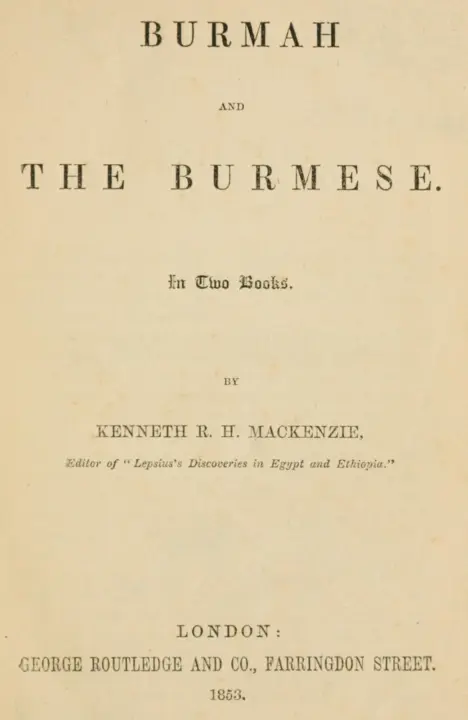
THE CLASSIC COLLECTION · 1853
"Burmah and the Burmese" by Kenneth R. H. Mackenzie is a historical account written in the mid-19th century. The work provides a comprehensive exploration of Burmah (now Myanmar) and its people, focusing on the socio-political landscape, including details about the government, culture, and the backdrop of war during that period. This narrative aims to elucidate the customs and societal conditions of the Burmese, highlighting their strengths, as well as examining the oppressive reign of their king. The opening of the book begins with a preface that discusses the implications of the ongoing war in Burmah while expressing hope that British intervention could lead to improved governance and civil liberties for the Burmese people. Mackenzie touches on the complexities of Burmese civilization, emphasizing both its rich culture and the despotic nature of its rulers. He highlights significant geographical features, such as the Irawadi River, and mentions the wealth of natural resources in the land, alluding to the economic potential that remains untapped under the current governance. The narrative sets the tone for a detailed investigation of Burmese society, its history, and the challenges it faces amid colonial ambitions.
Introduction adapted from the source catalogue; source summaries may be automatically generated.
Free to read · English · 84,457 words · No account needed
MAKE TIME FOR A GOOD BOOK
On by default. Untick to stop anonymous reading totals. Each page counts after 10 seconds in view. How this works.
Anonymous counting is on unless you have switched it off.
[49] I should not have ventured to say as much as this, had I not found myself corroborated by Dr. Buchanan Hamilton. His remark is as follows:—“I should certainly have been silent, had I thought that Captain Symes or Mr. Wood’s inquiries on these subjects had prepared them to give their opinions with advantage. But I imagine that this has not been the case; and I hope the information I here give may be of use to professional men.”—MS. in the British Museum, Additional MS. No. 13,872. In the same collection of papers on Ava are a number of communications from Symes to the Marquis of Wellesley, in the course of his second embassy. It is but fair to add, that these letters appear written under more just impressions than his printed journal was.
[50] Ava, vol. ii. p. 206.
[51] Residence in Ava, p. 134.
[52] Embassy to Ava, vol. i. p. 93 sq.
[53] Governor or chief man.
[54] Ava, vol. i. p. 98 sq. See also Cox, Residence in Ava, pp. 37-45.
[55] Cox, on the contrary, was informed that there were five hundred and twenty wells: this, however, is ably shown to be impossible by Crawfurd, not by snappish contradiction, but by calculation. The captain was, evidently, misinformed.
[56] Ava, vol. ii. p. 178.
[57] Sangermano, p. 171.
[58] Ava, vol. ii. p. 162.
[59] Alves, quoted in Ava, vol. ii. pp. 167-9.
[60] A tical is worth about two shillings and sixpence. This would be
£6,250.
[61] See Wilson’s Documents of the Burmese War, Appendix, p. xliv.
[62] But, after all, this cannot be considered as other than the substitution of a light or heavy, as the case might be, personal service for a tax in kind or specie. The tax was taken in labour; that is all the difference.
[63] Crawfurd, vol. ii. p. 175.
[64] See Malcom, vol. i. p. 174.
[65] Ava, vol. ii. p. 186.
[66] Page 75.
[67] Edinburgh Review, No. xliv. p. 354, Jan. 1814.
[68] I am chiefly indebted to Sangermano, pp. 76-9; and Crawfurd, vol.
ii. pp. 157-9.
[69] Page 77.
[70] Description, p. 77.
[71] Now, however, the soldiers have attempted to get into uniform, and wear belts and conical cases of tin, to resemble the English cap.
[72] Snodgrass, Narrative of the Burmese War, pp. 64 and 65. We shall hereafter return to these excellent “soldiers and gentlemen.”
[73] Ava, vol. ii. p. 160.
[74] Burmese War, p. 21.
[75] Description, p. 78.
[76] Sangermano, p. 79.
[77] Burmese War, p. 205.
[78] Ralph Fitch, in Hakluyt, vol. ii. p. 259. London, 1599.
[79] See p. 18.
[80] I have preferred to give the spelling of the black-letter folio, as it is not very corrupt, and lends additional quaintness to the writer’s remarks.
[81] Page 61.
[82] This intimated that the elephant was the divine ruler of the other animals, and the scarlet borla of the Peruvian Inca was bound upon its temples.—Prescott, Conquest of Peru, vol. ii. p. 44.
Your reading position is saved on this browser. Take it to another device with a library code. Reading pages adapt to text, rather than matching a printed edition.
BEHIND THE BOOK
This eBook is for the use of anyone anywhere in the United States and most other parts of the world at no cost and with almost no restrictions whatsoever. You may copy it, give it away or re-use it under the terms of the Project Gutenberg License included with this eBook or online at www.gutenberg.org. If you are not located in the United States, you will have to check the laws of the country where you are located before using this eBook. Read the source licence.
The original source file, including credits and licence, is retained by this library. Request an original-format copy at no charge. Please include the book title and Project Gutenberg identifier #64271.
KEEP YOUR CURIOSITY GOING
Cécile Tormay

Moritz Busch
John L. Ransom
Frances Wright
Cécile Tormay

Mabel Potter Daggett