THE CLASSIC COLLECTION✦An outlaw’s diary: the CommuneCLASSIC FREE BOOKS
An outlaw’s diary: the Commune
Cécile Tormay
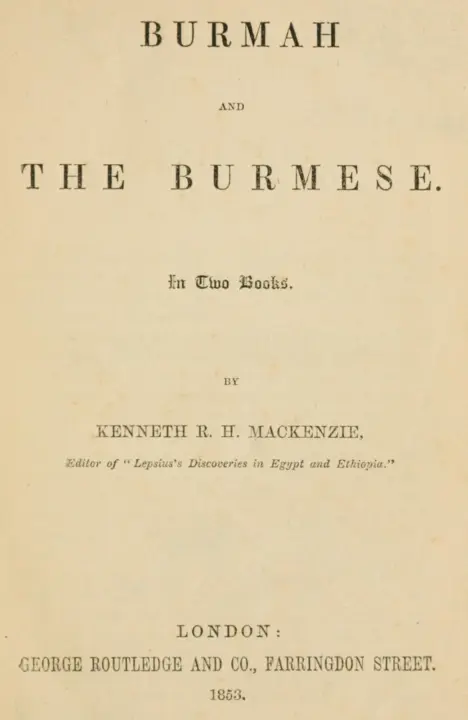
THE CLASSIC COLLECTION · 1853
"Burmah and the Burmese" by Kenneth R. H. Mackenzie is a historical account written in the mid-19th century. The work provides a comprehensive exploration of Burmah (now Myanmar) and its people, focusing on the socio-political landscape, including details about the government, culture, and the backdrop of war during that period. This narrative aims to elucidate the customs and societal conditions of the Burmese, highlighting their strengths, as well as examining the oppressive reign of their king. The opening of the book begins with a preface that discusses the implications of the ongoing war in Burmah while expressing hope that British intervention could lead to improved governance and civil liberties for the Burmese people. Mackenzie touches on the complexities of Burmese civilization, emphasizing both its rich culture and the despotic nature of its rulers. He highlights significant geographical features, such as the Irawadi River, and mentions the wealth of natural resources in the land, alluding to the economic potential that remains untapped under the current governance. The narrative sets the tone for a detailed investigation of Burmese society, its history, and the challenges it faces amid colonial ambitions.
Introduction adapted from the source catalogue; source summaries may be automatically generated.
Free to read · English · 84,457 words · No account needed
MAKE TIME FOR A GOOD BOOK
On by default. Untick to stop anonymous reading totals. Each page counts after 10 seconds in view. How this works.
Anonymous counting is on unless you have switched it off.
The particulars of the taking of Zinguzà by Momien, or Moung-Moung, are
as follows:[245]—
Chenguza had gone to Keoptaloum, a place on the banks of the Irawadi, about thirty miles from Ava, to celebrate a festival. As he was never regular in his time of going in or out, no one could tell when he would return; indeed, he was often late. Having obtained a royal dress, Momien presented himself at the portal shoedogaa, and demanded admission. But the haste of the conspirators betrayed them to the sentinel, who, opening the wicket, and then attempting to close, called out, “Treason!” However, it was too late, the guards were cut down, and the gate thrown open to the assailants. These, together with a body of men placed in ambuscade, occupied all the approaches to the palace, and kept it in a complete state of blockade. The various court officials, on the approach of the rebels, shut themselves up within the inclosures of the palace. Consternation and fright prevailed through the city all the night; the assailants were expected to attack them, but, in conformity with the Eastern and American custom, they did not attack the place till the morning, when they then blew open one of the palace-gates. They were gallantly met, however, by the guard, commanded by an Armenian, named Gabriel, who caused no small havoc among them, by three discharges of artillery from the guns on the top of the gate. However, the conspirators were too strong, or the defenders too uncertain as to whom they might be contending with, to withstand them long. Gabriel was killed by the thrust of a spear, and then his party fled. Thus Momien obtained a speedy and decisive victory, little dreaming of the speedy fate that awaited him!
Chenguza was now proclaimed an outlaw, and an armed force was detached to arrest him. But he had received timely notice of the fall of his administration, and, leaving all his court behind, escaped to Chagaing, were he was immediately besieged. Chenguza at first thought of defending himself; but finding that he was deserted by those on whom he placed his chief reliance, after a resistance of four days the resolution failed, and he determined on flying to the Cassay country, there to throw himself on the protection of the Munnipoora Raja. This intention he privately communicated to his mother, the widow of Shembuan Praw, who resided in his palace in the city of Ava. Instead of encouraging her son to persevere in so pusillanimous a resolve, she earnestly dissuaded him from flight; urging that it was far more glorious to die even by ignoble hands, within the precincts of his own palace, than to preserve life under the ignominious character of a mendicant fed by strangers, and indebted for a precarious asylum to a petty potentate. Chenguza yielded to his mother’s counsel, and preferring death to a disgraceful exile, caused a small boat to be privately prepared, and kept in readiness at the gaut or landing-place; disguising himself in the habit of a private gentleman, and attended only by two menials, he left Chagaing by break of day and embarking, rowed towards Ava, on the opposite shore. When the boat approached the principal gaut, at the foot of the walls, he was challenged by the sentinels on duty; no longer desirous of concealing himself, he called out in a loud voice, that he was “Chenguza Namdogy-yeng Praw;—Chenguza, lawful lord of the palace.” A conduct at once so unexpected and so resolute, struck the guards with astonishment, who, either overawed by his presence, or at a loss how to act for want of instructions, suffered him to proceed unmolested; the crowd, also, that so extraordinary a circumstance had by this time brought together, respectfully made way for him to pass. Scarcely had he reached the gate of the outer court of the palace, when he was met by the Attawoon, father of the princess whom he had so inhumanly slain; Chenguza, on perceiving him, exclaimed, “Traitor, I am come to take possession of my right, and wreak vengeance on mine enemies!” The Attawoon instantly snatched a sabre from an attendant officer, and at one stroke cut the unhappy Chenguza through the bowels, and laid him breathless at his feet. No person was found to prevent or avenge his death; he fell unlamented, as he had lived despised.[246] Such was the end of a monarch, accelerated, probably, by his own daring, which we cannot call heroism, but desperate madness.
Your reading position is saved on this browser. Take it to another device with a library code. Reading pages adapt to text, rather than matching a printed edition.
BEHIND THE BOOK
This eBook is for the use of anyone anywhere in the United States and most other parts of the world at no cost and with almost no restrictions whatsoever. You may copy it, give it away or re-use it under the terms of the Project Gutenberg License included with this eBook or online at www.gutenberg.org. If you are not located in the United States, you will have to check the laws of the country where you are located before using this eBook. Read the source licence.
The original source file, including credits and licence, is retained by this library. Request an original-format copy at no charge. Please include the book title and Project Gutenberg identifier #64271.
KEEP YOUR CURIOSITY GOING
Cécile Tormay

Moritz Busch
John L. Ransom
Frances Wright
Cécile Tormay

Mabel Potter Daggett