THE CLASSIC COLLECTION✦An outlaw’s diary: the CommuneCLASSIC FREE BOOKS
An outlaw’s diary: the Commune
Cécile Tormay
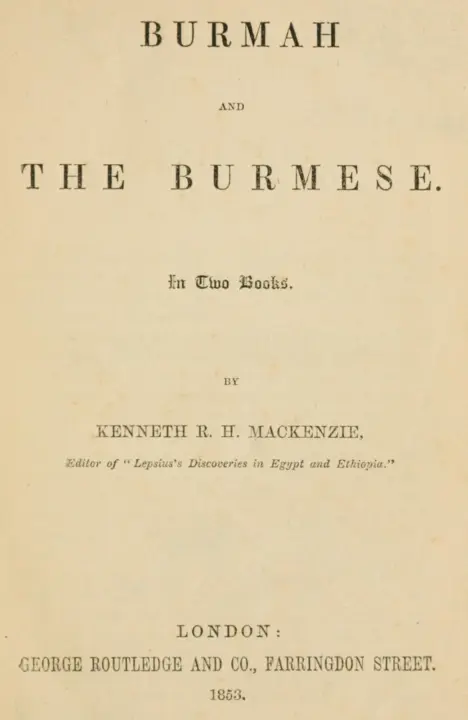
THE CLASSIC COLLECTION · 1853
"Burmah and the Burmese" by Kenneth R. H. Mackenzie is a historical account written in the mid-19th century. The work provides a comprehensive exploration of Burmah (now Myanmar) and its people, focusing on the socio-political landscape, including details about the government, culture, and the backdrop of war during that period. This narrative aims to elucidate the customs and societal conditions of the Burmese, highlighting their strengths, as well as examining the oppressive reign of their king. The opening of the book begins with a preface that discusses the implications of the ongoing war in Burmah while expressing hope that British intervention could lead to improved governance and civil liberties for the Burmese people. Mackenzie touches on the complexities of Burmese civilization, emphasizing both its rich culture and the despotic nature of its rulers. He highlights significant geographical features, such as the Irawadi River, and mentions the wealth of natural resources in the land, alluding to the economic potential that remains untapped under the current governance. The narrative sets the tone for a detailed investigation of Burmese society, its history, and the challenges it faces amid colonial ambitions.
Introduction adapted from the source catalogue; source summaries may be automatically generated.
Free to read · English · 84,457 words · No account needed
MAKE TIME FOR A GOOD BOOK
On by default. Untick to stop anonymous reading totals. Each page counts after 10 seconds in view. How this works.
Anonymous counting is on unless you have switched it off.
But by far the most lucid account that we have of the Burmese drama, is in one of the dramas themselves, which Mr. Smith has translated in the Journal of the Asiatic Society of Bengal; and he has added much to the value of the work by a few judicious observations, from which I present an extract to the reader:—
“The Ramadzat (Ramahyana), and other ancient fabulous histories, form the groundwork of nearly all the favourite plays, the outline of the story being merely preserved, while the language of the play depends as much upon the fancy of the performer as the taste of the audience. Each company is presided over by a teacher or manager, who drills the actors in their tasks from rough notes, which contain only the songs and the substance of the parts assigned to each performer. In every play, without perhaps a single exception, the following characters are represented,—a king, a queen, a princess, a minister of state, a huntsman, and some kind of monster.[181] The female characters are usually personated by men, it being considered indecorous in a woman to appear as an actress. I have to plead as an apology for the unpolished style of this translation, the acknowledged difficulty of turning the dialogue of a play into a foreign dress; moreover, the original, which was written from the mouth of an actor, was imperfect and ill written. I believe there are books in the palace at Umeraporee, containing the proper reading of all the approved plays, and the costumes of the characters, which are placed near the members of the royal family whenever they call their companies before them; but I have not been able to discover any work of this description here.”[182]
Of the play given by Smith, I shall here offer an epitome:—The nine princesses of the silver mountain, which is separated from the abode of mortals by a triple barrier (the first, a belt of prickly cane; the second, a stream of liquid copper; and the third, a Beloo, or devil), gird on their enchanted zones, which give them the power of flying like birds, and visit a pleasant forest of the earth. While bathing, a huntsman snares the youngest with a magic noose, and carries her to the young prince of Pyentsa, who, on account of her beauty, makes her his chief queen, notwithstanding his recent marriage with the daughter of the head astrologer of the palace. During the princess’s absence, the astrologer takes the opportunity to misinterpret a dream, which the king calls upon him to explain, and declares that the evil spirit, who is exerting himself against the king’s power, is only to be appeased by the sacrifice of the beautiful Manauhurree. The princess’s mother, hearing of this, visits the lovely Manauhurree, and restores to her the enchanted zone, which had been picked up, and given to the old queen, by the huntsman. The princess immediately returns to the silver mountain, but on her way stops at the hermitage of a recluse, who lives on the borders of the forest, and gives him a ring and some drugs, by which the possessor of them can pass unharmed through the dangers of the barrier. The young prince having put an end to the war, returns, and finding his favourite queen gone, he instantly sets off to seek her. Being arrived at the forest, he dismisses his followers, visits the recluse, who gives him the ring and drugs; he then enters the frightful barrier, and, after many adventures, arrives at the city of the silver mountain, and makes known his presence to his beautiful bride, by dropping the ring into a vessel of water, which a damsel is conveying to the bath of the princess. The princess, on finding the ring, inquires of one of the damsels what has happened at the lake, who tells her, that they found a young spirit resting himself, and that he assisted one of the maids to place the vessel of water on her head. The princess cries out, “Oh my husband, come and take me.” The king, her father, is angry that any mortal should presume to enter his country and claim his daughter, he makes him go through trials of riding elephants and horses, and shooting arrows, in which the prince acquits himself surprisingly, but the king insists on his selecting the little finger of Manauhurree from among those of her sisters, thrust through a screen; this he does by the assistance of the king of the Nats. Then, as in a European play, every one is made happy and comfortable.
Your reading position is saved on this browser. Take it to another device with a library code. Reading pages adapt to text, rather than matching a printed edition.
BEHIND THE BOOK
This eBook is for the use of anyone anywhere in the United States and most other parts of the world at no cost and with almost no restrictions whatsoever. You may copy it, give it away or re-use it under the terms of the Project Gutenberg License included with this eBook or online at www.gutenberg.org. If you are not located in the United States, you will have to check the laws of the country where you are located before using this eBook. Read the source licence.
The original source file, including credits and licence, is retained by this library. Request an original-format copy at no charge. Please include the book title and Project Gutenberg identifier #64271.
KEEP YOUR CURIOSITY GOING
Cécile Tormay

Moritz Busch
John L. Ransom
Frances Wright
Cécile Tormay

Mabel Potter Daggett