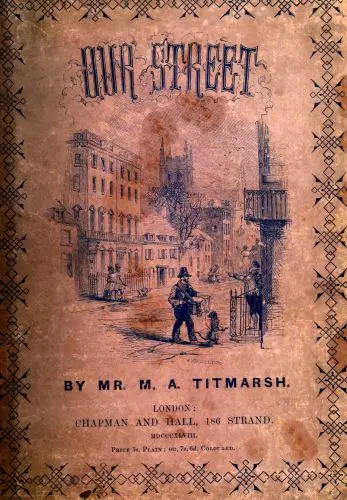
“Our Street”
William Makepeace Thackeray
THE CLASSIC COLLECTION · 1856
"Burlesques" by William Makepeace Thackeray is a collection of satirical writings and tales that reflects the author's brilliant wit and keen social commentary, likely composed during the mid-19th century. The work includes various pieces with humorous takes on society, literature, and contemporary issues of the time, showcasing Thackeray's unique storytelling style and critique of human nature. At the start of "Burlesques," the reader is introduced to a range of characters and settings through a collection of contents that outlines stories from different authors, demonstrating a playful exploration of various genres and styles. One key tale involves George de Barnwell, who is portrayed as a poetic character caught in a tumultuous struggle between ambition and reality, navigating the complexities of love and societal expectations. The opening sets the stage for a narrative infused with humor and a deeper narrative that addresses timeless themes of desire, morality, and the human condition.
Introduction adapted from the source catalogue; source summaries may be automatically generated.
Free to read · English · 155,399 words · No account needed
MAKE TIME FOR A GOOD BOOK
On by default. Untick to stop anonymous reading totals. Each page counts after 10 seconds in view. How this works.
Anonymous counting is on unless you have switched it off.
“Leave off deploring thy faithless, gad-about lover,” said the Lady of Chacabacque to her daughter, the lovely Fatima, “and think how the noble Barbazure loves thee! Of all the damsels at the ball last night, he had eyes for thee and thy cousin only.”
“I am sure my cousin hath no good looks to be proud of!” the admirable Fatima exclaimed, bridling up. “Not that I care for my Lord of Barbazure's looks. MY heart, dearest mother, is with him who is far away!”
“He danced with thee four galliards, nine quadrilles, and twenty-three corantoes, I think, child,” the mother said, eluding her daughter's remark.
“Twenty-five,” said lovely Fatima, casting her beautiful eyes to the ground. “Heigh-ho! but Romane danced them very well!”
“He had not the court air,” the mother suggested.
“I don't wish to deny the beauty of the Lord of Burbazure's dancing, mamma,” Fatima replied. “For a short, lusty man, 'tis wondrous how active he is; and in dignity the King's Grace himself could not surpass him.”
“You were the noblest couple in the room, love,” the lady cried.
“That pea-green doublet, slashed with orange-tawny, those ostrich plumes, blue, red, and yellow, those party-colored hose and pink shoon, became the noble baron wondrous well,” Fatima acknowledged. “It must be confessed that, though middle-aged, he hath all the agility of youth. But alas, madam! The noble baron hath had nine wives already.”
“And your cousin would give her eyes to become the tenth,” the mother
replied.
“My cousin give her eyes!” Fatima exclaimed. “It's not much, I'm sure, for she squints abominably.” And thus the ladies prattled, as they rode home at night after the great ball at the house of the Baron of Barbazure.
The gentle reader, who has overheard their talk, will understand the doubts which pervaded the mind of the lovely Fatima, and the well-nurtured English maiden will participate in the divided feelings which rent her bosom. 'Tis true, that on his departure for the holy wars, Romane and Fatima were plighted to each other; but the folly of long engagements is proverbial; and though for many months the faithful and affectionate girl had looked in vain for news from him, her admirable parents had long spoken with repugnance of a match which must bring inevitable poverty to both parties. They had suffered, 'tis true, the engagement to subside, hostile as they ever were to it; but when on the death of the ninth lady of Barbazure, the noble baron remarked Fatima at the funeral, and rode home with her after the ceremony, her prudent parents saw how much wiser, better, happier for their child it would be to have for life a partner like the baron, than to wait the doubtful return of the penniless wanderer to whom she was plighted.
Your reading position is saved on this browser. Take it to another device with a library code. Reading pages adapt to text, rather than matching a printed edition.
William Makepeace Thackeray
William Makepeace Thackeray
Charles Dickens & William Makepeace Thackeray
William Makepeace Thackeray
BEHIND THE BOOK
This eBook is for the use of anyone anywhere in the United States and most other parts of the world at no cost and with almost no restrictions whatsoever. You may copy it, give it away or re-use it under the terms of the Project Gutenberg License included with this eBook or online at www.gutenberg.org. If you are not located in the United States, you will have to check the laws of the country where you are located before using this eBook. Read the source licence.
The original source file, including credits and licence, is retained by this library. Request an original-format copy at no charge. Please include the book title and Project Gutenberg identifier #2675.
KEEP YOUR CURIOSITY GOING
Coulson Kernahan

Maurice Baring
Frances Wright
Cécile Tormay

Frederic Jesup Stimson

W. H. P. (William Henry Pope) Jarvis