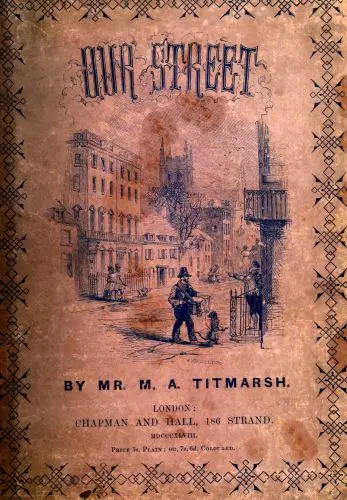
“Our Street”
William Makepeace Thackeray
THE CLASSIC COLLECTION · 1856
"Burlesques" by William Makepeace Thackeray is a collection of satirical writings and tales that reflects the author's brilliant wit and keen social commentary, likely composed during the mid-19th century. The work includes various pieces with humorous takes on society, literature, and contemporary issues of the time, showcasing Thackeray's unique storytelling style and critique of human nature. At the start of "Burlesques," the reader is introduced to a range of characters and settings through a collection of contents that outlines stories from different authors, demonstrating a playful exploration of various genres and styles. One key tale involves George de Barnwell, who is portrayed as a poetic character caught in a tumultuous struggle between ambition and reality, navigating the complexities of love and societal expectations. The opening sets the stage for a narrative infused with humor and a deeper narrative that addresses timeless themes of desire, morality, and the human condition.
Introduction adapted from the source catalogue; source summaries may be automatically generated.
Free to read · English · 155,399 words · No account needed
MAKE TIME FOR A GOOD BOOK
On by default. Untick to stop anonymous reading totals. Each page counts after 10 seconds in view. How this works.
Anonymous counting is on unless you have switched it off.
“Old Tug left no will,” shrieked Jemmy; “he didn't die to leave his estates to blackamoors--to negroes--to base-born mulatto story-tellers; if he did may I be -----”
“Oh, hush! dearest mamma,” says Jemimarann. “Go it again, mother!” says Tug, who is always sniggering.
“What is this business, Mr. Tuggeridge?” cried Tagrag (who was the only one of our party that had his senses). “What is this will?”
“Oh, it's merely a matter of form,” said the lawyer, riding up. “For heaven's sake, madam, be peaceable; let my friends, Higgs, Biggs, and Blatherwick, arrange with me. I am surprised that none of their people are here. All that you have to do is to eject us; and the rest will follow, of course.”
“Who has taken possession of this here property?” roars Jemmy, again.
“My friend Mr. Scapgoat,” said the lawyer.--Mr. Scapgoat grinned.
“Mr. Scapgoat,” said my wife, shaking her fist at him (for she is a woman of no small spirit), “if you don't leave this ground I'll have you pushed out with pitchforks, I will--you and your beggarly blackamoor yonder.” And, suiting the action to the word, she clapped a stable fork into the hands of one of the gardeners, and called another, armed with a rake, to his help, while young Tug set the dog at their heels, and I hurrahed for joy to see such villany so properly treated.
“That's sufficient, ain't it?” said Mr. Scapgoat, with the calmest air in the world. “Oh, completely,” said the lawyer. “Mr. Tuggeridge, we've ten miles to dinner. Madam, your very humble servant.” And the whole posse of them rode away.
We knew not what this meant, until we received a strange document from Higgs, in London--which begun, “Middlesex to wit. Samuel Cox, late of Portland Place, in the city of Westminster, in the said county, was attached to answer Samuel Scapgoat, of a plea, wherefore, with force and arms, he entered into one messuage, with the appurtenances, which John Tuggeridge, Esq., demised to the said Samuel Scapgoat, for a term which is not yet expired, and ejected him.” And it went on to say that “we, with force of arms, viz, with swords, knives, and staves, had ejected him.” Was there ever such a monstrous falsehood? when we did but stand in defence of our own; and isn't it a sin that we should have been turned out of our rightful possessions upon such a rascally plea?
Your reading position is saved on this browser. Take it to another device with a library code. Reading pages adapt to text, rather than matching a printed edition.
William Makepeace Thackeray
William Makepeace Thackeray
Charles Dickens & William Makepeace Thackeray
William Makepeace Thackeray
BEHIND THE BOOK
This eBook is for the use of anyone anywhere in the United States and most other parts of the world at no cost and with almost no restrictions whatsoever. You may copy it, give it away or re-use it under the terms of the Project Gutenberg License included with this eBook or online at www.gutenberg.org. If you are not located in the United States, you will have to check the laws of the country where you are located before using this eBook. Read the source licence.
The original source file, including credits and licence, is retained by this library. Request an original-format copy at no charge. Please include the book title and Project Gutenberg identifier #2675.
KEEP YOUR CURIOSITY GOING
Coulson Kernahan

Maurice Baring
Frances Wright
Cécile Tormay

Frederic Jesup Stimson

W. H. P. (William Henry Pope) Jarvis